Posted in Uncategorized, tagged Flat-coated retriever, flat-coated retriever history, Swansea Jack on November 28, 2008 |
In dog lore, we often hear of canine heroes. We have a whole genre of literature devoted to them, as well as “family films.” But the truth is there are real dog heroes out there.
One of these was a flat-coated retriever born in Wales in 1930. He was known as “Jack,” and his owner lived near the River Tawe, a perfect place for an aquatic dog like a flat-coat. There were docks nearby, and the dog had a perfect place to enter the water.
In 1931, when Jack was only about a year old, he saved a 12 year old boy from drowning. Less than a month later, he saved another person who had fallen from the docks. This rescue happened in the view of a large number of the public. He received a silver collar from the city government.
Swansea Jack.
It was said that he would leap into the water any time he heard someone calling for help from the water and haul them in. In his short life, he is rumored to have rescued 27 people. He was named Bravest Dog of the Year by the London Star in 1936, and he received a silver cup from the Lord Mayor of London and two bronze medals from the National Canine Defense League.
Unfortunately, like too many good dogs, his life was cut short. In 1937, he consumed rat poison, and the Swansea docks no longer had their guardian.
This is his burial monument:
Today, the people of Swansea are sometimes called Swansea Jacks. Supposedly, they get this name from this heroic dog.
Posted in Uncategorized, tagged Russian retriever, Russian setter, South Russian Ovtcharka, South Russian Owtcharka on November 27, 2008 |
1 Comment »
The nonsense about golden retrievers being from Russia is further exacerbated with this breed. This dog was used as a setter. It is clearly a griffon fo some sort, or maybe a cross between a setter and poodle-type dog. Supposedly, this breed could be diffult to find in Russian in the 1860’s, when Colonel Hutchinson wrote about them in Dog Breaking. It is possible that the Russians did have some sort of griffon like the Spinone Italiano. And in Slavic languages the word for pointer is often translated as setter, like the Cesky Fousek (Bohemian wire-haired pointing griffon) of the Czech Republic is sometimes translated as the Bohemian Setter. The Russian setter is said to be one of the ancestors of the Wire-haired Pointing Griffon (Korthals Griffon). Maybe it shares an ancestry with the German wire-haired and broken-haired pointers.
I don’t know what a Russian setter was. It may not even be Russian. But it could be. There are dogs in Eastern Europe that do have the rough hair and also point, the wire-haired Vizsla of Hungary and the Bohemian Wire-haired pointing griffon (Cesky Fousek).
Compare the Russian setter with the Spinone:
Maybe this breed was crossed into some lines of retrievers. It would describe the retriever named “Devil” that was entered as a flat-coat in The Complete English Shot. However, it is unlikely that it played any role in the development of modern retrievers. Keep in mind that that some yellow wavy-coated retrievers (of Tweedmouth’s strain) in the early twentieth and late nineteenth century were called Russian to make them seem more exotic. Maybe it is the case with this breed, too, and might explain why it was impossible to find one in Russia!
***
My favorite anecdote about the Russian retriever story is that some estate holder in Britain managed to get a supposed Russian Retriever from the Southern Russia or the Ukraine. The dog was very aggressive, and no trainer could get it to retrieve anything. The dog was said to be white with thick matted hair. It resembled a poodle-type dog, which in Western Europe would mean a water dog, perfectly suited for retrieving work. However, what they actually had was a livestock guardian dog, which are bred to have very low prey drive and high levels of aggression towards people and animals with whom they did not grow up with. One golden retriever book I have said it was Komondor, which is a possibility. I think, though, that it was actually a South Russian Ovtcharka:
Retrievers do have a prey drive. What do you think retrieving is? It’s modified predatory behavior, which partly modified by breeding and partly by training. A LGD has been selected to have very little prey drive, because its job is to stay with the sheep, goats, or whatever else its supposed to guard without killing them through play predatory behavior or real predatory behavior. This dog would be worthless as a retriever, even though it looks like a poodle or barbet (superficially). The high level of aggression toward other dogs would probably disqualify it from ever being used around other retrievers anway, because retrievers have been bred to have rather low dog aggression in order to allow for multple dogs to be used in trial and on shoots, including dogs that are not from the same household.
Posted in Uncategorized, tagged grey foxes, tree climbing fox on November 27, 2008 |
1 Comment »
It’s not the wolf. It’s not the coyote. It’s not the dingo or the New Guinea Singing dog. Not the Carolina dog either.
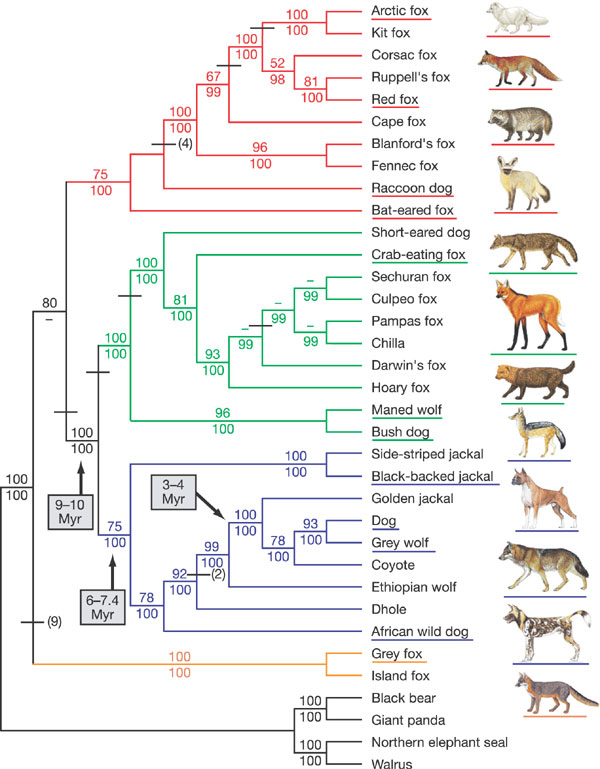
It’s the Grey Fox! This primitive species of wild dog is found from the US Canadian border (Southern Ontario, Southern Manitoba, and the southernmost Eastern Townships of Quebec– all of these at low densities) south to Colombia and Venzuela. It is the only North American wild dog to live also in South America, unless you are one of those people who thinks that Panama is South American, because it once was a province of Colombia. If that’s the case, the Coyote also appears on both continents, but most of us think of Panama as part of the North American continent.
Here’s a video of a family mousing or eating grasshoppers in a meadow in Pennsylvania:
These foxes are not really true foxes. They may actually be the oldest of all wild dog species. They still can climb trees and regularly do so. The similarly ancient and primitive racoon dog (Marderhund) or tanuki is also able to climb trees.
In the Eastern US, grey foxes live in denser woodlands than the red foxes do. Red foxes were actually quite rare in the US before European settlement. In fact, they may have only existed in the northern tier of states or even farther north. When the English settled Virginia, the new rich from the tobacco trade tried to bring English foxhounds to Virginia to hunt foxes. The foxhounds were accustomed to trailing foxes over miles and miles open terrain and the foxes going to ground. What they received from the grey fox was species that lived in the dense thickets and climbed trees to escape danger. These hounds were unable to tree the foxes, simply because they were unable to air scent the foxes in the trees. Then, the Virginians imported the red fox. The cleared land was perfect for this species, which then spread throughout North America, breeding with the northern population of native red foxes.
Where the two species occur together, the red fox is actually not dominant over the grey. The two are actually about the same size, but the grey fox is built like a bulldog. It’s also more aggressive toward the red. That’s why those people who shoot foxes for their fur using electronic calls are able to call both reds and greys on red calls but only greys on grey calls. The grey fox’s dominance over the red is unusual because the red is dominant over all of the other fox species with which it shares a range.
The grey was never as popular as the red as a fur bearer. The southern races of the grey lack an undercoat, where they are known as the “Samson fox” because of their terrible lack of hair.
Posted in Uncategorized, tagged curly coated retriever, murray river curly-coated retriever, retriever varieties on November 27, 2008 |
3 Comments »
If I were to ask you to name the retriever breeds, you would probably say the Labrador, the golden, the Chesapeake Bay, the Flat-coat, the Curly-coat, and Nova Scotia Duck Tolling Retriever (the only retriever whose name has too many words in it). More thoughtful people would also add the Newfoundland (some really could be used as retrievers), the standard poodle, the barbet, and the Portuguese and Spanish Water dogs, as well as the Irish and American Water spaniels. Some might add the Boykin spaniel, which can be used as a retriever, as can field, cocker, and English and Welsh springers (although for all intents and purposes, only the working type English cocker ad springer really are widely used as gun dogs). The Wetterhoun and all of the HPR breeds on the European continent can be used as retrievers. So the list can get quite lengthy. There are still a few setters that can retrieve, although it’s not widely bred into them.
I also knew a mini dachshund that had quite strong retrieving instinct, but she was a smooth-hair and utterly useless in cold water. And dachshund legs aren’t good for swimming.
But of the true water dogs, I have left out a breed. In fact, most of us in the Northern Hemisphere would leave it out. In fact, the curly-coated retriever that we that was developed in Britain is really uncommon, much rarer than the flat-coat, which is growing in popularity because of its similarity with the well-known golden and flat-coated retrievers. The NSDR was only recently recognized in the US, but it is developing a following. The old curly-haired dogs are so unknown that I’m sure lots people think they are goldendoodles or Labradoodles if they happen to see a curly.
But in the Land Down Under, the curly-type was a popular dog. The Labs and goldens that the Aussies get are so inferior in working ability, that they really have had to hold on to their working retrievers. Curly-coats were popular when Australia became an immigration destination for many Europeans, and the curlies have remained their working retriever. But it was their own distinct curly. In fact, the Aussies have their own line of Curly-coat that is definitely a separate breed. It is really similar to the old curly coat, which wasn’t as long in the leg as the moden dog. This dog is the Murray River Curly-coated Retriever, which along with the NSDR, has a very cumbersome name!
Here’s a video of one playing with a Labrador/British Curly cross in Australia, which is really the only place where they exist– kind of like the platypus!:
The Murray River is in the southern part of the continent. The the late nineteenth century, the people who lived along the river lived very close to nature. They needed a dog to help retrieve shot game for the table–a “meat dog.” This early type of curly fit the bill. These dogs date to the 1870’s.
By 1900, local retriever fanciers had clearly developed their own type of curly-coat, perhaps with outcrosses to flat-coats (which were the dominant retriever at the time) and the Irish water spaniel. The resulting dogs had slightly different coat from the Curly we know in this hemisphere. The curls were not as tight, and the dogs were not extremely large. It also does not come in black, as the other curly. The only color it comes in is liver, which may be influenced because of the use of the IWS in the cross. Also, keep in mind that all early retrievers had a least some water spaniel influence.
Murray River curlies
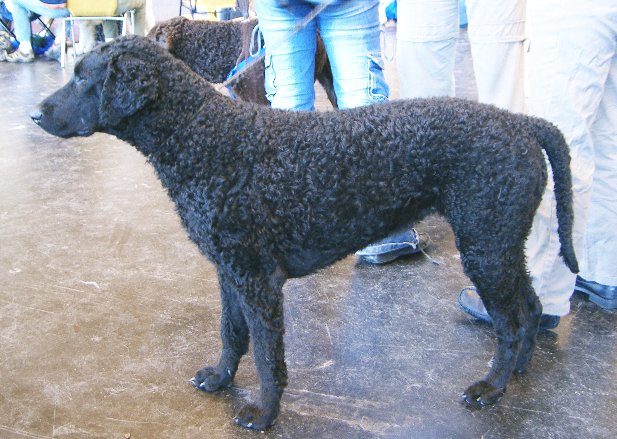
Compare with the curly we know better:
The British curly has a strange coat like a Persian lamb’s fleece. It’s not a doodle dog. It’s a retriever that sheds– a lot. This breed has remained pure for longer than the other retrievers, simply because its coat cannot exist when it is crossbred. The short curls really cut through the water, and it would be a popular gundog, except that it has a temperament more like the old type water dogs than the Labrador. Although not as rough as the Chesapeake, it’s been known to be a bit stubbon and a occasionally aggressive. Breeders have done a lot to reduce these tendancies. Soft Maple Curlies is a kennel that is trying to change some of this, breeding dual purpose dogs (the curly, unlike the Lab and the golden, has a working conformation standard).
I’ve never actually seen a Murray River Curly. As far as I know, they do not exist in the US. They aren’t recognized as a show breed, and they are bred very much for their working ability. Apparently, the Murray River curly is what Australians mean when they say curly-coated retriever, so it’s probable that this breed is actually more common in Australia than the British curly. I guess the British curly is becoming a museum piece.
If you would like to find out more, check out the Soft Maple Curlies site. They know more about them than I do, because I’ve got very limited experience with this breed. I’ve heard they are similar to the Chesapeake Bay Retriever, which is thought of as the most dominant of the retrievers. However, the Chesapeake has been bred for a more gentle temperament and greater biddability.
For info on the Murray River Curly, here’s a good site. Here’s another. As one would expect from performance bred dogs, the size varies in the Murray River Curly. However, the original site is wrong about the MRCCR being the smallest retriever. Even at those sizes, the NSDR is still smaller. But I wouldn’t expect Australians to have known about the NSDR, which is also a regional breed. NSDR bitches can be as small as 35 pounds. It is possible that there are some individuals of the Murray River curly are smaller than this.
Murray River duck shooters and their Murray River Curlies, circa 1900.
I want to thank the youtube user Dmentias for providing more accurate information. This breed is not yet standardized, and it is still thought of as a regional dog. It does not appear in any of the dog breed books (it’s not in Bruce Fogle’s Encyclopedia of the Dog, but the Labradoodle is!)
Posted in Uncategorized, tagged Chinese Crested dogs, origin of hairless dogs on November 26, 2008 |
60 Comments »
There’s a famous story about the strangest dogs in the world. Supposedly, in the days of the Chinese maritime golden age, the traders hauled small hairless dogs, which killed the rats that tried to hitch a ride on the junks. When food became scarce on board, the hairless dogs were eaten. The Chinese supposedly introduced hairless dogs to the Americas and Africa. One version of the story is that hairless dogs come from Africa originally, and the Chinese traders took them to these far off ports.
The dog I’m talking about is called the Chinese crested dog, the breed that dominates the World’s Ugliest Dog Competition. One variety is nearly hairless, except on the head, feet, and tail. The long hair on the head resembles a crest, hence the name. The other variety is called the powderpuff. It has really long, thick hair. The hairless gene is dominant, but breeders cannot breed the hairless cresteds together, because the gene is a lethal homozygous, which means the puppies with two copies of the hairless gene usually die in utero. So the powderpuffs are necessary for development and maintenance of the breed. Some hairless dogs actually have a lot more hair on them than is expected, but unlike the powderpuffs, they have a single coat that may have bald patches.
The story behind this breed may be malarkey. The only hairless dogs that exist are of American origin. The Xoloitzcuintli (Mexican Hairless) of Mexico is the most famous. It is believed to have medicinal powers, because it gives off lots of body heat through its skin. There are also breeds in Peru that have hairless varieties. It’s a similar gene that causes the hairlessness in these dogs. It’s a dominant gene, although its not necessary a lethal homozygous. It’s likely that pariah dogs in the Americas started turning up hairless amd then these were kept as pets and given preferential breeding opportunities. It’s not unusual to see hairless dogs among the pariah dogs in some Mexican cities, even today, although these dogs are not as hairless as the dogs we have here.
But here’s the thing: the coated varieties of all of these dogs are not long-haired. The coated Xolo looks like a Carolina dog. Here’s a picture:
Where did the Chinese Crested originate?
Well, there’s actually a good theory on this breed. It involves no Chinese junks. It doesn’t involve China at all.
In the 1920’s, two breeders named Ida Groves and Deborah Woods founded the Crest Haven Kennel. All Chinese Crested dogs come from there. My guess is that they took the smaller Xolos and bred them to the Maltese and other puffy breeds of dog. It’s kind of funny, though, because the Rothschild Zoological Museum seems to think that there is something to the African and Chinese origins of these dogs. My guess is they were fooled by some dog dealer.
Hairlessness is really well-established only in Latin American dog populations, where there are lots of interesting dog mutations. In addition, there are dogs with two noses in Bolivia. These dogs were probably more common in the past, because the Spanish conquistadors mentioned them almost as often as they mentioned the hairless dogs. Remember, the people of the Americas were expert dog breeders, every bit as much as European and East Asian dog breeders. Dogs were often the only domestic animals they had, so breeding for utility was a concern.
Posted in Uncategorized, tagged Field type Irish setter, Irish setter, National Red Setter Field Trial Club, red and white setter, red setter on November 26, 2008 |
1 Comment »
The National Red Setter Field Trial Club maintains a registry and runs field trials for the working strain of Irish setter that was imported to the United States during the nineteenth century. The interesting history of these dogs and their registry can be found here.
But what I find interesting is what the dogs look like. Check out their hall of fame. Note the broader heads and shorter ears. They are more moderately built. They are not long-legged in the least. I could easily mistake these dogs for dark golden retrievers. Some these dogs have white marking, which appears in golden retrievers, too. Keep in mind that the original Irish setters were red and white, and that the red and white strains almost went extinct (They existed only in Northern Ireland and were saved by a Protestant minister named Noble Huston. More on the red and whites here.)
In Europe there has been an attempt to keep a dual purpose Irish setter. Again, I’m not opposed to this attempt, but my guess is that once competition gets too high in both arenas, type variances are inevitable.
Here’s a video of a Russian Irish setter from West European bloodlines. I had read somewhere that the Soviets actually maintained lines of working Irish setters that were not dissimilar to the American red setter registry lines (broad head and moderately boned and feathered). However, this dog is not one of them. It’s a dual purpose dog.