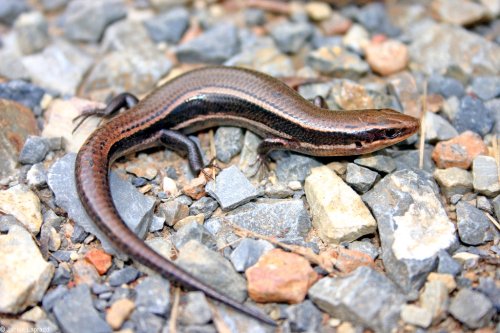
Originally, we had only two species of lizard at the farm. Now we have three.
Yesterday, I saw what I thought was an unusually colored five-lined skink.
However, it was a bronze-colored lizard. Five-lined skinks are not bronze colored. You can actually count the five yellow lines going down their backs.
This lizard looked very like a five-lined skink but for its coloration.
I didn’t think anything of it until I caught a skink in the basement. It was also of this bronze coloration.
Then I knew I had something.
This species is new to my particular area. It is found more commonly in the higher elevations of West Virginia, but this particular farm is on some unusually high ridges in the unglaciated Allegheny Plateau.
So now we have three lizard species on the farm instead of two. The Northern fence lizards and the five-lined skinks had better make some room.




How very cool to find this species on the farm. What do you think might be responsible for it’s extending it’s range?
Sigh, I have no lizards in my corner of the world, just amphibians and colubrid snakes. Not even timber rattlers anymore as my ancestors allegedly killed them all by the end of the 19th century, along with our “species” of wolf. I haven’t kept up with the latest taxonomic nomenclature debates about eastern wolves, hence the quotes around species. I do know the skin or skins in our state museum collection contain a different DNA sequence from the grey wolf, and are akin to the wolves of Algonquin National Park.
However, that has little to do with your handsome new skink neighbor! Enjoy!!
It’s the mitochondrial DNA that is different– it’s just not different from coyotes.
MtDNA comes from the mother’s side.
More and more people believe that coyotes always lived in the East and then were killed off along with the wolves. John Smith described “wolues” the size of foxes, which is an exaggeration but most likely means coyote.
When the wolves’ numbers dropped they mated with coyotes.
Coyotes have been found from the Pleistocene.
http://www.museum.state.il.us/exhibits/larson/canis.html
It’s also possible that they and the “red wolf” are derived from Canis edwardsii, but I don’t think that the evidence is very convincing.
Red wolves and Eastern wolves make for really good “species” to conserve. If something is a unique species, then it must be saved. However, a unique subspecies with coyote in it should be saved, too, don’t you think?
Also these two species of skink have an extensive northern range– but they don’t get as far east of the Champlain Valley.
They are critically endangered in Vermont but have a more extensive New York range on the other side of the lake.
http://herpcenter.ipfw.edu/index.htm?http://herpcenter.ipfw.edu/outreach/accounts/reptiles/lizards/Five-lined_Skink/index.htm&2
BTW, I have no idea why the coal skink is here.
It’s probably because it’s more of a woodland species and woodlands are now matured. This used to be a working dairy farm with an orchard adjacent to it.
Interestingly, the timber rattler is quite endangered here, but our state government won’t protect it.
However, they did make it the state reptile.
is it actually endangered?
No.
I have found a skink in my backyard tilling my garden yesterday… I was wondering.. is this common for Omaha, Nebraska… and what should I do with it… just let it go?
Not normal at all.
That’s their normal range.
I’d take to a herpetologist, if you can find one to see what it is.
It could be a really remarkable find!
I saw one of these just today while pulling weeds in the yard (Norfolk, Virginia). It is quite beautiful and strong I might had. That thing put up quite a fight against my fingers but he was no match for my pinky. I let him go after he said Auntie. :-D