
The wild dog from yesterday has a somewhat controversial identity. Historically, it was called the Egyptian wolf and was recognized as Canis lupus lupaster. For those of you have old wolf books, this animal is the supposed wolf that lived in Egypt (but not the Sinai, where the Arabian wolf lives) and Libya. I need to repeat that this is not the subspecies that lives in the Sinai. That animal is definitely the Arabian wolf (Canis lupus arabs).
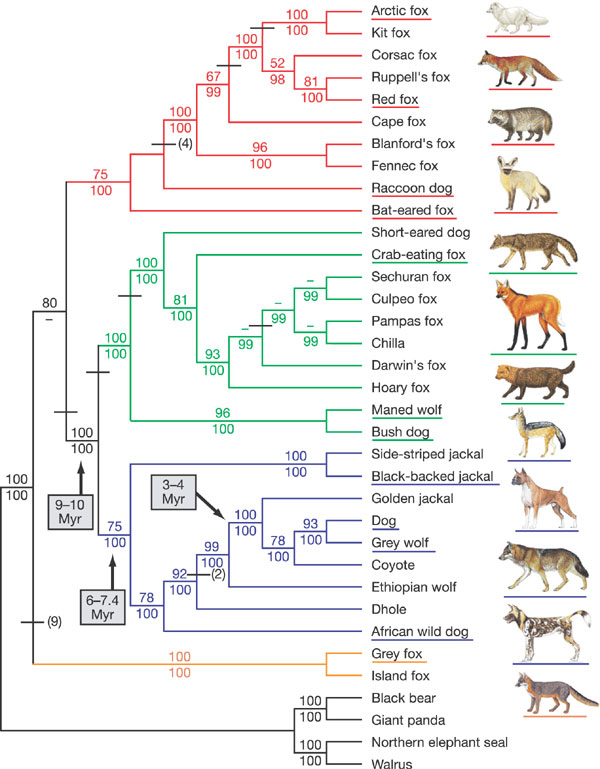
However, recent analysis of its MtDNA has changed the Egyptian classification. It turns out that its MtDNA is very similar to Golden jackals, and thus, most taxonomists refer to it as the Egyptian jackal (Canis aureus lupaster).
But that is not the end of the story.
It turns out that this animal does have some unique characteristics. It is a very wolf-like jackal, with longer legs and slightly larger size.
Some morphological studies suggest that this animal represents a unique population of Canis that was isolated from other jackals. It is believed to have existed in two separate populations: one in the Sahara and one in the Danakil, where it is called “the wucharia.”
However, both of these animals could represent wolf populations that once lived in Africa, which then became stressed through persecution. As the wolves became more stressed, they started breeding with golden.
We know that the same thing has happened with the “red wolf” and “Eastern Canadian” wolf, which some authorities consider separate species from C. lupus. The fact that we get golden jackal MtDNA is exactly what we would expect. MtDNA comes from the matriline, and in “red wolves” and “Eastern Canadian wolves,” we have evidence of coyote MtDNA. In the New World wolves, we know that female coyotes breed with male wolves. The reverse has never been seen in the wild. It would make sense that a similar situation would occur here.
Just as I consider C. rufus to be C. lupus rufus, even though it has coyote MtDNA, I think it might be correct refer to the wucharia and Egyptian wolves as subspecies of C. lupus.
Of course, it may be that both represent a unique species, which we would call C. lupaster.
It is another one of those canids like the red wolf and Ethiopian wolf that no one can fully classify. I am very hesitant to create species, especially when a species appears to be an intermediate between two known species.





[…] an Egyptian wolf/Egyptian jackal/wucharia/deeb. Possibly related posts: (automatically generated)It’s tough being a “painted […]