I found something rather interesting in W.E. Mason’s Dogs of All Nations.
The entry for the flat-coated retriever has this description for its color:
“Color : Rich black, free from rustiness and from white. There is also a Golden Retriever so named because of the golden or yellow color of his coat.”
While it is interesting that liver isn’t even mentioned as a color for the flat-coat, Mason places the golden retriever as a color variety of the flat-coat. That means, in his eyes, the golden is basically a golden or yellow flat-coat.
This is the photo Mason includes with the flat-coat entry:

Now, this book was published in 1915, when the golden was in the process of separating from the flat-coat. During this same time period, the Russian origins myth about the golden was being bandied about. Mrs. Charlesworth, who is basically the founder of the golden retriever as a separate breed, was a firm believer in this story. In 1915, the dogs were considered separate breeds, but you could breed black flat-coats to goldens and then register the offspring as separate breeds depending upon color.
Apparently Mr. Mason was not a believer in the Russian origins of the golden. Or maybe he didn’t get that memo.
However, when one goes a bit deeper into his text in the section about Russian dogs, one comes across this dog:
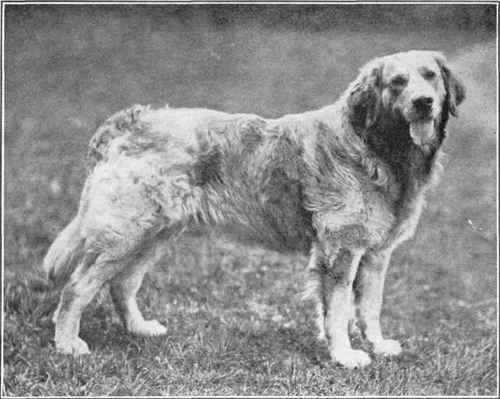
The entry that includes this dog is called a “Russian yellow retriever.” The dog has this description:
Color: Yellow or rich red sable. Height: 28 in. Weight: 90 lbs.
This dog is similar in all essentials to the English [flat-coated] Retriever, except that he is a size bigger and heavier in coat, and of course different in color, as his name implies. He is used principally for tracking wounded deer.
Now, this dog is not Russian at all.
This is Col. William le Poer Trench’s strain that came from culls from the Tweedmouth strain. The culls he had were of the larger, Newfoundlandy- type of golden that appeared in some the dogs in the strain in the late 1880’s and early 1890’s. He firmly believed his dogs were Russian, and he managed to get the Kennel Club to let him show his dogs as a different strain. However, they had to be shown within flat-coat breed, which means they didn’t do so well.
He was a noted liar. He got a former keeper from Guisachan to write a letter verifying the Russian origins of the dog. He then went to Russia (supposedly in the Caucasus) in search of new stock. New stock from the Ovtcharka lines that were supposedly in this strain. Of course he found no dogs. He claimed that all the dogs were in the mountains with the sheep, and he couldn’t find any. However, it is more likely that he found some dogs of the Ovtcharka type, and after dealing with the dogs for a few minutes, very quickly realized they were entirely unsuitable as an outcross to a line of retrievers. (This video explains why).
These dogs look a lot like the big pet goldens that are offered today.
It is interesting that their job description was tracking wounded deer. There are accounts of the Tweedmouth strain dogs doing a lot of deer tracking at Guisachan. This is usually where someone says that bloodhound was crossed in, but the evidence isn’t that good. And my main complaint with it is that I have found no records of short-haired dogs with heavy ears in the entire strain.
But it is very interesting that the Tweedmouth strain of wavy or flat-coat was exhibited in two different breeds at one point. I should note that Trench’s Russian dogs played no role in the founding of the golden retriever as a separate breed. His strain became defunct after he died in 1920.
And if you look at the early goldens from the Ingestre, Noranby, and Culham lines, you can see that they are very clearly of the flat-coat/wavy-coat type, and not of the giant yellow dogs that supposedly came from Mother Russia.




The flat-coat in the photo looks very similar to today’s flat-coats. Interesting that the liver colour is not mentioned at all. Flat-coats are used a lot for “blood tracking” in Scandinavia and are very good at it.
Goldens are very good at it.
This is what golden retriever used to look like (red or yellow flat-coats): https://retrieverman.files.wordpress.com/2009/08/noranby-diana.jpg
Very different from that Russian Yellow dog.
Hey, Liz! Good to see you here! Keep in mind that in 1913, there was a great push among certain fcr breeders & judges to define the flat-coated retriever as black retriever (in contrast to the golden ones.) Kind of what I experienced in the early 1990’s.
They certainly didn’t understand the charm of a liver flatcoat
The golden was officially separated from the flat-coat in 1912, so this does make some sense. There was a period in which the two breeds were being split, and it makes sense that the flat-coat people would have wanted yellow and red purged from the gene pool. Because yellow and red are somewhat similar to liver in appearance, perhaps they also wanted that color purged as well. After all, red and yellow flat-coats of the Tweedmouth strain were registered as livers until 1908, when the category for “Flat-coats (yellow)” was adopted. (It no longer exists today).
The dog in the top photo is just gorgeous. I love the silouette of a flatcoat – there is something beautiful about a dark, simply well-proportioned dog.
I really like the flat-coat conformation. They are really close to what you want in a working retriever’s conformation.
I had a golden that looked exactly like that, just she was tawny colored (with a white tail tip).
I also had a golden that looked like the dog in the bottom photo!
Oh god, those funny names that got stuck to these breeds of ours.
The names “flat coat”, “smooth coat” and even “wavycoat” were originally given just to make the difference from the curly coated retrievers (which was there already).
Flat means simply “no curls”, as did the “smooth”.
And I just didn’t mention about the labrador…
Must say tho’ the golden retriever IS a good name.
Given to them by a child predator.
Seriously, the guy who called first called them golden retrievers was a child molester.