Was a fake!
And everyone got it.
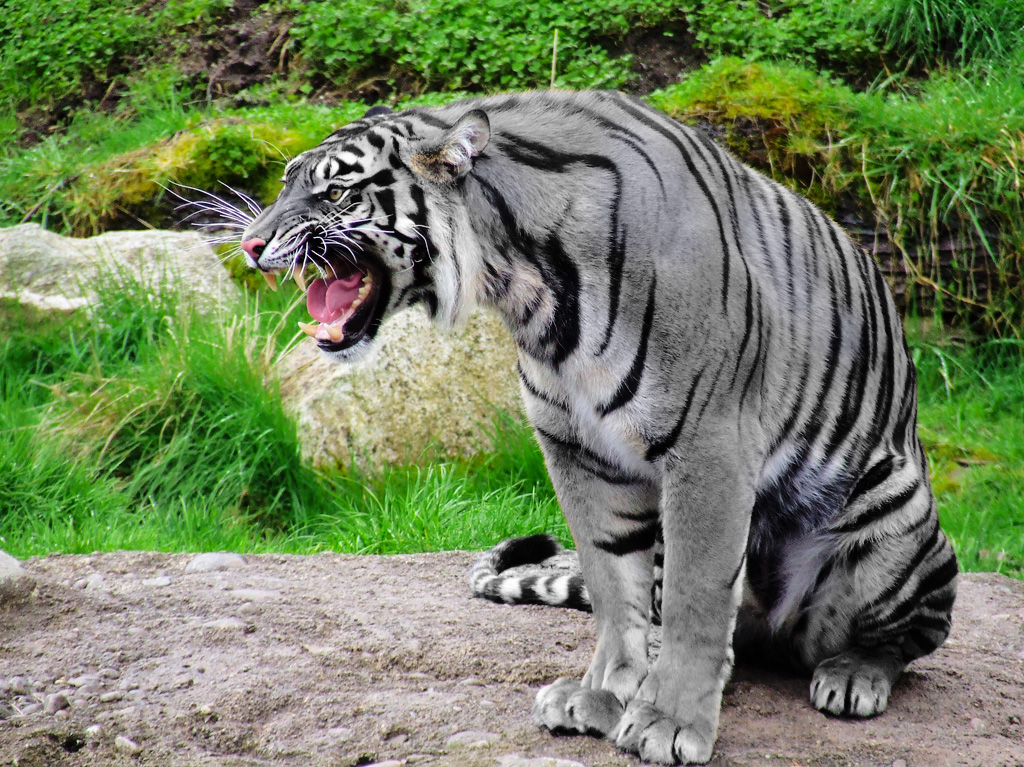
Here is the original:

The so-called “Maltese” coloration in tigers has been observed in wild South Chinese tigers. However, an alleged blue Amur tiger was spotted in Korea during the war.
This coloration has not been observed in captivity. Indeed, the color may have entirely disappeared from the tiger population. It wasn’t that common anyway. The fact that it has only been confirmed in the very endangered (or extinct in the wild) South Chinese tiger means that it is unlikely to make a reappearance.
I’m very skeptical about breeding tigers for unusual colors. The Maltese coloration and the normal orange with black stripes have been reported in healthy adult tigers. White tigers have all been captured as cubs, and the white tiger population that exists in zoos and circuses is a mixed subspecies. They have a mixture of Bengal and Amur tiger genes.
That means they can’t be part of any species survival plan.
And we all know that white tigers would have a very hard time surviving in their natural environment. After all, even the Amur tiger from the snowy forests of the Russian Far East isn’t white in color.
The white coloration comes from a single cub captured in India. It was obviously a Bengal tiger, and then its offspring were all line bred to produce this color. Amur tiger blood was added to the mix to increase size.
And a big white tiger is a lovely attraction. However, it has very little conservation value itself. It can’t be released into the wild, and it cannot even produce cubs that would even be considered for it.





[...] The Answer. Possibly related posts: (automatically generated)REAL WORLD IS HOLDING OPEN CASTING CALLSgood look ng [...]
‘Golden Tabby’ tigers are my favorite man-made color variant. But it’s really annoying how many ‘Preserves’ and such go on about how they’re doing some kind of conservation work by breeding these colors.
I want to know what the population of the maltese tiger is!!!!!!
Apparently, it is 0.
None have been seen since at least the Korean War, although that sighting may have been dubious.
how do u no there r 0 they might be in resrves or zoos
There are none in zoos, and none have been seen in the wild since the 1950′s.
Maybe one will turn up, but tiger population are so fragmented that it’s likely that these recessive genes will never be expressed again.
How do you exactly know this for sure, though? It’s not like the whole world broadcasts everything for the public to see.
I’m not sure, but it’s pretty unlikely.
If there’s one in North Korea, we’ll never know about it.
How do you know the orange pic isn’t fake? lol you could color it from gray to orange lol, I color grayscale photos all the time?
I think that would be awesome if the cat were really gray!
I recently read on a site, that white tigers are a genetic mutation. That people inbreed them to produce the white gene. they are a cross breed between the sieberian and the bangel.
Correct.
And they derive from a single Bengal tiger that was imported and they were inbred to produce the recessive.
And then bred to Siberian tigers to make a big white tiger.
Siberian tigers are not white.
Is that the only way to get a white tiger? To inbreed them?
No, but because it’s a recessive, it’s the easiest and most sure way.
They can linebreed them, which is like inbreeding but not with as close relatives.
So the chance of birth defects wouldn’t be as likely then? What would be the point of breeding them if it caused some to live in pain?
When you breed close relatives like that– even with line breeding– you increase the chances that a bad defect might pop up.
It is being spread on Facebook again…. :-\