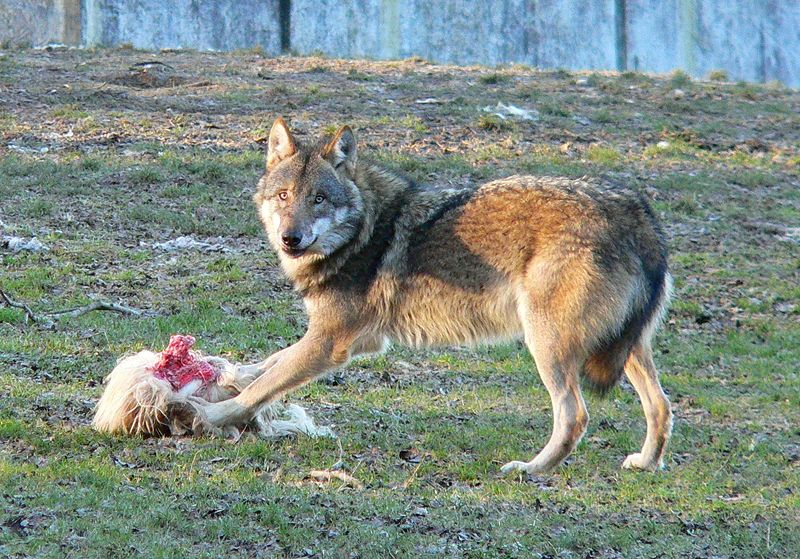
From the NY Times:
Borrowing methods developed to study the genetics of human disease, researchers have concluded that dogs were probably first domesticated from wolves somewhere in the Middle East, in contrast to an earlier survey suggesting dogs originated in East Asia.
This finding puts the first known domestication — that of dogs — in the same place as the domestication of plants and other animals, and strengthens the link between the first animal to enter human society and the subsequent invention of agriculture about 10,000 years ago.
A Middle Eastern origin for the dog also fits in better with the archaeological evidence, and has enabled geneticists to reconstruct the entire history of the dog, from the first association between wolves and hunter gatherers some 20,000 years ago to the creation by Victorian dog fanciers of many of today’s breeds.
A research team led by Bridgett M. vonHoldt and Robert K. Wayne of the University of California, Los Angeles, has analyzed a large collection of wolf and dog genomes from around the world. Scanning for similar runs of DNA, the researchers found that the Middle East was where wolf and dog genomes were most similar, although there was another area of overlap between East Asian wolves and dogs. Wolves were probably first domesticated in the Middle East, but after dogs had spread to East Asia there was a crossbreeding that injected more wolf genes into the dog genome, the researchers conclude in Thursday’s issue of the journal Nature.
***
Humans lived as roaming hunters and gatherers for most of their existence. Dr. Wayne believes that wolves began following hunter-gatherer bands to feed on the wounded prey, carcasses or other refuse. At some stage a group of wolves, who happened to be smaller and less threatening than most, developed a dependency on human groups, and may in return have provided a warning system.
Several thousand years later, in the first settled communities that began to appear in the Middle East 15,000 years ago, people began intervening in the breeding patterns of their camp followers, turning them into the first proto-dogs. One of the features they selected was small size, continuing the downsizing of the wolf body plan. “I think a long history such as that would explain how a large carnivore, which can eat you, eventually became stably incorporated in human society,” Dr. Wayne said.
***
Two other experts on dog genetics, Carlos Driscoll and Stephen O’Brien, of the National Cancer Institute, said they believed that Dr. Wayne’s team had made a convincing case. “I think they have nailed the locale of dog domestication to the Middle East,” [emphasis mine] Dr. O’Brien said in an e-mail message from Siberia, where he is attending a tiger management workshop.
Dog domestication and human settlement occurred at the same time, some 15,000 years ago, raising the possibility that dogs may have had a complex impact on the structure of human society. Dogs could have been the sentries that let hunter gatherers settle without fear of surprise attack. They may also have been the first major item of inherited wealth, preceding cattle, and so could have laid the foundations for the gradations of wealth and social hierarchy that differentiated settled groups from the egalitarianism of their hunter-gatherer predecessors. Notions of inheritance and ownership, Dr. Driscoll said, may have been prompted by the first dogs to permeate human society, laying an unexpected track from wolf to wealth.
Well, there goes Peter Savolainen’s theory.
The authors are not dismissive of the Goyet Cave finding. They also don’t put an exact date on domestication.
But what they did do was tear apart Savolainen’s theory that dogs were domesticated 16,000 years ago in southern China. They also find plenty of evidence that dogs and wolves have exchanged genes since the two split into separate “cultures.” Some dogs have similarities East Asian wolf DNA. Others have affinities with European and Middle Eastern wolves. Some even have affinity with North American wolves. The Middle Eastern wolves turned out to be a major influence on domestic dog genetics, which is not all that surprising. This is where people first met Canis lupus.
It was here that the first wolves became curious about their new neighbors.
And the rest is history.




so what do we know about how “purebred” wolves actually are? Can we determine what, if any, wolves are actually wolves, and which are part dog?
(as a comparison, genetic studies indicate that almost all of the remaining North American bison have some cattle in them. There are a few exceptions including the bison in Yellowstone Park)
That is a good question
These studies have been able to clade out wolves and different types of dogs, but there is a lot of overlap.
If you can find the study in Nature, it’s really interesting how what they’ve done. It will be up tomorrow.
I didn’t buy off on the Chinese theory. It never made any sense that the first domestication would be “rice farmers” raising wolves as food. There are so many other animals that would have been easier to keep (ducks, geese, etc) and more applicable. I’ll have to try and get the Nature article. My guess is that there was more than one domestication point, multiple times when “not a wolf, not quite a dog” animals went feral, multiple times when a bitch was tied out for “whatever romeo comes by” or was bred by “can leap fence”.
There’s been a few examples where DNA didn’t match up with the bone record of various animals, so I’m still inclined to believe that domestication occured BEFORE 15,000 years ago, possibly considerably before. It depends on what one defines as domestication. “not wild, but not genetically different from wolves” could have been hanging out with us before we split with the Neanderthals. I’m familiar with the issues of “taming wolves” but I also believe that the behaviors they are asking for from these experiments (don’t steal from the table for example) aren’t realistic. I don’t think the F1 generation of Russian tame foxes would have passed these tests either. Bark at intruder/drive them off, help chase prey into waiting hunters with spears and “hang around” may have been more than sufficent if the “not a dog/not a wolf” provided even a 1% gain in success/security. And you can have a 100o failures if 1 succeeds. The assertion that it’s too hard is because the test is wrong. You don’t need an animal that obeys initially. you need an animal that includes you in the group and cooperates more than it doesn’t –and frankly, a crippled wolf might have done quite nicely in that department.
Peggy Richter
If you read the actual article, it doesn’t say when dogs were domesticated. It just says that Middle Eastern wolves were the most important source of genetic material for dogs.
And that’s where humans would have first encountered wolves as they left Africa.
You’ve been reading lots of stuff that I have been reading, because I’m very much inclined to agree with you. Wolves developed a “culture” that based upon cooperating and associating with humans. C. lupus had had lots of different cultures and adaptations to those cultures. There were some in Alaska that were big game specialists. http://notexactlyrocketscience.wordpress.com/2007/06/21/bone-crushing-super-wolf-went-extinct-during-last-ice-age/
The wolves that became dogs could have evolved a similar niche– just one that involved either humans or hominids.
Maybe wolves were somewhat like orcas in that they had genetically and behaviorally distinct “cultures.”
I’m using that word with quotation, because it is not generally accepted that dogs have cultures.
You should link directly to the gorgeous image of the canine family tree they have up.
(I love images like this)
I want to make a poster out of that chart.
Zoom in and check where goldens and flat-coats are in relation to each other and the Labrador.
It fits the historical record perfectly.
That’s it!
Ha! The standard and toy poodles are where they belong – with the (other) working breeds. And no – I’m not surprised. They are the original versatile dog.
Companion group my arse – bite me, AKC.
I thought they were going to be with the retrievers.
[…] Yes. Tasha was the first dog to have her genome sequenced. The research helped compile a list SNP’s (single nucleotide polymorphisms) that have been used to trace disease in domestic dogs. They were also key in the study I wrote about yesterday. […]
Peggy Richter, why more dog domestication researchers don’t get what you just said(wrote), I can’t understand–it is really just common sense! Of COURSE the first tamed wolves didn’t behave and weren’t as obedient as modern day dogs, but then, they didn’t need to! It’s like saying early Cro Magnons were not our ancestors because, well, they wouldn’t know how to behave or dress for the Metropoliton Opera! And how many hundreds, maybe even thousands of years did wolves remain WOLVES in their symbiotic associations with early humans? They had constant access to breed back to the wild, and obviously did, and humans having zero experience or tradition in selectively breeding animals, this wolf/human partnership could have gone on for many years and generations with no discernable difference between wild and tame wolves for the archaeologists to discover. Being perfectly suitable partners as wolves, there would have been no need to change until the hunter-gatherer lifestyle began to change. Tame wolves do not fit into settled, agricultural societies very well, and especially not when other animals began to be kept as livestock. That’s when I believe the change from wolf-to-dog really accelerated, and make no mistake, it was because of human selection, not loose, wild wolves “domesticating themselves”!!!!
The way that most people, even researchers, approach the question of dog domestication is far too simplistic. Human beings of all cultures, from the most to the very least evolved and sophisticated, take and keep pets. The few hunter/gatherer tribes left on Earth today do so, whether they are in jungles, or desert regions, or points in-between.
Granted, there is a difference in a “tamed” pet that was taken from the wild, and a truly domesticated animal. But I think that many different canine species, primarily wolves but also foxes, dingos and dholes, must have contributed genetic material to the animal that we know as the domestic dog. Wolves and dingo-like animals were probably the animals from which truly domesticated dogs sprung, but it’s way to easy to say “this was done here and here but not there. For that same reason I think that calling domestic dogs a subspecies of wolf is inaccurate. They are a species unto themselves, closely related to wolves but not conspecific.
I have to disagree with your last sentence. The amount of gene flow between the animals called wolves and dogs is extensive, and it’s one thing this particular study found. So I consider them to be the same species, but they have differences. Wolves are very diverse. We don’t call Arabian wolves a separate species from Arctic wolves, yet both are quite different from each other. We don’t call wild rock doves a separate species from the domestic pigeon, yet many forms of domestic pigeon are as far removed from that animal as dogs are from wolves.
There are doggish wolves (see Wags).
There are also wolfish dogs.
Some dogs rarely bark. Bond very strongly with just a few people, and tolerate just a few other people.
I’ve got some posts on this if you do a search function on the blog.
Retrieverman,
You do good work!!
My dilemma as I research dog history, and then try to apply that history as a breeder, is trying to remember it is very unlikely dog breeds were developed in the manner in which we currently breed purebred dogs.
I am increasingly of the opinion that dog owners in the 1700’s (which I think is the most important century when it comes to breed development) didn’t necessarily breed based on particular traits. Instead, I think dogs weren’t as closely restricted as today, and often ran loose, and mated. The 18th century owners then selected and/or kept those puppies which were useful in whatever endeavor the owners followed.
That means the puppies selected were not products of human selection but of a dog getting to a bitch. The litter was born and then the human selected certain puppies to keep. Litters weren’t bred based on preconceived traits determined by the human but puppies were kept based on what the human wanted/needed at the time.
We are seeing some of this today in the increasing popularity of smaller dogs because of the diminished living space we all face. If you live in New York City, and want to love a dog, it’s a lot easier to house a 10 pound Toy dog than a 90 pound retriever. We retriever owners can continue to breed our dogs but they are not going to be selected by those city dwellers very often.
I used to read dog history with an eye as to why did they want to produce this type of coat, size, ear, tail, temperament, etc., etc. Now I read dog history as a happenstance: dog owners in the 17th and early 18th century weren’t necessarily in charge of which dog bred which bitch; instead, they selected the traits after the litter was born.
It may not be a revelation to anyone but me….:)
That’s exactly how it happened. Originally, dog types and strains produced variable offspring, but it was decided to standardize them.
For working breeds owned by working class people, this was the process by which they were standardized: https://retrieverman.wordpress.com/2009/07/16/losing-our-rustic-working-dogs-because-of-misguided-efforts-to-save-them/
Kittenz, I may be one of those “lumpers” when it comes to categorizing species(although I will agree there can be big differences between subspecies, as in the Arctic/Arabian wolves Retrieverman mentioned), but I consider dogs simply(and complicatedly!) just the domestic descendants of wolves–quite different in some ways, enough perhaps to definetely be considered a “subspecies”, but I think biologically speaking, the domesticated descendants of all wild animals are still the same species as their wild cousins–put them back in the wild under the same selection influences, and they revert physically and behaviourally to what their wild ancestors were(usually). Dingos are not that old as a “species”–they have only been in Australia a few thousand years–brought, it is believed, by humans, and reverting to the wild–they are similar to feral populations of “pariah” dogs all over the world–so cannot be considered anything other than a distinct variety, but not a seperate species. Genetic studies have verified the wolf ancestry–no jackal bloodlines either, which was a quite popular notion for the longest. Dogs breed and produce fertile offspring with wolves(and coyotes, which many consider an offshoot from wolves), and their basic behaviours(uninfluenced by humans) are more like wolves than any other canid. Dholes(and African Wild Dogs) are VERY different genetically, and have different chromosome numbers, and apparently cannot interbreed with wolves or domestic dogs, so are most assuredly not part of our modern dogs’ development. You are so right, though about “primitive” tribes keeping pets of all sorts–always have obviously, which is where our domestic animals come from! Why Coppinger and others don’t notice that in history I don’t know–they need to take a BASIC Anthropology 101 course, and study OTHER domestic animals for comparisons! When Coppinger says wolves are nasty and untameable(despite kuhzillions of modern cases to the contrary!), I say, they are a heckuva lot easier to tame and keep than an eagle or a falcon! Or a wild bull or horse or wild boar! Or a camel or an elephant for gosh sakes! This is just common sense! Sure, it is hard to properly raise and keep wolves in modern agricultural or urban society, but for ancient hunter-gatherers, it was a match made in the Happy Hunting Grounds!(literally!)
….And Curlylady–so right; modern strict “purebred” breeding practices are only a couple of centuries old, for most of the breeds. The only exceptions might be some of the mid-eastern sighthounds, where religion reared it’s dogmatic head many centuries ago–the Islam belief that dogs are “unclean”, except “dogs” like Salukis and other greyhound-types, that were created by Allah to course, and therefore must by all means be kept from cross-breeding with common infedel mongrels or dogs of any other type!(simply by isolating their bitches in heat, and culling any “accidents”). And in many instances–a lot of Nordic breeds come to mind–the dogs that SURVIVED were the ones that bred–a lot of natural selection pressure above and beyond mankind’s whims at work there. And what-do-you-know, a lot of the Northern breeds developed under such conditions have maintained more wolflike characteristics than other breeds! For the longest, it seems that many peoples’ throughout history were satisfied with maintaining more general “types” of dogs, rather than strict, specific “breeds”, and it would be much healthier for the dogs if we went back to this outlook! Blasphemous a notion as that is to modern conformation dog breeders, who so want to believe “their” breed has been “PURE” for THOUSANDS of years!!!! Yeah, right…..
[…] were derived from southern Chinese wolves that were domesticated 16,000 years ago. (This finding has been challenged recently. I have a short piece in The Bark about […]
[…] We now know dogs were first domesticated from Middle Eastern wolves. […]
There is another report out that says dogs were first domesticated in Europe 32000 years ago ,so maybe when the ice forced the then inhabitants to seek refuge further south they introduced their dogs to the middle east
It’s likely that domestication happened a very long time ago in several parts of Eurasia. However, the majority of dogs living today are derived from wolves that are very closely related or the same as the subspecies native to the Middle East.
I happen to think that dogs were domesticated through a process that began 10’s of thousands of years ago.
Ive just started studying canine behaviour. One of my questions in my course is:
List 5 areas/stages that have had a significant effect on the domestication of the dog as a companion animal? Im finding it very difficult to get five points. The points that i have already got are training, breeding, cultural process, feeding…..do you think the points ive got already correct? any help or suggestions would be great.
I think I’d go with these five stages:
1. Wolves scavenge and follow hunter-gatherer camps– perhaps for tens of thousands of years.
2. Wolves start to develop dog morphology– either through neotenization or something else.
3. Village dog stage. Dogs live in villages and are freely breeding.
4. Man begins to selectivley breed the village dogs.
5. Man begins to create breed dogs 150 years ago.
Thanks very much retrieverman for your help, very much appreciated. With the points above is that the same process of the evolutionary steps in the domestication of the dog?
Yes.
[…] analysis that had suggested that the Middle East wast he primary source for most modern dogs, but he also posited that Central Asia would be the place where one would find the most morphologically …. Derr contends that the Middle Eastern wolves followed humans out of the Middle East into Central […]