Archive for March, 2010
The most important blog post about dogs I’ve ever read
Posted in animal welfare, dog behavior on March 26, 2010 |
Wales bans e-collars
Posted in Uncategorized on March 26, 2010 | 61 Comments »
From the BBC
Posted in animal welfare, dog behavior on March 26, 2010 |
Posted in Uncategorized on March 26, 2010 | 61 Comments »
From the BBC
Posted in dog breeds, tagged bulldog showing, bulldogs on March 25, 2010 | 11 Comments »
Make sure you rub that special spot:
Posted in dog breeds, tagged extinct dogs on March 25, 2010 |
Pretty nice video, don’t you think?
Posted in Absolute Piffle on March 25, 2010 | 9 Comments »

Great Danes can run 65 MPH!
I should’ve thought of this!
You learn things about dogs that I never knew:
Like Great Danes can run 65 MPH, and Weimaraners once hunted with Goethe, Schiller, and Herder on hunts in the Thuringian forest. And beagles love drugs!
Posted in dog breeding, dog health, domestic animals, tagged Chinese dogs, Chinese Kennel Club, conspicuous consumption, dog culture, Thorstein Veblen, Tibetan mastiff on March 25, 2010 | 11 Comments »

Thorstein Veblen, American economist (1857-1929).
Dogs have always been used as symbols. It seem one of the perversions of the relationship.
Dogs exist not just for the jobs the perform or the companionship they provide. They exist because of what they say about us. It’s disconcerting. I know.
Thorstein Veblen, a somewhat unorthodox American economist, understood the power of this symbolism perfectly. He noted that as agriculture became more efficient to have a class of people who did not have farm, the non-farming class began to use possessions as symbols to represent their class. Veblen called them the leisure class. It is somewhat similar to Marx’s ownership class, but it is not exactly the same. In industrial and mercantile societies, the leisure class includes the rising middle classes.
In this system, people buy things they can’t use to prove their status. Veblen argues that this comes from ancient and Medieval societies, where hunting and warfare were generally the realm of the nobility (the leisure class of their time period). Owning hunting dogs and weapons that one may never use was a sign of one’s status. In industrial societies, the rising middle classes also took to using possessions to signal status. People buy things to show that they are on the way up in the world, not because they are useful. It’s why people buy brand name clothes. It’s why people buy sports cars. It’s called conspicuous consumption. The term is Veblen’s own invention, although it is almost never attributed to him.
It’s also why people buy “useless” dogs. It is no coincidence that the rise of purebred dogs and the mass production of family pets happens just as the industrial revolution begins to take off. In the late eighteenth and early nineteenth centuries, the dog everyone had to have was a Newfoundland. The dogs had a romantic history as working dogs on their native island. There were many stories of these dogs saving people from drowing, and how wonderful they were as ship’s dogs.
The Industrial Revolution began in Britain. At the same time, Britain was putting together the world’s largest navy, and the nation’s maritime tradition was already developing itsplace in the popular imagination. Anything associated with ships would have fascinated the British public. Those ships were their space shuttles. They were their connection to both national prestige and to the outside world.
Newfoundland dogs probably became popular simply because they were common on ships. If you owned a Newfoundland, it was like being connected to these ships. You could signal your patriotism by owning one. It also helped that the dogs were gentle, very intelligent, and excellent family dogs.
Those traits also played to another sign of rising social status, one could care about the children. One didn’t have to sell them into indenture just to make a living. One didn’t have to make the children work long hours on the farm. People with status can afford to buy pets for their children, and what could be better than an heroic Newfoundland dog?
These issues play out today almost exactly as they did then. It’s just now the fads often don’t last as long as they did back then. Only a handful of dog breeds have been popular for nearly a century. As far as I can tell, only the German shepherd, the poodle, and the beagle have been in the AKC top ten for registrations for over 70 years. I might be wrong about this, but the retrievers have only been popular for a relatively short time.
We also have different species for people to buy. African hedgehogs are now replacing Chihuahuas as the pet to carry around in a purse. Pot-bellied pigs were a big deal in the early 90’s, but now there is an even tinier breed of swine that is being offered.
Fad pets fit perfectly with Veblen’s conspicuous consumption. The mass production is one of the things that drives a lot of welfare problems in companion animals. Puppy mills are but one of the concerns connected to mass production. Narrowing gene pools to produce exotic colors is another, but this one often goes unmentioned.
But this problem is hardly confined to Western societies.
Conspicuous consumption has started to appear among the rising middle class in China.
To look like you’re rich in China, you have to get a Tibetan mastiff.
I don’t know whether the breed they buy is the recreated dog that has been a source of intrigue in the dog fancy for many decades or the actual livestock guardian mastiffs that are found in Central Asia
You can’t get better symbol of relative wealth in Chinese society. Meat consumption is on the rise, but most of the Chinese diet is plant matter. To own a carnivorous pet shows real changes Dog ownership is very strictly regulated, and in many areas, people are allowed only one dog. If you rely on your dog for anything, you have to choose one that is economical in size and broadly applicable in its utility. The dogs that are close relatives of the Western chow chow have to be good watch dogs and livestock guardians. They also have to have good pelts and produce nice carcasses to butcher.
Now what could better tell the world that you’re up and coming than to own a dog that really has no purpose in an urban environment. The dogs look like lions, which are a symbol of luck in Chinese culture.
The dogs evolved on the Tibetan plateau and lived as livestock guardians for thousands of years. Some dog experts claim that they are the original mastiffs, although I’m somewhat skeptical.
So like the Newfoundland, these dogs have a romantic connection to the traditions and lore of the society in which they are found. One cannot make the case that these dogs have much economic utility to urban dwelling young professionals. They could have a chow-type dog as a watch dog, and it wouldn’t cost that much to purchase or feed.
The dog is valuable for what it is, not for what it does. To buy one is the perfect example of conspicuous consumption.
***
I should note here that Veblen hated dogs. All dogs– although he did respect those dogs that actually worked.
This is something that he shared with Chairman Mao Zedong. Dogs were persecuted by the Communist Party from 1949 until 1976, when Mao died. During the Cultural Revolution, the Red Guards went on dog killing sprees throughout China’s cities. In a country that experienced a lot of famines, keeping animals that had little economic utility was seen as taking food away from starving children.
So the dogs got shot.
Since Mao died, his successors have liberalized restrictions dog ownership. They first allowed small dogs. Then they allowed big ones.
And now they have a burgeoning dog market (and not just for food).
One wonders what pit falls the Tibetan mastiff will experience from its newfound status in China.
The breeder featured in this piece appears to be running a high priced puppy mill.
And we all know where that leads.
China is trying to get into the FCI, and my guess is they are going to try to adopt the entire Western model of the dog fancy.
The contours are already there. It just needs a little push for the infrastructure to appear.
And if it does, it might hamper the kennel club reform movement in this country.
The newly open Chinese market for inbred show dogs will distort any attempts to increase genetic diversity and deal with health problems here.
One can only hope that they don’t adopt the Western model.
But I’m not holding my breath.
Posted in wild dogs, wildlife, wolves, tagged Burmese gray dog, cryptozoology, dhole, gray dhole, grey dhole, red dog on March 24, 2010 | 24 Comments »

A regular dhole. The supposed gray one I'm talking about lives in Myanmar. It is not a pack hunter.
Of course, I’d rather not have to go to Myanmar if I could help it.
It’s not a nice place for human rights.
But it might be worth the risks for this.
***
One of the things about dholes is that they make more sense as an ancestor of the domestic dog than the wolf does.
Dholes are much more socially tolerant than wolves are. There are reports of dogs running with dhole packs, and dhole are not normally aggressive toward each other.
They also come in a red coloration that is virtually uknown in wolves, but it is common in every virtyually dog population, including so-called primitive dogs. Dhole puppies often have black muzzles. This makes them look a bit like Malinois.
Dholes are much more easily tamed than wolves. Brian Houghton Hodgson, the British ethnologist and naturalist who worked in India in the 1850’s, believed that they were the ancestor of the domestic dog, because he had known several that were kept as pets. They were as tame as any domestic dog. Hodgson noted that the skull of a dhole is very similar to a generic domestic dog, but the dhole has much larger teeth.
Yes. That would all make sense. It also lay credence to Peter Savolainen’s research on dog mtDNA haplotypes that suggests that domestid dogs are derived from Southeast Asian wolves. Although wolves existed in India and Southern China, they really aren’t well known in Southeast Asia. In fact, it may be that there were never any wolves in Southeast Asia– and there aren’t any right now. But if the dhole had been the ancestor, we would be able to make lots of sense of it.
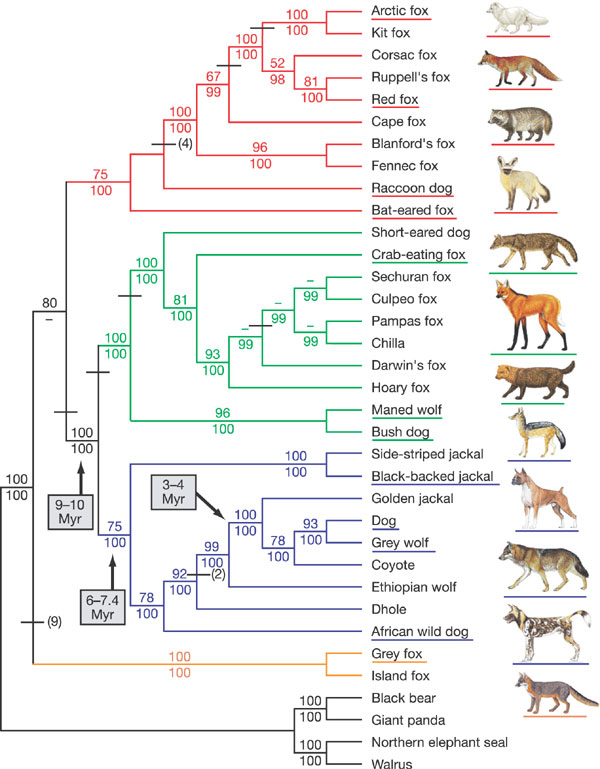
However, dholes have never produced a litter of hybrids with dogs or any other version of Canis lupus. They are not interfertile with any members of the genus Canis. It turns out that dholes are more distantly related to dogs than they are to black-backed jackals, which are one of two jackal species that cannot interbreed with domestic dogs/wolves/dingoes, golden jackals, Ethiopian wolves, or coyotes.
The dhole theory all makes sense.
Too bad there’s just one that one little glitch there.
***
Wolves historically lived in the northwest of Burma, but these gray dholes are said to be smaller than red dholes. I doubt that these are wolves.
Golden jackals are grayish compared to the dhole, but I’ve never heard of one that was very dark gray with a black muzzle. I’ve heard of dark gray ones.
It could be a golden jackal/dog hybrid.
Black muzzles are almost exclusively a dhole and domestic dog trait.
I don’t think dholes can crossbreed with anything. It would be interesting if they could.
But I’m not so sure that one could say that this animal is a dhole/wolf hybrid. I can’t imagine what one would look like, but the real problem is that wolves had a very limited range in Myanmar/Burma. They are currently extirpated from that country.
Could it be a new species?
Maybe.
And that’s why I think its worth exploring.


 | williewestfall on Bobcat scat |
 | cyborgsuzy on Forgive the gratuitous ne… |
 | retrieverman on Forgive the gratuitous ne… |
 | pondpawed on Forgive the gratuitous ne… |
 | Eugenie on Tailgate |