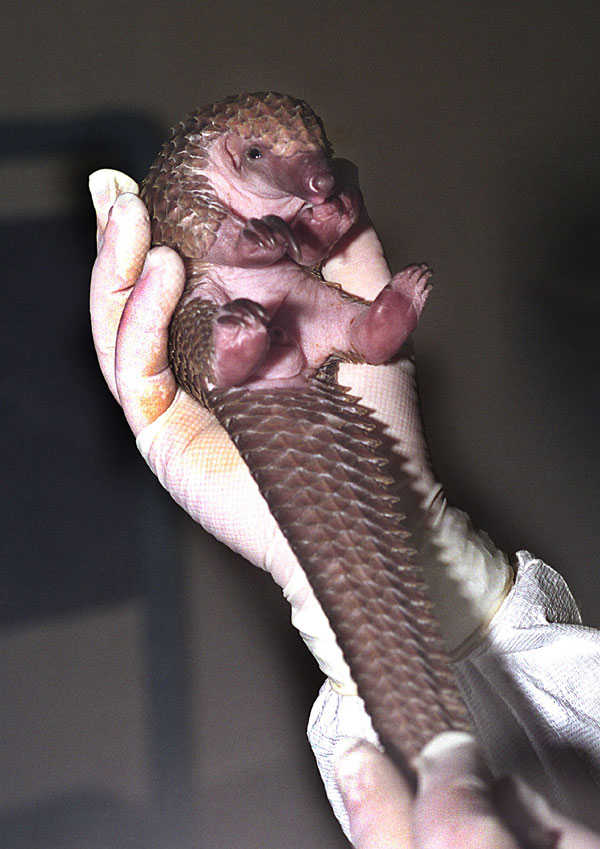
A baby pangolin of some sort.
I asked the question yesterday about which animals were most closely related to pangolins.
Originally they were lumped with the sloths, the anteaters, and the armadillos to form the order Edentata. This order also included the aardvark (more about that animal this evening).
Today the sloths, the anteaters, and the armadillos are all in the order Xenarthra. (If you watch any Jeff Corwin shows, this is one of his favorite words to use.)
The aardvark isn’t related to Xenarthra. Calling them “earth pigs,” as their name means in Afrikaans, isn’t really all that far off the mark. I’ll discuss aardvarks a little later.
Pangolins, though, are actually not closely related to either aardvarks or the New World anteaters and armadillos.
They certainly look like they would. I mean a silky anteater does look a bit like a pangolin with the scales, right?
Well, it turns out that pangolins aren’t that closely related to any of these animals.
Their closest relatives are in the order Carnivora.
Yes. Pangolins are more closely related to puppies than they are to anteaters and aardvarks.
Analysis of their DNA finds that the order for the pangolins, Pholidota, is closely related to Carnivora. The two orders are now grouped in a single clade called Ferae. Ferae also included an extinct order of carnivorous mammals known as Creodonts.
Now, this sounds a bit strange. Carnivores are known for their teeth. In fact, one of their distinguishing features is their impressive carnassials. Pangolins are toothless.
No Carnivore has armor plates.
But if you look at the video of the spotted skunk from the earlier post and compare it to the video of the pangolin, can you see a family resemblance?
***
The closest relative to Ferae are the Perissodactyla.
Those are the odd-toed ungulates: tapirs, rhinos, and the horse family.
These same studies have fond that horses are more closely related to dogs and cats than they are to cows.
But cows are more closely related to dolphins.
And we primates are most closely related to colugos (“flying lemurs”), tree shrews (which aren’t shrews), and then rodents and lagomorphs.
So we’re more closely related to rats than we are to dogs.






[…] The Answer. Possibly related posts: (automatically generated)Baby PangolinIllegal animal trading puts Malaysia ….Monday […]
Based on observed behavior (and headline news) that last statement comes as no surprise.
Pretty fascinating (I can’t get over the whole cattle/dolphin bit).
Remember the even-toed ungulates?
Those used to be called Artiodactyla.
And all whales and dolphins were in the Cetacea.
Those have since been merged.
The absolute closest relative to the dolphins and whales are the hippos.
Indeed, hippos are more closely related to those animals than they are to pigs!
The new order for whales and dolphins and all the ungluates with cloven hoves is Cetartiodactyla.
Check this out:
http://news.bbc.co.uk/2/hi/science/nature/4204021.stm
Just a stupid question here… Now that humans are understanding more about DNA, are we re-classifying everything according to what we know today as far as DNA? Are we totally discounting other means of determining relationships of one species to another? I am not judging this, just trying to rework my own mental picture of the whole schematic.
Aside from that question, how does canine DNA compare to that of a bear’s DNA?
That’s actually a big debate in taxonomy right now.
Morphology is the traditional way of doing so.
There is actually a big debate about the red wolf that is worth checking out.
http://www.canids.org/PUBLICAT/CNDNEWS3/2conserv.htm
I found this: http://www.sciencenetlinks.com/sci_update.php?DocID=273
“Well, it turns out that bears, including ancient cave bears, are closely related to dogs – they’re about 92 percent similar on the genetic level. And it just so happened that scientists have sequenced the entire dog genome.”
Yes.
Bears are definite Caniformia.
The last thing I read on this was that the bears share a relationship with seals, sea lions, and the walrus.
Now you did it… I should be working and I am off Googling: DNA Phylogenetic Trees mammals…
I love this kind of procrastination!
“So, how well do phylogenetic trees from morphological studies match the trees made from independent molecular studies?”
http://www.talkorigins.org/faqs/comdesc/section1.html
I found this to be really interesting… It says to me that the “science” is evolving quickly and at the moment, we are just scraping the surface. The reason I say that is the number of possible valid conjectures at the moment is very high. My guess is that this will lower once more statistics are gathered and analyzed… Makes me want to go back to school to study genetics. The research sounds fascinating to me.
back to work…