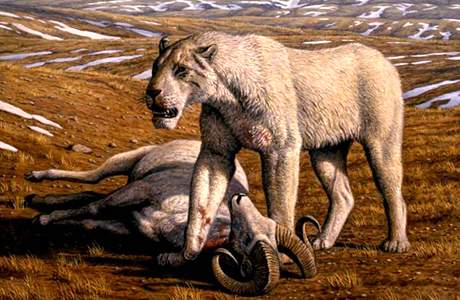
It is not a Smilodon or an American lion (Panthera leo atrox).
The genera Smilodon and Homotherium are relatively closely related. They both are in the subfamily Machairodontinae.
Machairodonts were in the cat family. They were not pantherine cats, like tigers, lions, leopards, and jaguars. They were in their own subfamily.
It is incorrect to call members of the Smilodon genus “saber-toothed tigers,” even though that’s what the Flintstones called them.
You can tell that this particular cat is a Homotherium because of its prey. Dall sheep have always occurred in the northwestern part of the continent. Smilodon fatalis, a contemporary of both ancient Dall sheep and Homotherium serum, existed only the southern part of the North American continent. The two animals likely had an overlapping range, but they may or may not have been direct competitors. It is believed that the Homotheriums serum was a creature of higher latitudes and higher altitudes than Smilodon fatalis, kind of like how the modern bobcat inhabits warmer areas than the Canada lynx.
One of the hallmarks of Homotherium is that the forelegs are longer than the hind legs. It was also at least partially plantigrade, which is unlike any modern cat species.
The other identifying feature of this cat is the deepened lower jaw. Lions, including cave and American lions, and tigers don’t have this feature.
The Homotherium cats lasted until about 10,000 years ago in North America.
If Coppinger is right that the animals we domesticated are either garbage or feces eating animals, then we might have a new candidate for domestication.
What raised this question wasthis piece in the New York Times. (Hat tip to Patti S for sending it my way).
The question that was raised in the piece is one that will surely launch discussion on this blog:
Is coyote coursing dog fighting?
Some facts:
Coyotes are very closely related to dogs. They can interbreed and produce fertile offspring. (Photos of captive hybrids are here).
However, they are clearly different species. Coyote and dog hybrids are not always fertile. Breeding coydog to coydog results in puppies that are infertile within three generations.
Coyotes and dogs have different body language. Coyotes have a threat gape that domestic dogs and wolves don’t have. I’ve read that New Guinea singing dogs might use the threat gape, but I’ve not read any confirmation of it in the literature.
Dogs usually hate coyotes. Even dogs that love other dogs seem to hate everything about them. I’ve heard of regular large domestic dogs killing coyotes, and coyote hunting with hounds is becoming as popular as fox hunting with hounds where I live.
Coyotes usually hate dogs– or really like them. Those that like dogs usually like the smaller ones, and they like them only as a food source.
Because coyotes and dogs are variable animals, their behavior is not written in stone. Some coyotes love playing with dogs. (See this video and this one. Please ignore the comments on that second one that say that the coyote is “luring” the dog to its death. That can happen, but how often it happens is a good question. My guess is more dogs kill coyotes in this county than the other way around. Coyotes are normally scared to death of domestic dogs– and yes, I live near a forest that is full of coyotes and I haven’t lost a dog yet.)
Now, the problem with counting coyote coursing as dog fighting is that I don’t think we can call coyotes dogs.
Wolves and coyotes do hybridize, but it generally happens only when wolf populations are very low. In the wild, the only matings between wolves and coyotes occur between dog wolves and bitch coyotes. Female wolves have no interest in mating with coyotes.
But even at the taxonomic level, I am not sure we can even call this fighting at all.
The coyotes can get away– and often do.
And element of fair chase exists here.
And if coyote coursing is banned, what happens to the owners of some free roaming dogs who decide to kill a coyote?
In the rural parts of the country, free roaming dogs are the rule, not the exception.
Coursing does have some advantages. It probably does not significantly reduce the coyote population, but it teaches coyotes to fear dogs and people. Those that get away learn that large dogs will kill them.
Ranchers who use livestock guardian dogs probably benefit from the fact that greyhounds and longdogs have trained the coyotes to fear domestic canines. I know that my dogs don’t have much to fear from coyotes, simply because foxhounds have taught the local coyotes the same lesson.
I don’t think we consider these aspects when we talk about banning hunting methods. The states that have banned cougar hunting with hounds have also seen cougars reconsider their relationship with both people and dogs. Cougars have learned, as the leopards of Africa and Asia have known for millennia, that dogs are tasty. Most historical accounts of cougars often talk about how “cowardly” they are, which is often mention in the context of how much they fear dogs. Wolves probably taught the cougars to fear dogs, but without learning this fear from either wolves or hunting dogs, the cats have started stalking pets. And it’s not a big leap from stalking dog to stalking people. (But cougar attacks on people are still quite rare.)
Of course, cougar hunting with hounds was banned in several states through animal rights activism.
And animal rights activists want to ban coursing.
Several years ago, California had a vote on whether to ban jackrabbit coursing. In case you didn’t know, jackrabbits are hares, so California was technically wanting to ban hare coursing, which has already happened in some European countries. The proposed legislation didn’t even make it out of committee.
It probably had no traction, because it’s hard to get someone worked up over a rangy old hare that eats crops.
However, coyotes are a different matter.
Not only can one try to make the case that coyote coursing is dog fighting, the coyote can be turned into a romantic wolf figure very easily. It’s very hard to argue against that wolf figure.
Please do not assume that I have an antipathy toward coyotes. I really don’t. I like having them around. I like listening to them at night, and whatever they are doing here, they aren’t harming the ecosystem. I appreciate their intelligence, their family units, and their close relationship to the domestic dog.
But I also respect the coyote coursers. They are breeding longdogs, staghounds, and greyhounds that are built for function. They are bred in a real open registry system (if registered at all.)
I think it’s a big, big stretch to call this dog fighting or even make such a comparison.
And the coyotes live natural lives up until the sight hounds catch them and dispatch them.
Fighting dogs really don’t have that luxury. Their lives are tied up in the fighting industy, which means they experience little more than a lifetime of suffering.
If you have to compare the pain and discomfort inflicted by dog fighting and the pain and discomfort inflicted by coyote coursing, coyote coursing comes up a far distant second to the real blood sport.
I hope these misconceptions won’t kill off coyote coursing, but I certainly hope dog fighting disappears entirely. My views are not inconsistent. I think you’d have to be willfully blind not to see it.