
This image comes from W.E. Mason’s Dogs of All Nations (1915)
The entry goes as follows:
Color: Yellow or rich red sable. Height: 28 in. Weight: 90 lbs.
This dog is similar in all essentials to the English [flat-coated] Retriever, except that he is a size bigger and heavier in coat, and of course different in color, as his name implies. He is used principally for tracking wounded deer.
The same book has an entry on the flat-coated retriever that mentions the golden retriever with that breed, and it implies that they are separate breeds.

Below this image of a flat-coat, Mason describes the color:
Color : Rich black, free from rustiness and from white. There is also a Golden Retriever so named because of the golden or yellow color of his coat.
So what is going on here?
Well, the dog in the top photo isn’t from Russia at all.
It is a yellow retriever with long hair, and except for size, it is very similar to the dogs that became golden retrievers.
I can tell you with almost certainty that the Russian yellow retriever is derived from the same stock as the dogs that became golden retrievers.
Why?
Well, there was a fellow named Col. William Le Poer Trench. Trench was an interesting fellow in golden retriever history.
If you’ve ever heard that they come from Russian circus dogs, Col. Trench is who you can blame.
At some point in the 1880’s, he got some yellow retrievers from the Tweedmouth line. His dogs came from the Earl of Ilchester’s dogs, which were all line from Tweedmouth’s breeding. From those dogs, Trench founded his own line, calling them St. Hubert’s.
Some of these dogs were very similar to working flat-coats and golden-type dogs, like St. Hubert’s Peter (note the brown skin):

This particular dog was presented to George V.
“St. Hubert’s Peter” was his name. I don’t know whether Col. Trench bred him, but it seems that he comes from his line. However, the dog looks very different from the dogs I associate with St. Hubert’s dogs.

Yes. Those are the dogs.
And they look very similar to the dog in the top photograph. They are actually gold in color, as this painting of them clearly shows.
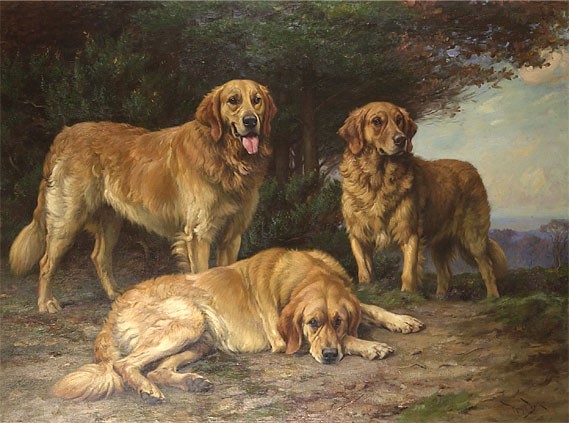
The dogs were not registered as golden retrievers or flat-coated retrievers, as would have been the norm. They were registered with the KC as a separate breed called the Russian yellow retriever. (There are actually two very different breeds that called Russian retrievers, one of which is nothing like a golden retriever!)
Because the St. Hubert’s dogs were registered as a separate variety of retriever, they actually competed as something other than the breed called “Flat-coats (golden)” in at least one dog show.
Now, as I said before, the story of the Russian origins of the golden retriever comes from Col. Trench. Col. Trench supposedly had the goods on the 1st Baron Tweedmouth’s breeding program. He had a letter from Guisachan’s kennel man that claimed the dogs were definitely derived from a troupe of Russian circus dogs. The evidence even included that famous photo of Nous.
The story goes that the circus dogs were crossed with bloodhounds to make the yellow retrievers, which is where I think some of this bloodhound story comes from. If there were any bloodhound-retriever crosses, they most likely were not bred from.
Trench wanted to add new blood to his line, as the story goes, and he claimed to have gone to the Russian Empire in search of new blood. The dogs were all in the mountains when he came there, and he couldn’t find any.
Supposedly, these Russian circus dogs were all ovtcharkas– another gaping hole in the story. Ovtcharkas are lots of things, but one thing they are not is retrievers!
My guess is that even if the story about his trip to Russia had been true, if he came across the dogs, I think he’d definitely reconsider taking one home to breed to his retrievers.
But the Russian story was so persistent that even when the golden retriever became a separate breed, everyone believed they were Russian-derived. It was accepted as truth until Elma Stonex got access to the Guisachan kennel records in the 1950’s.
And even today, I come across sources that swear goldens are from Russia.
Of course, it is generally accepted that Trench’s line died off when he passed away. It is not listed as one of the founding strains of golden retriever.
I don’t know exactly how to take Col. Trench’s legacy. Either he was a person who was prone to flights of fancy or a terrible liar. Whatever he did, he totally distorted our understanding of what a golden retriever is.
And although blond hovawarts could pass for golden retrievers, their relationship to the livestock guardian dogs is tenuous (except for some Cao de Castro Laboreiro that might be in the ancestral St. John’s water dog).
Golden retrievers are not retrieving Ovtcharkas!
But understanding this history explains why W.E. Mason put the Russian yellow retrievers as a separate breed from the flat-coated and golden retrievers in his Dogs of All Nations.





Oh, I have been so busy but I am bookmarking this page… You have such great info here. I need to spend time looking at this…
have you seen this book from 1897?
It lists the Russian Retriever in one of the chapters:
“The Russian retriever is a large leggy dog, very squarely built, with an excess of hair all over him, long, thick, and inclining to curl, a large short head, round and wide in the skull, rather short and square in the jaw, not unlike a poodle. The ears are medium sized, pendulous, heavily covered with hair; the legs are’ straight, covered with long hair front and back, like an Irish water spaniel. The eyes and whole face are covered with long hair, like a modern Skye terrier, but more abundantly. The coat throughout is long and dense, and requires great care to keep it in anything like order, as it readily gets felted.”
Look at all of the dogs listed… it’s really cool how they describe each breed.
Oh, I forgot to put in the link.
Table of Contents: http://chestofbooks.com/animals/dogs/British-Dogs/index.html
Russian Retriever chapter:
http://chestofbooks.com/animals/dogs/British-Dogs/Chapter-XXXVI-The-Russian-Retriever.html
Before Chest of Books was put up, I did a post on the “Russian Retriever” in Dalziel’s British Dogs (it’s a classical text):
https://retrieverman.wordpress.com/2008/12/17/another-russian-retriever/
That doesn’t surprise me… you seem right on top of this stuff!
I am having fun searching through for other great historical books about dogs… I just found this one:
http://chestofbooks.com/animals/dogs/British-Dog-Shows/index.html
which has a retriever section…
By 195 (the date of “Dogs of all Nations” the Retriever (Golden or Yellow) was recognized separately from Flat-coats by The Kennel Club.
As to Col. Trench…his first Golden “Sandy” circa 1886 was from Lord Ilchester. Trench was well known in Irish Water Spaniels before the turn of the century. While his first “yellow retrievers” (after Sandy) were said to have been from Scotland, no information was given as to their breeder or pedigree, so there is no real information on them. There are photos of several in an early magazine article of which I have a copy. The Wright Barker painting of three rather idealizes the dogs, compared to their photos. Barker also did at least three other paintings of one or more these dogs.
Col. Trench was rather a showman, and (according to some who knew him) “a bit free with the truth”. Some of his dogs appeared at shows circa 1912-1915. On his death in 1917 (I think it was) his will directed that his remaining dogs be destroyed. But some descendants from dogs that he sold or gave as gifts may have survived. One at least went to Lady Aberdeen and was photographed with her at Haddo House.
More than one Golden historian has speculated that there might have been some contribution to the St Huberts’ dogs from the large pale flock guardians such as the Kuvasz, Maremma, Tatra Mountain dog, or a similar type of Ovtcharka. There’s a photo in Hutchinson’s Dog Encyclopedia of a lady with a dog identified as a Pyrenean Mountain Dog (we call them Great Pyrenees)….looks almost identical.
The description Jan gives from the 1897 book sounds very much like a Komondor or a similarly coated ovtcharka. No wonder it didn’t work out as a retriever!
The only edition I can find online is from 1915, but there are earlier editions– like 1905ish.
From appearances it seems logical that those Livestock guardians are relatives. Until you meet one.
The behavior is so different.
The Hovawart is a re-creation. It is a mixture of Kuvasz, Newfoundland, and GSD. It will guard like a shepherd and they are easily trained, but they aren’t super friendly and social the way goldens are supposed to be.
If there is a relationship, it is indirect, through the dogs of Newfoundland, which migh have some livestock guardian in them.
At first I thought Dalziel’s dog was an ovtcharka, but the behavior is different.
They are generally extremely docile, very intelligent, and show great power of scent, and for “tricks” of retrieving from land or water excellent, and they make good watch dogs, and it is only as companion dogs they are likely to take a place in this country. I have known three that I consider good specimens, namely, Mr. E. B. Southwell’s Czar; one the property of Mr. Pople, of the British Hotel, Perth; and one that met with a tragic end, having been burnt to death in a fire which destroyed the house of his owner in Villiers-street, Strand. I should say the height of each referred to would be about 26in. at shoulder, and the colour throughout a grey.
South Russian ovtcharkas do not retrieve, are not easily trained, and are not docile.
I think this breed is a Russian version of the poodle-type water dog. The Russians had poodles, because they were obsessed the French culture after Peter the Great. (Although poodles are probably of German heritage). The Russians may have had a line of poodle that was big and heavy and useful for retrieving.
There was a pet line of Russian poodle, but these were the size of miniature poodles and were built closer to the greyhound in build.
However, I think there was another, and it was a working poodle similar to this dog.
This is something like what I imagine a Russian retriever would look like:
It’s a goldendoodle that has been bred to be silver.