
It is an island fox (Urocyon littoralis). It is the only other species in the genus Urocyon besides the gray fox. It looks very similar to that species, but it is quite a bit smaller. The normal gray fox of the mainland weighs 8 to 15 pounds, while the island foxes weigh only 3 to 6 pounds. The island foxes have significantly shorter tails in proportion to their bodies than the mainland gray foxes do, which is one reason why they are sometimes called “short-tailed foxes.”
It is often claimed that the island fox is the second smallest of all wild dogs. Only the fennec fox is more diminutive. However, I have a little trouble verifying this claim, but I will say that the island fox is very likely the smallest canid in the New World.
The animals are found exclusively on the Channel Islands of California. Six of the eight islands have foxes, and each island has its own unique subspecies. Each is a little bit different from the other, but one of the main differences between the different subspecies is the number of vertebrae in the tail. They also differ in their markings.
The foxes are believed to have colonized the Northern Channel Islands 10,000 to 16,000 years ago. Lower ocean levels during the last ice age allowed the foxes a better opportunity to visit the islands in search of food. In fact, they weren’t really visiting the islands. The were visiting a single large island that now makes up the four northernmost islands.

As the sea level rose, the foxes from those three larger islands in the northern part of the archipelago became isolated from each other. The single large island had become four. Anacapa Island had no fresh water on it, so it could not support a population of island foxes.
Okay. That explains how the foxes got to the northern islands.
But what about the southern islands? After all, those islands aren’t very close to those northern islands that the foxes first colonized.
Well, there is a thing about animals that evolve on islands. If there are few major predators, the animals become very docile and curious. There simply is no reason to be scared of anything. It is a dangerous development, of course, because one can easily make a list that have either gone extinct or are endangered simply because they evolved into fearless and docile creatures.
Island foxes are a good example of what wild dogs are like when they evolve without persecution from man. Unlike wild gray foxes on the mainland, these foxes are not extremely afraid of people. Most wild dogs, if not victims of generations of persecution, are actually quite curious about our species. For some reason, we catch their fancy, even if it is just an excuse to beg food.
These foxes had a relationship with the Native Americans who lived on the islands. They were most likely kept as pets, and the foxes were then carried from island to island. It is believed that these foxes colonized the southern islands through human introduction.
The San Clemete fox began to separate into its own subspecies in the past 3,000 to 4,000 years. The San Nicolas subspecies is believed to be only about 2,000 years old, and the Santa Catalina subspecies is the most recent. It may have evolved as recently as 800 years ago.
The foxes are critically endangered. Introduced species have had a negative effect on the island fox population. Cats compete for the foxes for food. Grazing animals have diminished some of the foxes’ habitat. The grasslands and the chaparral are not exactly as they once were. The land is now much more eroded, and the foxes are more exposed than they once were.
Among these grazing animals are a herd of bison that a Hollywood film crew introduced as living props in a Western that was filmed there. The status of these animals is quite controversial. Virtually all orthodox conservationists want them removed. However, the tourists love them, and because tourists love bison and tourists bring money, the bison remain.
The real problem these foxes face comes from predation from golden eagles. On the northern islands, the number one reason for fox mortality is the golden eagle.
Yes, and we know that golden eagles are a protected species. And they are native to California.
The foxes have thrived on their islands when there were tons of golden eagles in the vicinity.
Why would the foxes now suffer from golden eagle predation?
Well, the answer has to do with several actors on the island ecosystem.
Originally, golden eagles almost never came to the Channel Islands. Those islands don’t have enough prey to tempt them from the mainland. Furthermore, the islands were home to bald eagles, which do not tolerate golden eagles near their nests. Bald eagles eat mostly fish and were no major threat to the foxes.
When the bald eagle population crashed last century, the golden eagles didn’t have to worry about intruding on their territories anymore.
However, they still did not start colonizing the islands until the golden eagles discovered that there were large numbers of feral pigs on the island. Feral piglets are a good food source for a bird of prey, and they soon colonized the island, living almost exclusively on piglets. However, they occasionally caught foxes, and because the foxes had evolved without much selective pressure from predation, even just a little predation has proven disastrous.
Conservationist have tried to mitigate these problems by killing off of feral pigs, but the eagles still persist. It is now believed that the only way to take care of this problem is to remove the golden eagles from the islands.
And then there is the problem with the San Clemente loggerhead shrike. This is an endemic subspecies of the very common “butcher bird” of the mainland. However, it has suffered greatly from introduced species. Rats and feral cats have taken their toll on shrike numbers.
Island foxes also raid their nests, so it is been decided that something must be done to prevent the foxes from preying upon shrike nests.
Because the foxes are critically endangered, it was decided to use non-lethal methods. The most successful of these involved the use of e-collars. The foxes were all captured and fitted with the collars. Whenever, a fox approached a shrike nest, it would be shocked. Very quickly, the foxes learned to avoid the areas where shrikes were nesting.
Everything about these foxes has proven to be unusual and complex. Not only do they own their current distribution to the actions of man, they currently owe their survival to our understanding a complex island ecosystem. We are only just now figuring out how to do it, and even then, it is a daunting challenge.
But we will get there.
Let’s hope so.
***
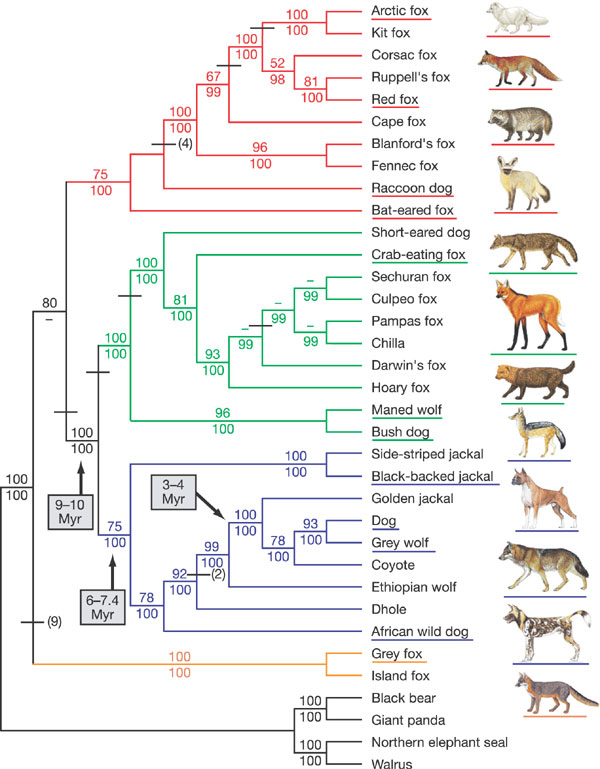
Any time we are dealing with the genus Urocyon we must remember that we are looking at a living fossil. Both species in the genus represent what is generally believed to the be one of the oldest– if not the oldest– extant form of wild dog. They have many primitive traits, not the least of which is their ability to climb trees almost as well as any cat.
I should also note here that the island fox is thought of as a separate species from the more common gray fox for some rather interesting reasons. It has not been reproductively isolated from the mainland very long. Indeed, they can still crossbreed, and it was recently found that the island fox has nearly identical mtDNA sequences with the gray foxes of Southern California.
Its status as a full species bothers me a bit.
This is particularly true, when you understand that I am adamant that dogs and wolves represent a single species. The differences between an island fox and a gray fox are nothing compared to the differences between a chihuahua and an arctic wolf.
Dogs and wolves separated a long time ago– much longer than the paltry 10,000 years that exists between mainland gray and island foxes. The original mtDNA studies found that they separated over 100,000 years ago. Current consensus now says that this happened anywhere from 15,000 to 40,000 years ago. That’s still alonger than island foxes have been separated from their mainland cousins.
This gets even more interesting. If one takes into account how widely distributed the mainland gray fox and how variable it is in appearance, then one could see that there might be room to count the island gray fox as a subspecies.
Keep in mind that the gray fox is very widely distributed. Its range includes areas in Canada very close to the US border, and from there, its range extends south through Mexico and Central America to Colombia and Venezuela. Most people are unaware of the gray fox’s wide distribution.
And throughout its range it varies in appearance. The smallest individuals are half the size the largest ones.
So one could theoretically put the island fox within the same species as the gray fox. It would fit nicely with the diversity that exists within that much more common species.
However, it is also useful to understand the island fox as a species. It has a very different lifestyle than virtually all of its mainland cousins. It lives on an island where it is the largest mammalian predator. It has evolved without significant predation as a selective pressure on its behavior.
Behaviorally and ecologically, it is quite unique.
And thus, I am still conflicted about how I would classify this animal.





[…] It’s an island fox. […]
You really tend to overthink the whole species separation thing. There’s aren’t really any hard-and-fast rules that always apply. You said yourself that they’re behaviorally and ecologically unique. I say they’re ‘different enough’ to be separate species. Let’s just call them that.
Then again, I also think dogs and wolves should be considered totally different species.
But they can crossbreed.
If you took a regular gray fox and turned it loose on one of the islands, it would breed and produce fertile offspring.
The dog wolf thing doesn’t work for me.
What happens when you get a doggish wolf or a wolfish dog?
It’s theme and variation on the same organism.
Species can be diverse.
That ours is not in terms of genetic diversity doesn’t mean that others aren’t.
C. lupus is a diverse species.
As is Urocyon cinereoargenteus.
And mtDNA, although useful, is not the final story.
See the whole “dogs come from southern China 16,000 years ago” debacle.
As quoted within the paper “None of the island genotypes are found in our sample of mainland foxes and all island genotypes share a unique restriction site for Hha I.” This quote refers to the mtDNA. Five mtDNA genotypes unique to the island fox is significant. That combined with morphological differences make it difficult to argue against species status.
Oops. I put the old paper on there.
There is another one that I was looking at at the same time.
I read that again.
I guess you’re right.
However, 10,000 years of separation is not enough to make a species.
Intense selection from extreme geological isolation could very well make a species in 10,000 years. But again, that’s probably more of an opinion.
It depends on your generations.
If it’s a fruitfly or a mouse, yes.
But something that has a slower reproductive cycle– perhaps not.
And you have to be careful with the genetic stuff.
Remember Przewalski’s horse is now considered the same species as the one we ride, even though it has a different chromosome number.
The nuclear DNA studies on dogs and wolves show such tiny amounts of variation between the two that it’s almost a joke to consider them separate species.
Remember, we are a genetically depauperate species. 1. We’re not that old as a species. 2. The Toba Catastrophe.
Although the multiregional hypothesis has been rejected (mostly) for our origins, I don’t know why it’s never considered for other species. I think there is a good chance that wolves are derived from several ancestral species of ancestral Canis, which is one reason why we get screwy things like Indian wolves, Eastern North American wolves, and Himalayan wolves with unique mtDNA sequences.
I am trying to come up with a hard and fast rule on species. Ernst Mayr doesn’t help me.
The difference between dogs and wolves is obvious. We have different laws for them; one is clearly domesticated, one isn’t; one is found overwhelmingly in the wild, one is found overwhelmingly in association with humans. One shows different set of behaviors than the other. The fact that there is some crossbreeding on the edges doesn’t mean much. I don’t think it’s a joke at all to consider these two distinct groups as, well, two distinct groups.
It’s not at the margins. There is extensive gene flow between the two populations– that’s one of the findings from genome-wide analysis– and there has been throughout their history. This isn’t like coyotes and dogs, which very rarely do this. Black wolves and wolves with hind dewclaws are all the result of interbreeding with dogs.
Calling wolves and dogs separate species makes as much sense as calling Eurasian wild boars and Large white “Yorkshire” hogs separate species. There are differences. It’s just that with dogs and wolves there is ton of cultural baggage associated with both.
I think it’s silly.
Because if you look at the DNA, there’s no way you could call them separate species. The nuclear DNA is unbelievably close. All dogs have C. lupus DNA, whether we like to admit it or not.
http://www.nature.com/hdy/journal/v103/n6/full/hdy200977a.html
I’m really not seeing the “extensive gene flow”. Dogs and wolves have overlapped territory for thousands of years now, yet remain two distinct groups. They’re undeniably related, but occasional gene transfer doesn’t mean much *in this case*. Nor does it matter *in this case* that their DNA is so similar. Behavior, habitat/geography (by which I mean, association with humans), and morphology are enough to call them separate species, IMHO.
So by that logic, golden retrievers and pekingeses have been separate for 1,000’s of years and are very distinct morphologically. So I guess they make fine species.
No only that, they can’t interbreed without human intervention!
Which is more than I can say if you took a golden bitch in heat and put her with a male wolf.
You’d get some ugly puppies.
Remember, I’m putting this within the context of how diverse C. lupus is and how diverse it once was. There are major differences between wild wolf subspecies.
Yes. There has always been a gene flow between dogs and wolves. It doesn’t happen here anymore, because wolves live in places where there are few people. In Europe, it’s a different story– especially Romania.
Why is it that domestic pigs and Eurasian wild boar are the same species now? Why is the Przewalski’s horse the same species as the domestic horse?
If those are the same species, then dogs are C. lupus.
End of story.
Which is why there is strong precedence for a difference in definition “domestic breeds” and “species”. Human “artificial” selection is considered differently from “natural” selection (which can also, confusingly, be caused unintentionally by humans).
Domestication by definition equals some kind of break from wild ancestors. Morphological and behavioral, if nothing else.
I would make the same argument for Przewalski’s horse and domestic rats (which, though domesticated, are still considered the same species as their wild cousins). At the least, they need to be a subspecies.
What about domestic pigs and Eurasian wild boar?
Go through my search function on this blog for stories of Native American dogs screwing wolves.
When you realize that every black wolf has a dog ancestor, I don’t know how you could think otherwise.
When I look at a wolf from Western Canada, I see a dog.
I see different dog breed.
This one has been selectively breed to be very strong and tough. It can kill moose and drive grizzly bears off its kills.
It’s also been selected to be very emotionally reactive and nervous.
I don’t see how its differences are any more extreme than the differences between domestic dog breeds or between other wolf subspecies.
I see uniqueness, but I see it as part of theme and variation on the same wonderfully diverse organism.
Splitting to me is just asking for trouble. That leads to bad conservation decisions, like killing off a major line of Mexican wolves because they started developing dog-like characteristics from being bred in captivity, not through hybridization.
Also I think coyotes, Ethiopian wolves, C. lupus, and golden jackals are all separate species. They can all hybridize and produce fertile offspring, but they have been on separate tracks of evolution for at least a million years.
I have a harder time accepting that the following subspecies of C. lupus are separate species: 1. familiaris. 2. lycaon. 3. pallipes. 4. himalayensis. 5. rufus. 6. dingo. 7. hallstromi (if you count that as a full subspecies and not part of dingo).
But there are people who would split all of those into separate species.
But if you’re just using behavior and looks, then pekes are a separate species from golden retrievers. They behave and look as differently any mammals. In fact, they don’t even look like they belong in the same order.
But it’s not *useful* to classify pekes and GR as separate species. There is clear precedence for all forms/breeds of a domestic animal to fall under the same species, whether they could mate naturally or not.
Speciation is an ongoing and fluid process. By definition, there are no hard rules. When it comes down to difficult cases or gray ares, scientists have to step back and consider the overall *usefulness* of lumping or splitting comes in.
Or they choose to split so that they can name a “new” species after their drinking buddy or favorite professor. There’s plenty of precedence for that, too. *G*
This is a fox, not a dog. They are of a different genus (urocyon) from dogs (canis), never mind species.
Yes, foxes can appear dog-like, and so can some cats. Doesn’t make ‘em dogs.