
Ch Toveri Arvokas owned by Mrs Joan Bateman. Photo credit by Saanse.
This dog is a Finnish spitz.
It is a technically a bird dog. The dogs are famous for flushing grouse and capercaillie into trees,and barking like mad to alert hunters to their location.
However, it can be used in the same fashion as the elkhounds of Norway and Sweden, the bear dog of Karelia, and the hunting laikas of Russia. These dogs can be used to hunt moose (elk) and bears.
As I have mentioned before, Norwegian elkhounds are used to hunt all sorts of things in West Virginia. They can flush grouse and tree squirrels. In some areas, they have a very good reputation as all around hunting dogs.
It is from this analogy that I understand what this breed’s original purpose was.
I have no clue as to whether Finnish spitzes are related to the elkhounds, but they do share some traits. One of these is the very strong selection for barking.
In fact, I can see some similarities in build between this breed and the black Norwegian elkhound, which contrary to some comments on this blog is a different breed from the gray. There are black gray elkhounds, but when I am talking about the black elkhound, I’m talking about the more slightly built and shorter-haired breed.
I’d like to know if anyone has looked into the history of this breed as a part of the elkhound family. I do know that red coloration sometimes pops up in gray Norwegian elkhounds, but they are sabled with black masks.
If anyone has any info here, I’d greatly appreciate it.
Maybe I’m incorrectly classifying here, but I think I’m onto something.
And no, please don’t give me FCI classifications.
Give me hard historical data.





[…] Finnish spitz. Possibly related posts: (automatically generated)Identify the dog breedIdentify the Dog BreedDog sitting tomorrowNo Title […]
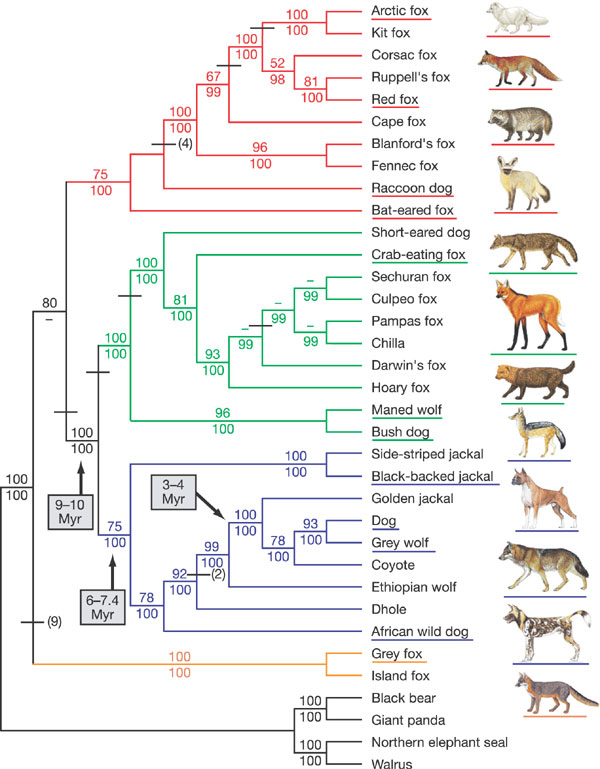
theoretically, the Finnish spitz clades mtDNA haplotypes that are identical or one mutational step from the Basenji. Source: Savolainen et al., 2002b; *Vila et al., 1997. The article I came across included Buhund,Finnish lapphund,Finnish spitz, Icelandic sheepdog,Norrbottenspets, & Norwegian elkhound together based on MTDNA. So yes, related. Another site had a pretty good chart showing some specific dogs and put them in subclade B1 – again with Icelandic sheepdogs and Russian Liakas. And incidentally, with my own breed, Belgian Sheepdogs (they list them as Groenendael in the chart).
mbe.oxfordjournals.org/content/vol0/…/mbe-09-0236-File002_msp195.xls
This one found Norwegian Elkhounds to be less related than the Icelandic sheepdogs. Note that they found a Finnish spitz that claded with the Ds as well which put it in with the Jamthund. And another in group A.
One has to be careful making absolutes. While a CORE group or “the majority” of a breed may trace to one clade/ancestry, this is not the same thing as saying they all do. One of the things I find facinating is the assertion about “recent interbreeding with wolves with Nordic dogs” yet I haven’t seen a single study on the W6/D6 MTDNA group which are identical dogs/wolves and surely ALSO indicate a recent interbreeding (of course, one does have to ask, “which way?” although it does seem to be that it was a wolf bitch used for dogs rather than the reverse).
Vr, Peggy Richter
Well before 1906 all these kinds of dogs regardles of size and color where registered as nordic spitz and that is how
all the experts of I have read wiews them; Jämthund ,buhund,norrbottens spets,finsk spets,västegöta spets,vit älghund,hällefors hund ,hede hund, lundehund
and finish spitz are all related.
There are hunters using both the finnish spitz and it´s swedish sibbling breed for moos hunting…
Here is what the breed’s club in Finland says about the breed in it’s history section (written by Matti Joenpolvi):
Finnish Spitz is a breed whose exact origin is unknown. It is not known how or when exactly did the breed with it’s specific features known today evolve. The first written datum about these dogs are from 19th century, by French expeditionist de la Martiniere, who writes about dark red dogs found in the north, and before him, Wilhelm von Wright, who says there are barking bird dogs that look a lot like foxes. It is presumed, that the dogs first came north with the Finno-Ugric people, who moved north from their home along the river Volga. They had gotten their dogs from the related and neighbouring people (linguistic data is said to support this), and during their travel across Europe the dogs mixed with German and Baltic dogs. The dogs also transformed with the changing terrain, they became smaller and concentrated on tracking, finding the prey and informing the hunter, instead of killing the prey, as they had done before in more open landscape, where the prey was not so scarce.
The history of Finnish Spitz on Finnish ground is thought to begin around 100 AC. Now, before the Finno-Ugric people came along, the Sami people lived in Finland, and some of the “new” dogs mixed with their dogs. The dogs that moved further north to the “wilderness” remained purer (more inbred that is, I presume :D). The breed did not mix with wild wolves. This dog was used by pelt hunters (who used bows), but later, with the spread of fire guns to the common hunters, these dogs became more popular. The hunting for birds is a recent thing, from mid 20th century, because before that the hunters caught birds by using traps. In 1889 The Finnish Kennel Club was found, and it’s mission was to survey and improve the use of the Finnish “barking bird dog” and Finnish hounds. By 1897 the breed was already known by the name suomenpystykorva, Finnish spitz.
So this is what the Club’s site has to affor. And also the “mad barking” is not meant just for informing the hunter, it is also for confusing or luring the prey to stay still in that tree (and not to pay attention to the aproaching hunter).
That’s interesting.
My grandpa used Norwegian Elkhounds to hunt grouse in West Virginia, and they did exactly the same behavior.
However, it’s not considered sporting to shoot birds out of trees here.
He also used a chihuahua for this same purpose.
One of the tenants in my apartment complex have the Finnish spitz. Very interesting. I will have to ask her about the history of the breed.
When I found out the temperament is very much similar to a Shiba Inu, suddenly it became a turn-off for me since I grew up with a Shiba– you know the kind of dog that would go romping off in the bush, be missing for days, then come back on its own accord when it has gone hungry or thirsty. Great dog, just not something I want to own in middle of the Greater Vancouver Metro.