“Basing dog training on a misunderstanding of wolf behavior is as useful as basing human education on a misunderstanding of chimpanzee behavior.”
Couldn’t have said it better myself!


 | retrieverman on Rottweilers are not bulld… |
 | Earth Whisperer Cons… on World’s most notorious I… |
 | Jen Robinson on Rottweilers are not bulld… |
| Nuthatch working at… on Bird buffet | |
| retrieverman on Rottweilers are not bulld… |





Many things I’m entirely on board with Dunbar on, but not this one.
For one thing, dogs ARE wolves. Sorry, Ian, but saying it ain’t so doesn’t make fact. Dogs are at the VERY most conservative a subspecies, and given that the behavioral differences that prevent them from freely interbreeding are purely the result of human intervention we could honestly and easily say that they are not even a subspecies.
I am also not sure how much time Ian has spent in large, long-term pack situations with dogs. I know he’s observed a great deal, but his concern is with dog-human interactions. If you put dogs together for a very long time in a stable grouping, they stop doing those big broad slow gestures – they move from the kind of behavior that you as a human associate with cocktail parties of complete strangers (HELLO. HOW ARE YOU. MY NAME IS) to the kind of communication you as a human have with your friend of fifteen or twenty years. Your best friend can come in the door and a hand flick means “Oh my goodness, the day I have had – no, don’t touch me, just get me a coke and turn on the TV.” Same thing with dogs. Everything speeds up and becomes substantially more wolf-like.
And, honestly, even if he WERE right (which he’s not, not about this) if you came to the planet as some kind of insectoid alien, something that had no idea how any living earth beings communicated, you could learn a whole heck of a lot about humans by watching chimps. You’d learn all about frontal contact, about food negotiations, about pairing and parenting, about play, about sleep patterns, family groupings, behaviors in the face of threats, affectionate touching, etc. All of those things are very, very consistent between humans and the big apes.
The problem most people have with dogs is that they know absolutely nothing about what’s normal. Everything they label as good or bad, acceptable or unacceptable, lines up with how closely the dog behaves to a human. Treating the dog like a wolf is so enormous a step in the right direction that the minor differences, like the extended adolescence and facial searching of the dog, can easily be made up at the end.
Dunbar has an ax to grind with Millan. He gets really mad and writes ranty stuff like that not because it’s correct but because he’s reacting against something that ticks him off. I respect his right to rant at will, but you need to distinguish between him trying to make an anti-Millan statement and him actually saying something measured and accurate about dogs.
LOL
I agree with you on something.
Dogs are wolves.
The rest, not so much.
I think you’ve mostly missed the point.
Even if dogs were identical to wolves (which they’re not), Milan’s ‘methods’ are mostly based off a misunderstanding of wolf behavior. By Milan’s own internal logic, he’s doing it wrong.
Did you even read past Dunbar’s first paragraph?
Yep.
That’s what he’s saying.
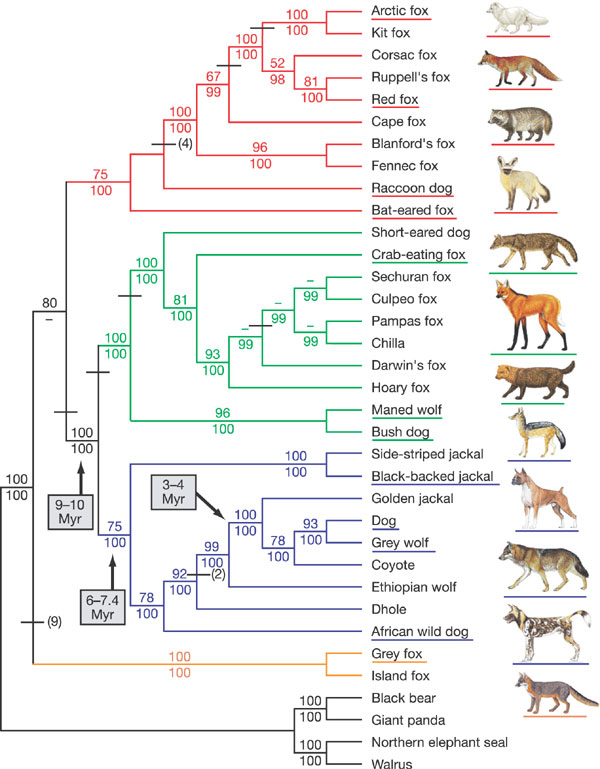
However, dogs are wolves in that they are both part of a diverse and marvelous species called Canis lupus.
Dogs are not wolves in that they are not specialized big game hunters, like the wolves everyone thinks of.
They are much more similar to the southern clade of wolves and the archaic wolves of Eurasia before they specialized into hunters of bison, horses, and other large ungulates.
I’ll buy your “they’re part of a diverse and marvelous species called Canis lupus”. Flexible phenotype, blah, blah, blah.
Unfortunately, what I see way too often that annoys the crap out of me is that when people say “dogs are wolves” they mean identical to, not similar to. (A variation on the “natural is always better!” argument.)
There is no practical reason to think that, or to espouse it as a philosophy. You shouldn’t be feeding your pug only fresh venison and have him sleep in an outdoor den.
The fallacy has a name:
http://en.wikipedia.org/wiki/Appeal_to_nature
Good heavens, of COURSE you should be feeding your pug fresh venison. Fabulous. You may find it convenient to also feed him other stuff, because they have to consume massive amounts of venison to keep weight on, but I’ve fed fresh venison to dogs for ten years.
And if your pug is identical to a wolf, does that mean an outdoor pen? Do wolves naturally live in an outdoor pen situation? Of course not. Wolves seek out the same kind of soft surfaces and temperature ranges that a pug does; they sleep about the same amount during the day that a pug does; if you brought them inside a house they would sleep on the couch just like a pug. Bring a sheep inside the house and, no matter how tame, it’s going to be looking for entirely different things to satisfy its brain. The drives and likes and dislikes of a wolf and a dog in every “what is pleasurable, what is painful” situation are going to be just about identical.
What WOULD be lovely about a big outdoor pen for a pug is that it could finally get the exercise it desperately needs and virtually no pug owners give, so I’d be fine with a pug in an outdoor pen for a good eight hours a day, with access to the pack and leisure during the heat of the day and during the sleep cycle. That’s very “wolf.”
I don’t know what practical difference, in this conversation, whether dogs are North American wolves or Asian wolves makes, but dogs are very happy to hunt large ungulates if they’re big enough to do so, and they hunt them very specifically and very successfully. Two of my Danes once took down a full-grown whitetail and killed him instantly. Dogs are one of the most effective and most damaging predators of the large ungulates in current farming situations too. They’ll also hunt a whole bunch of other things, just like wolves, but their hunting behaviors in no way exclude them as successful ungulate predators.
Dunbar has shown again and again, and has SAID again and again, that when he looks at what Millan does he sees bullying and intimidation. The problem with that is, as with most training decisions that infuriate people to the point of writing post after post after post on it, he doesn’t understand it and doesn’t have any desire to understand it. Millan doesn’t walk up to a dog and say “Hello; let me talk to you about my beliefs in pack structure.” Nor did he hone any of his techniques by watching wolves. Everything he does is dog-like.
He comes up to a dog and presents an incredibly consistent set of physical cues and responses that are very, VERY doggish. Ninety percent of his work is done before he even touches the dog because every dog sees him as relaxing and stable and dependable. I’ve never EVER seen Millan do anything I would define as bullying; what I’ve seen him do is interact with dogs the way established and strong packs do.
If I go put an obnoxious and undisciplined dog in my yard, my dogs will fix him. It happens pretty quickly and it involves the same kind of things Millan does – crowding into a corner, insisting that the dog remain still, poking and pressure behind the ribcage, and (if the dog objects to that) attacking the dog with inhibited mouths until the dog lies down and relaxes and then they stand on him. When he shuts up and stops it, they let him up, greet him, wag tails, etc. They’ll continue to discipline him very pointedly for every infraction until he knows how to behave consistently. Everything that Cesar does looks extremely familiar to me.
Dunbar doesn’t see anything familiar. He doesn’t understand it, doesn’t sympathize with it, and he has always gotten his results in a different way – by appealing to a different side of the dog brain. That makes him a different kind of trainer, but I think he way oversteps when he labels what he doesn’t understand as bullying and intimidation.
Millan’s long-term dogs are gloriously happy, relaxed, enthusiastic, eager learners. Their body language is consistently soft, open, confident, loose. That applies to the ones that came because they were uncontrollable fear cases too – do you really think if all he did was bully and intimidate he could fix so many fearful dogs?
Dunbar doesn’t look at those dogs, or if he does he dismisses what he sees. Because he’s decided the methods are invalid he hears Millan tell owners that the dog is being dominant (in many cases, absolutely true) and that word just sets him off. But he’s not LISTENING. Millan doesn’t sit there and give owners a treatise on how wolf family groups work; he says dogs in a power vacuum, who think their owners are unpredictable and unstable, are miserable. They have no one to depend on or trust and so they try to put things in order around them using whatever methods they can come up with.
When Dunbar says “train an incompatible behavior” he’s making a dominance statement. The way the dog learned to associate the word “sit” with a sit may have been a cookie; the REASON the dog will assent to sit when the doorbell rings is because they trust you to be in charge. Dunbar has so many issues with the word “dominance” that he can’t see that, but it’s true. There are hundreds of thousands of dog owners who can get a gorgeous sit – heck, there are hundreds of owners who have put UDs on their animals – but whose dogs still go attack the door when somebody knocks. The dog has the vocabulary, but still thinks he’s got to meet the threats. Until you show him – and it’s not training – that you are the one who can be trusted to meet the threats, you may have a gorgeously trained dog but it won’t be a happy dog. I’ve stood beside too many Open and Utility rings watching dogs make whale eyes and shake with fear (or anger) while their owner was stuffing cookies in its mouth to think that the mere training does a single thing.
When I have been where I get the National Geographic channel, and have watched some of Cesar Milan’s TV shows, I think of the advice I once got on ferrets who bite.
Many ferrets bite. And some of them ‘lock ‘ their jaws – they bite and hang on; you have to pry their jaws open to remove your finger.
Never put a ferret down your pant leg. By nature ferretrs go down rabbit tunnels (much like a pant leg) and while there, latch onto a rabbit in the dark, so . . .
So many people ask “How do I teach my ferret not to bite”?
Ferrets don’t learn well by punishment. In the wild, they hunt animals much bigger than themselves. But some ferret books still advise teaching a ferret not to bite by thumping his on the nose when he bites.
My observation is that this method teaches the ferret owner how to pay attention to the ferret, react quickly with their hands, and how to handle the ferret wisely so not to get bit – the ferret learns nothing.
Ferrets do learn very quickly by well timed rewards – they make dogs look like idiots. Ferrets learn quickly, and they are clever too.
I once bought a grown, not house trained ferret at a carport sale. I put her in the bathroom with a litter box – she pooped on the floor and slept in the litter box.
So I bought a nice at cat post with a sleeping hole in it, and fixed it up so that she slept there, not in the litter box.
I moved her poop into the litter box – but she still pooped on the floor.
One day, I went into the bathroom, she had been asleep, and like most ferrets had to poop as soon as she woke up – so I put her in the litter box and held my hands up so she couldn’t jump out until she pooped.
Then as she was backing into the corner to poop, as she threw her tail over her back, I handed her her favorite treat coated with her favorite oil.
After that one training, she ran and used the litter box everytime I went into the bathroom!
But there was still ferret poop on the floor by the door.
She couldn’t be pooping that much could she? Must be one of the other ferrets pooping by the door?
No. She was faking going poo.
She had learned to back in the corner and throw her tail over her back for a treat. That way she still got to poo where SHE thought poo should go – at the edge of her territory – by the door.
But she did understand that I wanted her to poo for a treat – as soon as I refused to give her the treat for faking it, she actually used the corner of the litter box for pooping – so long as I was there with a treat.
So some ferret books advise using a ferrets trainablity and great problem solving to train a ferret not to bite.
They advise giving the ferret a treat for not biting.
This just has never worked for me. No matter how smart the ferret, and how good the treat, there doesn’t seem to be a way to communicate to the ferret “This treat is for not biting.”
In the end, this training method, again, trains the handler how to handle the ferret without getting bitten, the ferret still bites, as turning your attention away for a moment or handing the ferret to someone else will display.
So what was the only useful advice on a biting ferret? “Get rid of it, and get a good ferret that doesn’t bite”.
Oh is retrievermans blog going to get comments on this one?
Yup, I watch Milan, and I think “Why don’t these owners just get a good dog?”
http://www.dogstardaily.com/training/social-hierarchies
LOL.
Now, I know you caught the date on that.
I believe that study came from the 1970’s.
You’ll note that I’m not promoting it as cutting edge.
I actually don’t think anyone can make great big broad generalizations about dog or wolf behavior.
It’s like “Wolves never attack people.”
Except when they do.
That was in answer to whether Dunbar had any long term observations of a dog ‘pack.’
You have to read the last paragraph.
It’s a good study. I have dogs that act exactly like that. Of course not everyone has multiple related generations of dogs in their house. There are breed differences as well (Scott and Fuller, which almost always puts me to sleep, have some interesting observations about that.)
It seems the social structures dogs form are much more culturally determined. I think that’s what Dunbar is trying to describe here.
When I was growing up, we have three female dogs. Two females shared leadership over the other, who was a golden retriever suffering from an inbreeding depression.
That’s still an interesting study.
Could part of the problem be that when most people hear “Dogs are wolves.”, they don’t so much mis-understand dogs, as they mis-understand wolves.
IF wolves were big nasty beast that eat children and attack women, then how could dear little Muffy and faithful Max be wolves?
But you know that a main tool of oppression and violence has been the war mastiff and the heavy greyhound (the lebrel, as the Spanish called).
I guarantee you that they have killed more people than the wolves have.
Wolves bred without us deciding things for them. We can’t control them, but we like to think we have absolute control over dogs.
So wolves and dogs must be different.
They are different, but the differences are within a tapestry of different tendencies and phenotypes.
Have you read about the buffalo wolves? Not timber wolves, not arctic wolves, but wolves that lived on the praires and hunted buffalo?
They were said to be large and the color of buffalo, except one thing that I read said that they were grey.
Supposedly, like grizzly bears are more dangerous than black bears, the buffalo wolves did attack grown humans, and the plains Indians feared them.
Wheather they were really wiped out by white men with guns, or by imported dog diseases, I don’t know.
There was a guy, long ago who claimed to have caught “the last buffalo wolf”, at a time that they were already said to be extinct.
He is said to have sold it to a retired doctor in Kent Pennsylvania. She was said to have been pregnant, but he killed the cubs, as “nobody would want them” – which would probably be about true at that time.
Be she was said to have been grey. i
I vaguely recall a painting of a wolf pack hunting buffalo and the wolves were brown.
Google doesn’t seem to understand “labrel” as a dog. I have not heard of this.
Someone did once tell me that Christobal Colon brought mastiffs with him, and for sport, he sicked them on native peoples he found in the Caribbean islands.
LOL:
http://awkwardfamilypetphotos.com/2010/09/02/behind-the-awkwardness-big-bad-wolf/
dunbar is wrong — dogs ARE wolves. You get cultural variation in humans, there’s no reason why there won’t be cultural variation in domesticated, modified wolves managed and controlled by humans. Dunbar is right: social behavior does NOT equal training.
When a young wolf makes an error in hunting a rabbit or elk, it’s parents don’t do the “alpha roll, stand over growl routine”. If the wolf makes a mistake that gets it too close to the defense equipment, it gets kicked, stomped or tossed BY THE ELK. Then it’s “over”. Moreover, some wolf packs are more “domineering” than others. It’s a little like small countries or city/states. Some allow freedom, some are run by tyrants.
Milan’s method assumes that all dog/human relations depend on the human being a tyrant like Idi Amin or master/slave. Dunbar is more on the order of human /dog relations being like kindergarden teachers and their students.
Dunbar’s methods don’t work with the most difficult cases of canine misbehavior that exist despite careful education. Milan’s method screws many dogs that are simply poorly educated.
For myself, I tend to feel that some dogs work well with the kindergarden teacher. Some seem to need the “strict schoolmaster” and some do well with a fair but strict drill sergeant. In none of those is the dog given “free choice”, but in none can the disapline be either excessive or unfair. And you have to show the dog what you want before you can demand it. As a herding person I rather like the sergeant image because eventually, that sergeant may have to depend on those “grunts” to save his life and to work as a unit, not a master/slave.
Peggy Richter
I think you hit the nail on the head with your last paragraph – training DOGS comes from experience with DOGS.
We can study wild and captive wolves all day long, but even if we had perfect data on exactly how any wolf would react in any situation with ANOTHER WOLF, at the end of the day, we’re humans interacting with dogs in an (for lack of a better term) ‘unnatural’ modern environment. It seems like people (like Milan) who focus too much on “what would a wolf do in this situation?” tend to ignore the needs and signals of an individual dog if it doesn’t fit the mold of an often imaginary version of ‘wolf’. (Alpha rolling blind terriers comes to mind…)
I don’t know if he has(?), but the way Ian dunbar writes(and I DO like most of the guy’s stuff), it seems he has spent little time with wolves–but I really don’t know. Different people focus on different things–like the anti-evolution video rant posted earlier, where the narrator sees NO similarities between animals of ANY kind, and humans! I have kept dogs of all types, and wolf hybrids of varying percentages(high to low percents) and been around quite a few captive wolves, both in the pet and zoo scenarios, as well as spending a lifetime studying anything I can on the subjects. And experience with other wild dogs–African wild dogs, various foxes, and coyotes. And to me, dogs and Gray Wolves(Timber wolves, er whatever you want to call this species) are VERY similar in most basic behaviours. Are they exactly the same? Well, no, thousands of years of domestication has indeed wrought changes, as it has on ALL domestic animals(as it has on Jungle Fowl and domestic chickens, or domestic cats and African Wildcats, or a zillion other examples–BUT, ALL these animals STILL SHARE characteristics in common with their wild ancestors–this is basic common sense!). All wolves are unique individuals, as are all dogs. Different breeds have retained more or less of their ancestral “wolfy” characteristics, physically AND behaviourally–the Pugs mentioned being much more altered in this way than Huskies, for example(again–common sense). Cookie-Cutter traing for ANY animal is never a good idea–sometimes Milan’s methods work well on some dogs–other times Dunbar’s are best–depends on the dog, depends on the situation. And sorry Mr. Dunbar, dominance hierarchies are a fact of life–you have to be BLIND not to recognize this. SURE, wolf packs are usually(though there are certainly exceptions to this rule!) families made up of parents and growing or grown pups, but SOMEONE IS STILL THE BOSS, and it is invariably the Alpha pair! They decide who does what when, just as human parents do(or SHOULD! Gosh, how many public scenarios have I witnessed when I wanted to tell inept parents to BE THE MOMMY!–OR DADDY!)–dominance does not necessarily have to be automatically aligned with bullying and DOMINEERING attitudes(DOMINEERING–DOMINANCE–two entirely different words!!!!!). The human/dog relationship still requires the human to be the pack leader–that’s just the way our human dominated society works. It doesn’t mean you have to be cruel or abusive or tyrannical, but if you ain’t the boss, you WILL HAVE PROBLEMS! Who is deciding when to walk(and where), when to eat, when to sleep, who not to attack or chase, where to poop and pee–if it is the dog, then the relationship will 9 times out of 10, fail or be miserable(or brutally short–as your dog will likely get killed)–that doesn’t mean you can’t let your dog be a dog(or a wolf!), but it has to be at the human’s discretion, or tradgedy will occur! Take it from an old and (hopefully) wise pack leader! It is BEST for the human to be DOMINANT, but you can be kindly, benevolently, and patiently dominant!
What I’ve noticed with free-roaming dogs in West Virginia is that the dogs who actually led tended to be those that were a lot smarter than the rest or were a lot more sure of how things would be.
That’s what the actual hierarchies are.
And it makes sense for a group to rely upon its most intelligent members.
Usually intelligence coincided with age.
And I know I’m smarter and older than any dog I’ll own.
I hope, anyway.
Someone I knew use to say: To train a dog, you need 3 things: a dog, a leash, more brains than the dog.
Leadership is not the same thing as being a boss.
Bosses push from the rear, leaders – well they get out in front and lead!
I remember a nature show that use to be on around supper time.
It showed migrating animals (wild sheep of some type, I think) . Like most herds, it was made up of a family of females and their young, with one big male – in a position which changed hands (or hooves) each year or so.
The leader was always an old female who remembered the migration route. The male was a warrior who fought off other males, he followed behind the migrating herd of females.
I remember a newspaper article about – I think they were bighorn sheep – these animals were reintroduced, but they weren’t doing well,
because they stayed in one spot and ate all the good grass – and then they wandered around that little area half starved trying to eat poor quality foods.
Lesson: animals have culture too.
The problem was solved by herding the bighorns south in the winter and then north again in the summer until they learned the route.
You probably remember this being done with migrating birds? There was some movie about a guy that did this with a goose, I think I read something about that in a review?
I did read about cranes, who were dieing out, so someone put the endangered eggs in nest of a similar but non-endangered crane speicies.
Sometimes fostering works, but sometimes it just doesn’t. The culture learned must match the underlying genetic traits.
Classic example would be a chicken egg hatched out by a duck.
Ducks lead their young to a pond to swim. Chicks don’t swim and don’t have waterproof feathers.
Ducklings hatched out by a hen, are said to swim, much to the distress of the hen, who believes her ‘chick’ must be drowning.
Dog have some inherited behavioral traits. I’m of the opinion that the type of training should match the type of dog.
Don’t mother hen a duckling, and don’t mother duck a chick.
My neighbor’s barn cat adopted a newly hatched orphaned duckling. Grew up into the most confused duck you ever met. But it did grow up. And ended up living a relatively long life.
Well, Retrieverman, that’s one of those scenarios where we as humans might misinterpret who is actually dominant in an animal group–just because everyone follows or defers to another does not automatically mean they are the submissive ones. I defer to my own dogs regularly–I know they interpret scents and sounds better than me, and sometimes their judgement of people or situations is light years ahead of mine–I try to be an open-minded leader. But in the end, I decide yay or nay(not always correctly!)–that makes me the dominant one in the relationship. Some dogs defer to others in the pack–often because they don’t really care about the outcome or consequences of something–but let it be something they are REALLY interested in, and then who IS REALLY dominant over who is very obvious indeed! We have two cougars that I care for at the N. C. Zoo–two neutered males–definetely an unnatural pairing! But they grew up together and are best buddies. The TRULY dominant one(and they do indeed have a hierarchy!) is VERY laid back and casual about most everything, and he is just not much food motivated at all. The other is hyper-nervous–he was rescued as a youngster from a warehouse in Detroit–locked in a crate and starving(we have numerous rescue animals here…), consequently, having almost starved to death, he if FOOD OBSESSED, and he regularly pushes the other cougar aside to snatch food treats from him, and the other cougar USUALLY lets him, because, well, he just really doesn’t care–not worth squabbling over. But boy howdy! Let it be a rare treat or toy this laid back cougar REALLY wants, and you see who is REALLY the boss–no question! Most people watching these guys would immediately misintepret who was dominant by what is usually seen, but you have to know them very well in a variety of circumstances to know for sure. Regardless there IS a dominance hierarchy that IS enforced in certain circumstances, as it is with any social(and not so social!) animals. Wolves nor dogs do not normally CONSTANTLY suppress or bully their packmates(with the occaisional exceptions that usually pay for their tyranny one day!!) or offspring–nonetheless, there IS a dominance hierarchy, recognized by everyone in the pack, except sometimes their human members who don’t like the idea of such basic behavioural realities. My wolf dogs who were kept in a pack of various other types of domestic dogs had no problem recognizing and communicating with the same body postures(tail, ears, hackles, stance, submissive rolls, etc.) and respecting and maintaining order in the process. Did roles change over time? Sure, just as they do in our own human society–but there is ALWAYS a pack hierarchy. Let your dogs dominate you out of some sense of human “fairness”, and you WILL have problems, or even tradgedy, just as you will if you try and let your 4-year old child run the household…….
How true Lane, old books use the word “dominance” when they really mean “winning at competition” – this is not the same as leadership.
It isn’t even the same as survivability.
Remembering the same nature show about the wild sheep that I mentioned above, it ended with the death of the big male in the winter,
saying that although he was the only male in that area to pass on his genes that year, he would die, as was usually the case for the boss ram,
because he had spend all his time and energy fighting the other rams instead of getting fat for winter.
How does one determine which dog/wolf is “dominate”?
In wolves, the wolves that breed and produce cubs?
But in dogs, the males often take turns, and the puppies can be sired by later breeding males as the female dog often breeds before the day of ovulation.
Perhaps the question itself is wrong? “Dominance” implies that one animal always chooses to compete and win,
As you pointed out with the pumas, they don’t always choose to compete.
And I have seen different dogs ‘win’ bones, sleeping spots, attention, whatevers, one time, while a different dog pushed harder another time.
And I once had a small dog who was NOT dominate – but learned to side with various other dogs to get what she wanted. So, with her help, a lesser dog could win over a more dominate one.
Perhaps the whole idea of watching wild animals with the intent to notice and record which animal is the dominate one, stems from the culture of dog fighting.
Have you seen old wild animal clips like what was inserted into Tarzan movies?
Lots of the old film clips are of wild animal fights – probably staged fights made to look natural – because how often can one just go to Africa and watch a leopard and a lionese fight?
Why the big deal over which animal is dominate? I believe it stems from the dog fighting culture. Remember that dog fighting was NOT illegal in many US states.
Rooster cockfights were only made illegal in New Mexico recently, and I think they are still legal in the country of Mexico.
Dog fighting and cockfighting are now illegal everywhere in the US, but game bred roosters, and game bred pit bulls are still forced to fight.
Wasting time on studying which animal is dominate bores me. Yes, in a zoo, you have to know the individual animals’ natures – but isn’t it just as important to know which animals are most accepting, which ones will welcome a new addition, as to know which animals are dominate?
Shouldn’t as much time be spent understanding which animals will share well, and which animals play well with others?
Isn’t it valuable to know not only which zebras are dominate, but also which of the dominate ones are also good at sharing, and which are tyrants?
Isn’t it nice to be able to say: “Oh that zebra, she will let newcomers in her pen, and she doesn’t care if others munch hay along side her”?
Isn’t that just as important to know as which one is dominate?
Same with pet dogs. I think PEOPLE get hung up on the dominance thing.
You have to be “dominant” to teach a puppy.
However, once he’s learned things, I’m much more willing to let him make some of his own decisions.
That’s actually how most normal working dogs were raised until both the radical behaviorists and the radical dominance theory people took over.
My grandpa used to train Norwegian elkhounds to tree squirrels and flush grouse.
How?
By taking them into the woods and letting them learn on their own.
If they ranged too far out, he went in the other direction and left them.
I think one needs to at least recognize the dominance hierarchy of any animals in one’s care, if at all possible. Understanding and respecting this will help enormously in helping animals get along. I try not to interfere with how my many dogs(and other critters) arrange themselves–so long as they don’t get too out of line! Human interferance involving aspects we may not fully understand can cause a lot of stress and disruption of pack order, or among any social grouping of animals. In some things, the human MUST be the boss(“NO, you MAY NOT run through those woods during deer season, although we run through them the rest of the year, otherwise, you will be SHOT!”–just one blatant example of WHY the human MUST be dominant in the final say, in a world dominated and so overrrun with humans. This is being the responsible leader/boss/alpha/parent, where dominance and compliance are a MUST, or else!). In regarding those sheep mentioned–the lead sheep that knew migration routes may NOT be the dominant animal–but make no mistake, those sheep have a hierarchy! Watch which ones are pushed away from food sources, or get the preferred sleeping spots, etc., and one will get a more accurate idea who is dominant over who. Despite my personal interest in and recognition of wolf and dog similarities in social hierarchies, and although these certainly can be valuable tools in understanding one’s dogs, and can work in practice if one is into that sort of thing(as I am–I whine to solicite sympathy, do “play bows” to get games started, growl convincingly to discourage certain behaviours, etc.), it certainly is NOT necessary. Dogs and wolves and all sorts of animals are plenty intelligent enough to learn human specific cues and behaviour and respond appropriately–they do it all the time even without conscience effort on our part! I mean, can you imagine trying to act like an elephant to an elephant? They might be bemused by such an effort on our part, but not any more likely to comply with our requests. That is the miraculous thing about animal training, that they listen, learn, and respond at all!
It seems to me that to dominate, one must prevale in a given situation.
The challenge can be verbal or psychological, and the challenge can be physical.
The “winner”, as determined by the one gaining the upper hand, or the one determining the outcome, does so more through strength of will.
Even when the challenger employs force, the test is decided by the contestant with the will to employ the most force. (Gile and wile not withstanding, these also, require will.)
It is interesting to me that there is no shortage of people challenging Milan’s technique for rehabilitating aggressive dogs. Generally, on the grounds of what constitutes the “proper training” of dogs.
Given that the one at the top of any pecking order sees no need to challenge any below it.