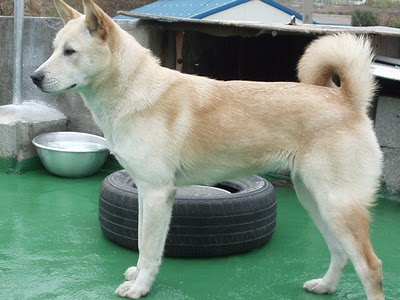
The Pungsan dog of North Korea is famed for its ability in hunting Amur tigers. It is more commonly used in hunting bears and wild boar.
According the North Korean government, the dogs are a cross between the East Asian spitz-type dog and the wolf that inhabits the Gamma Plateau.
I do not know if any genetic studies back up the wolf ancestry of this particular dog.
Most of these dogs are much lighter in color that this specimen. The photos I’ve seen have been of dogs that could easily be mistaken for white German shepherds or some unusually short-haired Samoyeds (Bjelkier, to my European readers).
Of course, one must have some skepticism about official breed histories.
And any official history about anything coming from North Korea must also be taken with a grain of salt.
Still, this could be another working breed with wolf ancestry– one that I had previously overlooked.
Quolls are sometimes called “native cats,” but a less common name for them that I think is more accurate is “marsupial martens.”
They are much more similar to the martens of Eurasia and North America than to any feline.
The tiger quoll is the only one that really approaches a house cat in size.
And it should be noted that it is not called a tiger quoll because it looks like a Bengal tiger. It is called a tiger quoll because it looks a bit like a miniature thylacine, which was known as the Tasmanian tiger.
Thlyacines were a wonderful example of convergent evolution.
It’s amazing how much their skulls resemble that of a placental wolf.
When Europeans colonized Australia, the only large predator on the mainland was the dingo, an animal derived from East Asian domestic dogs, which were derived from the placental wolf. Dingoes very strongly resemble certain subspecies of wolf, and they are currently recognized as a subspecies of wolf, Canis lupus dingo.
On Tasmania, there were no dingoes at all. Instead, there was this wolfish creature with stripes.
One would have thought that the two were related.
After all, they looked so much alike and lived in relative proximity to each other.
But evolution often produces similar animals from very different lineages. The closest relatives to the dingo are dogs and wolves. The closest relatives to the thylacine are the carnivorous marsupials. The two animals evolved to hunt relatively similar prey.
However, a study from 2007 found that although physically similar, the dingo is structurally much better equipped to attack large prey. It may have had more powerful bite, but the thylacine was forced to hunt mostly smaller prey.
When the dingo arrived in Australia around 4,000 years ago, the dingo could prey on all sorts of different animals, including the biggest kangaroos.
The dingoes were also pack hunters, which meant that they could more easily pursue larger prey.
It has been suggested that the natives of Australia were also regularly managing the land through burnings mean that there was less cover for the thylacine. The thylacine preferred to hunt in the dense forest, while the dingo was more at home hunting out in the open. This has been disputed, simply because aboriginal burning increases the number of species that inhabit the desert environment. The thylacine would have benefited from the burnings and would not have become so stressed that it would become extinct.
However, the dingo also had a complex relationship with the people– in the form of a kind of semi-domestication. That meant that the dingoes would benefit from the successes of humans.
The thylacine had none of these advantages. Humans would have been a major competitor for the thylacine for prey, and high densities of people would mean that the thylacine would have faced really intense competition from both people and dingoes. Such stresses could cause the thylacine to become extinct on the mainland.
It was forced to hunt smaller prey. It was a solitary hunter, and it had no beneficial relationship with people. Its hunting habitat was fragmented, and it simply could not compete with the dingo.
Because dingoes never made it to Tasmania, the thylacine was able to hold on for much longer.
I have never understood why people called this animal a Tasmanian tiger. It may be that it looked like a giant quoll, which are also called “native cats.” A big native cat might as well be a tiger, right?
However, it was soon the target of hunters in Tasmania, for it was widely believed to a great menace to sheep. Most the killings likely happened as the result of free roaming domestic dogs, but it was easier to blame the wild tiger than the tame dog. After all, if that 2007 study is correct, it is very unlikely that a thylacine would have risked so much to tangle with a sheep.
It is really a shame that the thylacine went extinct, because it was such a wonderful example of convergent evolution. Through the history of the earth, the doggish form has appeared several times. The earliest large hyenas actually looked more like dogs than modern hyenas do, and the Mesonychids looked a lot like wolves (in the case of Andrewsarchus mongoliensis, a very, very big wolf!).
It should not be a surprise that an animal similar to this form would pop up in the marsupial lineage. Mesonychids were actually related the even-toed ungulates and whales and were of no relationship to modern wolves or dogs at all.
Evolution does amazing things. Convergence is one of its most interesting aspects.