These are San Joaquin kit foxes, a critically endangered subspecies of the kit fox (Vulpes macrotis).
It is native to the San Joaquin Valley of California. There are about 7,000 of them left, which sounds like a large number.
However, the other subspecies of kit fox, the desert kit fox, is far more numerous. In the days before European settlement, there were hundreds of thousands of kit foxes in the Southwest and parts of Mexico.
The species itself is not endangered.
It’s just not as common as it once was.
Now, I recognize that this species is distinct from the swift fox (Vulpes velox), which has a more northerly and easterly range.
The two foxes hybridize in the wild and produce fertile offspring.
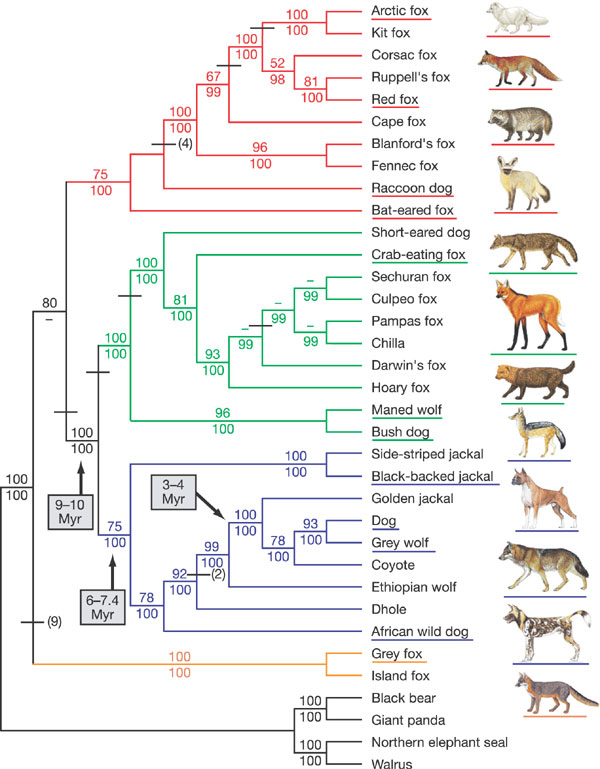
However, comparison of MtDNA from kit and swift foxes and the arctic fox found that there was as much difference between kit and swift foxes as exists between those two foxes and the arctic fox.
So is the arctic fox a swift fox, too? (Arctic foxes have since been moved from the genus Alopex and placed clearly within the genus Vulpes, where all the other true foxes are.)
The difference among these three foxes is far greater than exists between dogs and wolves.
And even if they can produce fertile hybrid offspring, we cannot say that they are the same species.
Wolves and coyotes are separate species because a distinct lineage exists between the two species. Coyotes represent a much older line of the genus Canis. The exact age is not known. But animals of the coyote type (Canis lepophagus in North America and Canis arnesis in Eurasia) have been around a lot longer than Canis lupus, which is derived from Canis mosbachensis.
That same thing can’t be said about wolves and dogs.
Dogs and wolves are very similar genetically and really don’t represent genetically distinct lineages– at least not in the same way.
So being able to interbreed and being able is not the only criteria for determining species.
That said, wolves and coyote have exchanged genes relatively extensively in North America.
And there is some evidence that humans have genes from other human species. (This finding is hotly, hotly contested, as you might imagine).
Species is a fun thing to fight over.
Taxonomy battles will never end!
***
How many species of giraffe are there?
If you can answer that, then you can then tell me what a Canis lupus is.
And while you’re at it, how many different species of orca exist?
Was the heath hen just an East Coast subspecies of greater prairie chicken?
Is a sharp-tailed grouse the third prairie chicken species? It’s in the same genus.
And while we’re on sharp-tailed grouse, why is it that prairie and plains subspecies live in the same region but don’t seem to interbreed? They also prefer entirely different habitats. Are they separate species?
Which cavy is the ancestor of the domestic guinea pig?
Try to answer these questions and you’ll see how complex this task really is.
Naming and classifying species is very difficult.
I think we better find some way to answer these questions.
After all, don’t we have an Endangered Species Act?
It’s there to conserve species.
But what is a species.
What animals are distinct enough to be called separate species?
The answer is complex– too complex for the law, which can be nebulous but not as nebulous as our concept of species.





Is there some hidden meaning in the title to this
blog entry?????
How?
Is it true bucks have been shining their horns this
week in Wv?
Deer have antlers, not horns.