Indigenous peoples of South America have often tamed crab-eating foxes.
This particular fox wound up going to a zoo as he matured.
Which is probably for the best.
However, from what I understand, those that the indigenous peoples kept very often returned to the wild when they reached sexual maturity, not unlike the dingoes Carl Lumholtz described.
I’ve read that the crab-eating fox is capable of producing infertile hybrid offspring with domestic dogs, but I have found no verified accounts– you know, that have a chromosome analysis.
So rumors of hybrids may just be nothing more than urban legends or a complete misidentification of the indigenous dogs of South America.
***
You’ll note that I call the offspring of this species a puppy, not a kit.
The reason is simple: a crab-eating fox, like all South American foxes, is not a true fox.
True foxes have kits.
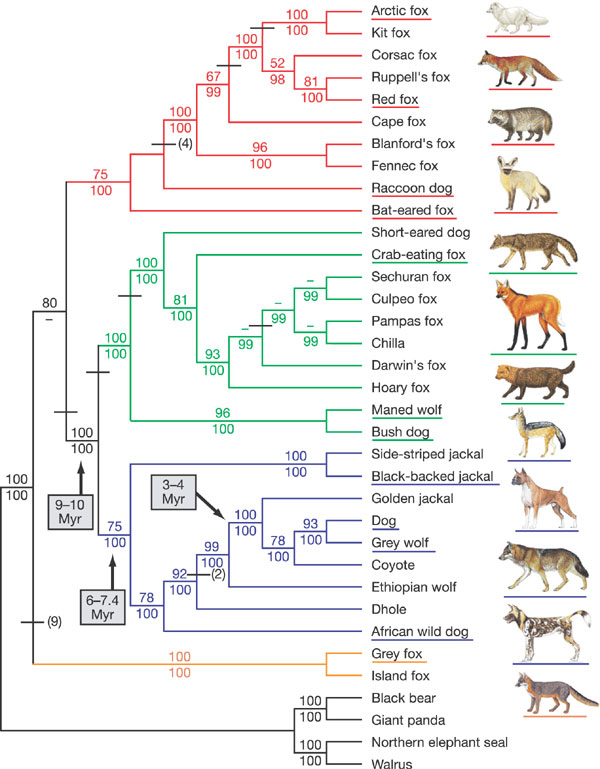
South American foxes (and all South American wild dogs, except the Urocyon gray foxes that live in Venezuela and Colombia) are much more closely related to the true dogs of the genus Canis and its allies, Lycaon and Cuon.
Those animals have puppies, so to reflect that evolutionary relationship, I suggest that we refer to the offspring of South American wild dogs in the same fashion.
The Linnaen names of some of the genera of South American wild dogs clearly reflect this relationship.
Most South American foxes are in the genus Lycalopex, a combination of the Greek words for wolf and fox– “Lycaon” and “Alopex.”
The crab-eating fox’s name is Cerdocyon thous. “Kerdo” also refers to a fox in Greek, and “cyon” refers to a dog. The genus name reflects the mixture of dog and fox characteristics in this animal, and thous is in reference to the old genus name for the jackals, Thos.
More interesting, though, is that all of these diverse South American dogs experienced much of their evolutionary history in North America.
North America used to have a great diversity of canid species, but these animals shifted south when the Isthmus of Panama formed.
With the exception of our two Urocyon foxes, all of North America’s wild canids are either in the genus Canis or the genus Vulpes, not unlike the majority of canids in the Old World.
South America’s diversity of canids is one of its more interesting features of its natural history.
Nowhere else in the world, except in domestic dogs, are there such diverse forms.
Where else are there bush dogs that are like dachshunds crossed with otters, maned wolves that look like red foxes on stilts, and short-eared dogs that are like nothing else on earth.
South American wild dogs are fascinating animals, just because they are so different from what we expect.





What color do you call this fox? I once had a mutt that color – even with the amberish ears – except my dog had more black hairs mixed into the mantle area.
In dogs, we call it agouti.
Strange, because an agouti is a rodent!