It’s a white Christmas


I hope everyone had a merry Christmas.
And here’s to happy new year.
I’m going to be in transit tomorrow, but I should be updating this blog over the next week while I’m in Germany.
Posted in golden retriever, Miley, West Virginia, tagged golden retriever, West Virginia on December 25, 2010| 1 Comment »
It’s a white Christmas
I hope everyone had a merry Christmas.
And here’s to happy new year.
I’m going to be in transit tomorrow, but I should be updating this blog over the next week while I’m in Germany.
Posted in Absolute Piffle, Miley, tagged golden retriever on December 25, 2010| 3 Comments »
It is a beef shank bone:


Posted in Flat-coated retriever, golden retriever, golden retriever history, Labrador retriever, Retriever history, Uncategorized, working dogs, working retrievers, tagged Flat-coated retriever, golden retriever, Irish setter, St. John's Water Dog on December 25, 2010| 11 Comments »
I have been trying to find a way to answer an unresolved “Identify the Breed” query for over a week now, but I have found the only to do it justice is to answer it is through historical analysis.
So this post will identify the breed in question and then explain how this fits into retrievers.

Ch. Kerry Palmerston was prominent Irish setter in the very early part of the twentieth century.
He is different from a modern Irish setter of the AKC show type, but reminds me very much of this Russian Irish setter:

Source for image. (History of Irish setters in Russia).
It is not accidental that some Irish setters do look like retrievers.
This Irish setter in W.E. Mason’s Dogs of All Nations (1915) has the same head and ears that Miley has:

Irish setters were used to refine modern flat-coated retriever in the late nineteenth and early twentieth century. It is Irish setters of this type that were crossed in, not the very feathered Irish setters we see in the show ring.
However, the setter influence on retrievers began long before these Irish setters were crossbred with flat-coats.
The original wavy-coated retriever began as a synthesis between the St. John’s water dog and some kind of retrieving setter.
Writing in the 1870’s, Stonehenge described the origin of the wavy-coated retriever:
The Large Black Retriever is known by his resemblance to the small Newfoundland, and the Irish water spaniel, or setter, between which two he is bred, and the forms of which he partakes of in nearly equal proportions, according to the cross. Hence the modern retriever is distinguished as either the curly-coated or wavy-coated, separate classes being made for them at most of our shows, and sometimes a third depending on color alone.
The Wavy-coated Retriever has a head like that of a heavy setter, but with shorter ears, less clothed with hair. The body is altogether larger and heavier, the limbs stronger, the feet less compact than those of the setter, while the gait more or less resembles in its peculiarities that of the Newfoundland. The color is almost always black, with very little white; indeed, most people would reject a retriever of this kind, if accidentally of any other color. The coat is slightly wavy, but not very long or curly; and the legs are but little feathered. The night is usually about 23 or 24 inches, sometimes slightly more or less. This dog can readily be made to set and back; and he will also hunt as well as a setter, but slowly, and lasting for a short time only.
–Stonehenge (John Henry Walsh), The Dogs of Great Britain.
The wavy-coats that evolved from breeding setters to “small Newfoundlands” (St. John’s water dogs) varied in appearance from very setterish to very looking something like a long-haired English Labrador:

Paris and Melody were early wavy-coated retrievers, and they show the variance that existed between a strain that had both St. John's water dog and retrieving setter at its base.
In the early days of the wavy-coated retriever as a show dog, the “St. John’s” type was preferred. They were often called “Labradors” in the early literature, although it is likely that at least some of these dogs were long-haired, unlike the modern Labrador retriever or the last surviving St. John’s water dog that were still living in Newfoundland in the 1980’s. Zelstone very strongly resembles a dog of this type:

Ch. Zelstone, b. 1880.
Nous, the foundational sire of the Guisachan line on which the golden retrievers were based, was also of this St. John’s water dog type, although of a gold coloration:

However, as time progressed, it was decided that the heavier built type was less efficient than the more lightly built dog.
Rawdon Lee wrote in his A History and Description of the Dogs of Great Britain and Ireland (Sporting Division)(1894) that in the early days of the wavy-coatedflat-coated breed that everyone wanted the “little Newfoundland type,” just in case someone shot a big hare:
Some of the early specimens were pure and simple little Newfoundlands, and it has taken a few years’ careful work to bring the wavy retriever to what it is at the present time. Not too big but just big enough. Our grandfathers said, “Oh! we want a big retriever, a strong ‘un; one that can jump a gate with an 8lb. hare in its mouth, and gallop with one at full speed.” This is not so now. A comparatively small dog is well able to carry a hare, and shooting is so precise that puss does not run as far as she did, when properly hit. Dogs are not made to assist bad shooters to fill a bag; and a man who cannot, in ninety-nine cases out of a hundred, stop a hare before she has run seventy yards, ought not to fire at another. And you do not require to have a special dog for that one chance in a hundred.
Lee also claimed that Paris, who is depicted above, was almost a “pure Labrador,” meaning that he had definite St. John’s water dog ancestry. However, by the end of the nineteenth century, the tendency was to select for a more setter-like build (and some more setter blood was likely crossed in as an extension of this desire. Lee thinks this tendency is just as bad as breeding for the heavy and coarse dogs:
At the present time there is a tendency to produce the wavy-coated retrievers with an inclination to the type and shape of head possessed by the setters. This is, no doubt, due to the fallacy carried out in breeding for straight coats, which are all very well in their way, attractive enough in the show ring, but thoroughly bad from a workman’s point of view. During my somewhat lengthened connection with dog shows I have noticed that, as a rule, the straightest and flattest coated dogs have the greatest tendency to the longer setter-like heads. If breeding for this coat in preference to that of type of head and character is continued, mischief will be done which may not be so easy to remedy as the variety was to be produced in the first instance. I would especially recommend the judges, in dealing with this retriever, to give more credit for the correct type of head than than for an actually and perfectly flat coat, not forgetting that the dog was originally “wavy-coated” quite as much as his jacket was straight.
But even then, the more lightly built type was seen as more functional in the field. George Teasdale-Buckell wrote in The Complete English Shot (1907) about Zelstone:
He was a flat-coated retriever Champion, and may have been himself a good worker; but he ruined the working qualities of the descendants of Jenny above mentioned, and brought the author’s strain of them to an end. Consequently, it is suggested that the Newfoundland is the type to breed out of the flat coats.
Teasdale-Buckell believed the functional conformation for flat-coats should always be away from the heavier-boned type. The flat-coat would always have a future when “he is bred more wiry and less lumbering.”

Don of Gerwn was a liver flat-coat, whose sire was a dog of Tweedmouth's strain (which is the basis of the golden retriever). He was of the type that George Teasdale-Buckell liked.
And that is how the flat-coated retriever evolved from the wavy-coat, which had both setter and St. John’s water dog types in it.
The golden retriever, although definitely influenced by the same forces that changed the flat-coat, held onto the heavier wavy-coated type a bit longer. I find the tendency in the golden retriever is to look at some of the early Guisachan dogs, which definitely had this type, and say that this is the only type. In reality, they were nothing more than reflection of the fact that they were early wavy-coated types.
This fact was not missed by the Reverend E.N. Needham-Davies, who wrote in Gundogs–Their Training, Working, and Management, that the golden strongly resembled the original small Newfoundland (St. John’s water dog) that was at the base of the retriever family. He believed that goldens had been one strain of flat-coat that generally been free of crosses with setters. I think one can make the case that the main Guisachan strain had little of Irish setter influence. The red setter that was crossed in was much more likely a variant of red Gordon setter, which Richard Ansdell portrayed in “The Gamekeeper”:

However, I highly suspect that many goldens that were registered in the foundational pedigrees were by-product of breeding Irish setters to flat-coats. Although the preferred color was always black in flat-coats, e/e reds could always be hidden as recessives. When these were born, they were faulty, but if one could register them as goldens and breed them into goldens, they would have been a definite source for both the dark color and setter ancestry. These darker colored more flat-coatish or setterish dogs were quite common in the 1920’s and 30’s and still make up the bulk of the working-line goldens in North America. I’ve noted that the early dogs in this country really resemble what we would call field-line dogs today. The working-type golden is really based upon the flat-coat that existed in the the very early part of the twentieth century.
The modern flat-coat has evolved along even more setter-like lines. Additions of Irish setter blood gave the flat-coat an even more gracile frame. It also reduced the density of its undercoat, which is very different from that of a typical golden, which is still bred to be quite dense. A significant minority of flat-coats also point, a trait that is uncommon in goldens (but still pops up every once in a while).
The show-type golden retriever as it exists now is actually an attempt to breed for the old-type wavy-coat. It may be one feature that has driven for a split between show and working types in the breed. This Newfoundland-type is less agile than the more lithe and wiry type we typically seen in the working bred dogs.
One must remember that in British retriever trials, the dogs must retrieve where ever the bird falls. If the dog must jump a fence to get the bird, he must jump the fence. A big lumbering dog is going to have hard time jumping the fence, so trial breeders were not going to select for his conformation.
Trialling mean that the flat-coated retriever would move away from the heavier-bodied type. Trialling changes the size and shape of dogs almost as easily as actual conformation showing does. The St. John’s water dog type would simply be bred out of the flat-coat over time.
However, as the golden retriever became a separate breed, the tendency was to breed for a conformation that truly distinguished it from the flat-coat. Because the original dogs at Guisachan were of the heavier old wavy-coat type, the decision was breed goldens with a bit heavier bone and better sprung ribs than the typical flat-coat. Winifred Charlesworth strongly encourages breeding for more bone in the golden in her contribution to Joselyn Lucas’s Pedigree Dog Breeding–For Profit or Pleasure. Of course, she was operating under the assumption that these dogs were derived from some kind of Russian dog, and their unique conformation did not come from the fact that the early Guisachan dogs were very typical of many of the wavy-coats that existed at that time. It was the Reverend Needham-Davies who figured out that many goldens were actually exhibiting the old Newfoundland-type wavy-coated retriever conformation.
So out of a founding strain that was primarily a cross between a setter and St. John’s water dog (“Labrador” or “Newfoundland” type of dog), the dogs evolved. Trials led to the selection away from the heavier-boned type, and it was only out of the foundation of the golden retriever as a distinct breed that anyone would try to breed for that type. It has helped distinguish the show-type golden from its flat-coat cousin very clearly. One can easily tell when one is looking at modern yellow flat-coat instead of a golden retriever.
However, if the two dogs had remained within the same gene pool, and the flat-coat had remained the dominant trial and show retriever in Britain, it is unlikely that the two would have diverged at all in conformation. Any goldens that retained the heavier conformation would have disappeared, just as any black flat-coats would have done the same.
But as different breeds, they had to have different conformation.
I am sure that similar stories exist with other breeds that have split apart in this fashion. I can show you many photos of goldens in the UK and North America that today would make nice moderate flat-coats, and I can show you others fo wavy and flat-coated retrievers– like Zelstone in this post– who had conformation very similar to the modern show-type golden.
The original wavy-coated retriever existed within the Paris and Melody continuum. Breeding for trials meant that the Paris-types in the greater wavy-coat type were to become rarer. When the golden retriever became a distinct breed, one of its distinct traits became the desire to breed for a more Paris-like dog.
Out of a diverse type came selection for trials and then selection for distinctiveness in both flat-coated and golden retrievers. This diversity still exists to a degree in golden retrievers, which have coalesced into working types (Melody/setterish/flat-coat-types) and show dogs (Paris/Zelstone/St. John’s water dog/Labrador/ Newfoundland types).
Posted in housekeeping on December 24, 2010| 15 Comments »

I am searching through all of Tacitus’s writings in search of a reference for a line about wolf-like dogs around. I have seen this quoted in several very credible texts, but I would like to see the actual source.
D0es anyone know of where Tacitus mentions these dogs that lived around the Rhine?
Posted in wild dogs, wolves, tagged Arctic wolf, Wolf on December 23, 2010|

Posted in domestic animals, tagged kittens, sphynx cat on December 23, 2010| 13 Comments »

These are sphynx kittens. It only through looking at hairless domestic cat kittens that once gets an idea of how large cat eyes are. They bulge out quite a bit through their sealed lids.
Posted in Miley, West Virginia, tagged golden retriever, West Virginia on December 23, 2010|

Posted in West Virginia, tagged agrarian economy, industrial middle class, industrialism, postwar economic boom on December 23, 2010| 7 Comments »

One the features that Miley and I pass regularly on our walks is the bizarre forest junkyard. It is really strange to come across several rusting old cars in the middle of maturing hardwood forest.
In the late 60’s or early 70’s, some guy parked in the middle of what was then a disused pasture that local family had used for generation to graze their dairy cattle. With no cattle being turned out onto the property, he found it a good place to abandon them.

And when pastures are no longer grazed or mowed, the forest gradually returned. Decade after decade, the shrubs have given away to saplings and saplings have grown into tall trees, choking out the undergrowth and leaving the rusty artifacts displayed upon the forest floor.

These old cars remind that things are always changing.
Their final resting place was once a vibrant pasture for dairy cattle. At one time, the agrarian economy flourished here. Big farm families manged to eke out an existence on ridgetop farms, cutting hay with scythes and pitching into stacks. They were all locavores, canning the produce from their gardens and butchering their own cattle and hogs for meat.
But more efficient agricultural practices and the development of the interstate highway system put an end to that agrarianism. It became cheaper to buy food with origins in Iowa or California than to raise one’s own food on these little ridgetop farms.
And the call of industry lured so many farm family away from those ridges. The postwar economic boom meant that the factories needed more workers. And the unionized auto plants were the ticket out of poverty in the hill and into the growing industrial middle class.
It was in that period after the war that West Virginia’s population dropped. Everyone ran to places like Cleveland or Detroit, where the wages and benefits were good. And the supermarkets kept you fed.
As the farmers left, the vast array of pastures and cornfields that had been cleaved from that ancient forest in the eighteen and nineteenth centuries began to return to its original condition. The forests began to work their way back in.
Of course, things have a way of changing back. The census data was released this week, and Michigan was the only state that had a decline in population over the past decade. Michigan– the place were most of these cars were likely made and the place where so many poor families from the hills found their way to the American dream.
But just as these cars have rusted away into the forest, that industrial middle class has also fallen away. No longer can a poor boy from West Virginia run off to Detroit and seek his fortune in the auto plants.
These cars stand as a remind of what once was. There were once farmers who pastured their stock on the rugged ridges of West Vrginia, and there was once a burgeoning industrial middle class in the United States.
Both of those things have disappeared, as these car surely will as they sit deep in the woods through each passing decade.

These old cars tell us what once was.
Like monuments to their era, the cars take us back to a time so different from now.
Technology and trade take us down different paths, and how humans relate to the landscape changes with each new advancement.
As we continue on into an uncertain future, perhaps it is time to stop and think about the old cars for a bit. What story do they have to tell?
***
I think this is the story:
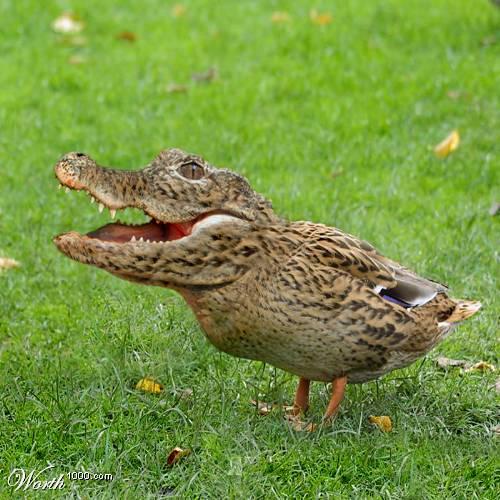
Posted in creationism, evolution, tagged crocoduck, evolution, phyla cross-over, Scientific theory on December 23, 2010| 7 Comments »
LOL.
A crocoduck!
BTW, evolution is not “an alternative to God.”
Evolution is a scientific theory. (What a scientific theory is. Evolution is not ‘just a theory” in the more common usage of the term).
Do I have to explain why the crocoduck thing is such a red herring?
But I will have to say that some state senator in Oklahoma thinks this is valid evidence against evolution. He calls it a “phyla cross-over.” I believe this is a rectally derived term, which makes him sound a whole lot smarter than he actually is.
If one gets a good look at the crocoduck, I can say they made an error there. The crocodile head isn’t a crocodile. It is either an alligator or a caiman.
Crocodilians, but not technically crocodiles.
Posted in evolution, tagged giraffe, recurrent laryngeal nerve on December 23, 2010| 1 Comment »


 | The Evolving Natural… on So does the maned wolf break t… |
 | SWestfall3 on So does the maned wolf break t… |
 | Ole Possum on So does the maned wolf break t… |
 | kuymal on The Thylacine was more a marsu… |
 | Kerry Rogers on The Thylacine was more a marsu… |