
The species from yesterday’s query was an Egyptian jackal. It comes from The living animals of the world; a popular natural history with one thousand illustrations; Volume 1: Mammals (1902) by C.J. Cornish, Frederick Courteney Selous, Sir Harry Hamilton Johson, and Sir Herbert Maxwell.
The animal is listed as a “North African jackal,” but the subspecies is better known as the Egyptian jackal.
However, its exact taxonomy is still being debated. Many sources, including Peter Steinhart’s The Company of Wolves, list this animal as a subspecies of Canis lupus. If listed as a wolf, it is called Canis lupus lupaster. Morphological studies found that it was most similar tot he Arabian wolf subspecies (arabs), which ranges into the Egyptian Sinai. Its skull is said to be almost exactly like that of the Indian wolf (pallipes). It is also larger than the golden jackal subspecies that are found near it. It is even larger than the European golden jackal, which is the largest accepted subspecies of Canis aureus.
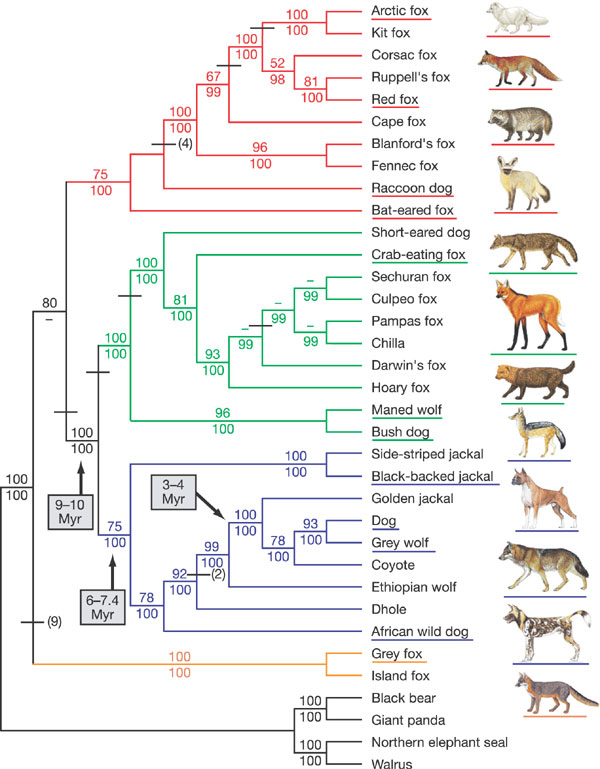
The most recent genetic evidence suggests that this animal is a golden jackal. The most recent analysis of MtDNA that compared Egyptian jackals with other members of the genus Canis. The study found that the MtDNA was most similar to the Israel golden jackal, and because of this finding, the Egytpian jackal is no longer considered a wolf.
However, the variance was quite high between Israeli golden jackals and Egyptian jackals. They differed by over 4 %, which is much higher than the variance between dogs and wolves. Of course, golden jackals are a much older species than wolves are, and one could expect to find a bit higher variances. Black-backed jackals have intraspecific MtDNA variances that are as high as 8 percent– even within contiguous populations. The black-backed jackal is the oldest subspecies within the genus Canis.
However, because the study that found that Egyptian jackals were golden used only MtDNA, one needs to be a bit skeptical. We know that wolves can interbred with golden jackals, as can domestic dogs. It seems to me that it is at least plausible that there was once a North African wolf that was very similar to the Arabian, Iranian, and Indian wolf subspecies. That animal became threatened through persecution, so it interbred with golden jackal bitches. For a wolf to have golden jackal MtDNA, it would only require a single female golden jackal ancestor.
In fact, this cross-breeding could have happened at any time. We know that wolves evolved in southern Asia, and when the first wolves entered Africa, the only mates they could find were golden jackal bitches.
No one has examined the nuclear DNA of an Egyptian jackal. They are not included in the .large genome-wide studies. They need to be.
Like the red wolf, their exact taxonomy is not clear until their full nuclear DNA is examined.
It is possible that the Egyptian jackal is a distinct species. A very similar large golden jackal-like animal with wolf characteristics was found in the Danakil. It is called the wucharia by the locals, who do not consider it to be the same thing as the golden jackal. Perhaps both of these wolfish jackals are new species or they are the descendants of relict populations of wolves that lived in Northern and East Africa.
We don’t know. Just as the coyotes of the Eastern US and Canada are quite wolf-like, there are also golden jackals that have wolfish characteristics.





Yeah! That’s the book I have! Neat old book–reading through it shows how differently perspectives on animals have changed over the years. My memory was a bit faulty, but the “Indian Jackal” WAS on the same page, just below this photo(obviously a Golden Jackal)! My caption called this photo the “North African Jackal”, and it DOES look amazingly like the “Indian Wolf” shown on the previous page(in my copy of the old book), and like Arabian wolves I’ve seen in other photos. Hard to say for sure without anything for size reference, but if jackals and wolves do ever crossbreed, this is likely what the offspring would look like, I think. Some of the “wolf” photos in this book I think are most definetely hybrids–like the white wolf, Carpathian wolf, female wolf’s head study, and the wolf-with-the-privy-paw shown in the canid section. Of course, Retrieverman, if you just got this photo from the internet somewhere and don’t actually have a copy of this old book, none of what I just said is going to make any sense to you!!!
I have it on my hard drive. I downloaded it when I was looking at golden jackals and researching this animal as a possible new species in the genus canis.
The photo comes comes from Wikipedia. Yes. I have the book on the computer, and I know what you’re talking about!