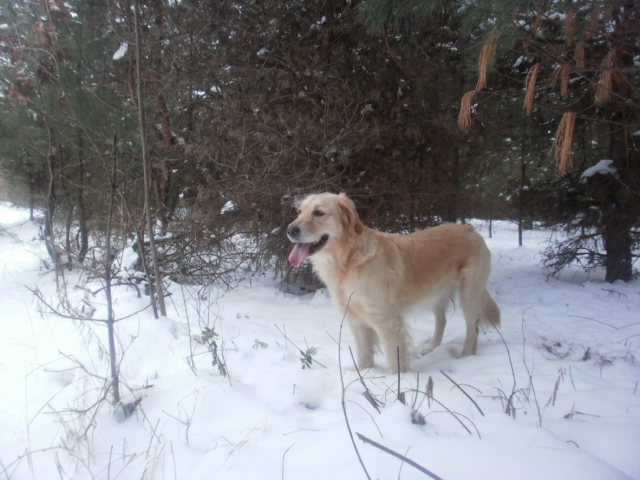
Miley is a good example of a generalist dog.
Even those of us who have breeds that have been bred for a particular specialized behavior know of individuals within the breed that are much more generalist in their behavior than one might expect.
Miley is a very good example of a generalist dog whose ancestors were definitely bred to be specialists. She has very weak retrieving instinct, usually only picking up toys as a greeting behavior. She is very different from some retrievers that live to retrieve. It becomes their live-long obsession that is relished to such an extent that one shouldn’t call it a mere métier. It becomes part of their being. Indeed, a big part their very existence becomes retrieving objects. They can be so long as they are able to retrieve.
Certainly, similar things can be said about dogs who herd, point, flush, course, and trail. Selective breeding produces these animals, which are then refined through training.
However, really specialized dogs are not common outside of the West. Although it is certainly true that many peoples of Asian and Africa have sighthounds, many of these sighthounds, like the aboriginal Afghan hound and the Azawakh, also are useful as camp and livestock guard dogs. Western greyhounds aren’t particularly useful for that purpose.
Although it is certainly true that East Asians and Native Americans in both North and South America have produced dog breeds with specialized abilities, most non-Western dogs are generalists.
The history of the generalist dog is much longer than that of the specialists or those whose ancestors were bred to be specialists.
This was even true in America. From the colonial period until about the middle of the twentieth century, the most common dogs about were curs, shepherds, and feists. All of these dogs were multipurpose, with both shepherds and cur doing herding and droving work and hunting varmints.
The feist joined its larger brethren in guard work, but its primary purpose was to hunt small game, including game birds. A large dog would flush a grouse or bobwhite, and the bird would fly away. But a small dog could make the bird take refuge in the trees, which it could easily be taken by the gun. The dog would alert its human companion to the location of the bird in the same way it would alert the location of a treed squirrel– by barking very loudly. Such shots of treed birds are deemed unsportsmanlike in our modern world, but in those days, it was important to make a kill as easily and efficiently as possible. One had access to only so much ammunition, and it could not be wasted on attempting to shoot birds on the wing.
All of these dogs still exist, but they are now in the minority. The vast majority of dogs in the US are either improved breeds that have been registered with a kennel club or they are imported working and hunting breeds, like Deutsch-Drahthaar and border collies. The rise of these breeds over the native multipurpose dogs has to do with the rapid social changes and increased wealth that happened in the United States after the Second World War. The vast majority of people are no longer rural. Dogs are no longer an economic necessity in most cases, and because people have more disposable incomes, they can afford pet dogs and working dogs whose utility is more or less that of a hobby animal. Although one can find shepherds and stockmen who rely upon their herding dogs, most herding dogs in America are owned by hobbyists. Very few hunting dogs hunt marketable species– the best case I know around these parts is of some hounds that are used to hunt bobcats. The dogs trail and tree the bobcat. The bobcat is shot, and its pelt is sold to a taxidermist, who makes a marketable specimen that some people like to display in their homes.
There are plenty of examples of dogs that have an economic utility, and I know that there are far more examples than I have posited here. But it doesn’t change the fundamental reason why the native multipurpose breeds have given way to the kennel club and imported working and hunting dog horde. The vast majority of people can afford to have dogs that are not as multipurpose. Owning a kennel club breed or a working breed with its own registry also imparts upon the owner a certain level of status. No longer does this person live out in the woods with his curs. He has a kennel club dog now.
The perspectives one has on generalist versus dogs changes how experts view dogs. In Merle’s Door, Ted Kerasote write about how differently Raymond Coppinger and Michael Fox view dogs. Coppinger prefers the specialized behaviors of many different breeds of domestic dog, claiming that “Any breed of dog behaves with greater complexity than any wolf.” Michael Fox prefers the more generalist behaviors of the wild wolf to those of specialized dog breeds, pointing the beautifully efficient movement that wolves have compared when compared to domestic dogs.
Kerasote is more in favor of the generalist dog, perhaps in part because Merle, the dog whose biography is the subject of the book, is a generalist dog. Although predominantly Labrador, Merle has no interest in retrieving or hunting birds in the way that retrievers do. Several people tell Kerasote that he just needs to send Merle off to a professional retriever trainer, who’ll turn him into a great working retriever. However, Kerasote refuses to do so. He feels that specialist dogs are a bit limited:
Specialist dogs can be brilliant at their jobs or sports, but, as is the case with some human athletes, mathematicians, or artists, their highly specialized skills can leave them unobservant. Data outside their purview doesn’t register. And the more proficient they become, the harder it becomes for them to think outside the box. They become idiot savants (pg. 140).
He continues:
Merle never followed this narrow career path, and friends thought this was a loss for him and for me. By allowing Merle to do what he wanted, they argued, I had wasted his life as a potentially good bird dog and squandered the enjoyment, I would have gotten watching him flush and retrieve.
On the other hand, I never tired of watching him scent elk, chase chiselers [ground squirrels], and delicately pick currantswith his incisors– all pastimes he chose for himself (pg. 140).
Merle was interested in all sorts of different wildlife, and he was interested in birds– but only in catching them and consuming them. Major faults for any retriever, but great assets for a dog who had grown up a nearly feral dog in the wild environs of the San Juan River in Utah. He had no interesting retrieving objects or shot birds, despite his obvious Labrador ancestry:
No matter how much you would try to cajole him, employing the usual kissing noises that attract dogs so well (they mimic the high-pitched squeaks of rodents), he remained unshaken in his belief that such games [retrieving] were exactly that– games. Instead he applied himself to the real– the real, somehow, always being connected to filling his stomach. Why should he respond to a person ersatz rodent noise, he logic seemed to go, when he could chase and kill real ground squirrels? Why should he fetch a retriever dummy when could flush and kill a real ruffed grouse?
I admire his integrity, though some friends found it disconcerting. One young couple, longing for some doggy energy in their lives, borrowed Merle for a day hike. A few hours later they returned with him at arm’s length. “He caught a grouse,” the woman said, a little shocked, “and ate it whole, right in front of our own eyes” (pg. 138).
That woman’s reaction to Merle’s predatory behavior notwithstanding, a retriever that knows how to catch, kill, pluck, and eat birds isn’t exactly what most working retriever people want. If Kerasote had been operating in the usual paradigm in which working retriever people operate, Merle would have had to have undergone some intense retraining, but because the author was operating from a different perspective, he is able to appreciate him for what he is.
Later in the book, Merle actually does show that he can learn to retrieve. He is taken on a pheasant hunt in Montana with working goldens and Labs, and he shows that he can retrieve a shot pheasant, simply by watching the other dogs do it, but when he retrieves the bird, the author is a bit overwhelmed with the realization that Merle just doesn’t like retriever work:
I was thrilled and overwhelmed. Without any reinforcement– except seeing his peers hunt–he had learned every detail of flushing and retrieving and hadn’t been spooked in the least by the report of the gun.[Merle had a fear of guns that probably stemmed from the fact that he was shot while chasing cattle during his feral existence in Utah]. Bursting with pride, I held out my hand to receive this, his first bird.
But instead of presenting the pheasant to my hand as the other dogs had done for their humans, he spit it at my feet.
There was no mistaking the scorn in his gesture. He held himself erect and looked at me with enormous defiance.
I reached down and tried to pet him, but he pulled back his head from my hand, his posture not softening in the least. Ramrod straight and every muscle tense, he fixed me with blazing eyes.
“See,” they said, “I can do this, I just don’t want to.”
Up until this point in my life, virtually all the dogs I had run into had pleased me. A very few–two, in fact–had frightened me. Many had made me laugh. A couple had made me cry. One– this one sitting before me–had made me feel ashamed on the day I hit him for chasing cattle. Dozens of dogs had filled me with love. No dog, until today, had managed to humble me.
“I understand,” I told him.
He stared at me hard.
“I get it,” I said. “You really hate bird hunting” (pg. 267-268).
Perhaps Kerasote’s pronouncements would have been different had he purchased Merle from a breeder of trial quality Labradors, but because he was open to Merle being a different dog from what his pedigree suggested, he was able to see Merle develop his own senses and live his own life. From that experience, the Kerasote and Merle were able to develop a real relationship– not between master and servant dog but between two partners who can experience the world together. On their long hikes in the wilds of the West, they sense the world as a team– primate seeing, canid scenting.
Miley shares many of Merle’s traits. Although her litter brother was retrieving to hand at 12 weeks, she has no interest in doing so. She might retrieve for a bit, but it’s not her primary interest. I think that deep down she wishes she had been born a sighthound, for she loves to course rabbits that have the stupidity to sit out in the open. She has caught rabbits and one fox squirrel that she has managed to run down in the open. She has brought the rabbits home alive without leaving a mark on them, and she would have done the same with the fox squirrel had it not decided to fight back. She has made only one kill on her excursions– a meat chicken that its owners abandoned in the woods. She caught three of them, carrying two home alive before realizing that she could stop the flapping if she killed it first. I have no idea what the purpose of turning those chickens loose on the property of others was, particularly when the woods are full of coyotes, foxes, and raccoons that would make shorter work of them than a young retriever dog could.
The generalist dog is as well-received in our society as it once was. Ted Kerasote’s book challenges us to look beyond our expectation and look to see what our dogs’ interests actually are. If Miley had been like her brother, her life might have been a bit different– well, there is no “might” about it.
But because she is not, she is still appreciated for what she is. She may be genetically a retriever, but her instincts, drives, and interests just aren’t in it.
And I’m okay with that.
She’s a generalist dog, who, like Merle, smells the tracks of the wild animals. Deer tracks get very careful consideration, because I think she would really like to be a deer hunter. They fascinate her to no end, but when she once came upon a doe nursing her fawn, she discovered exactly how protective such animals are of their offspring. The was lucky that the deer just chased her away. Some dogs don’t get off so easy.
As a puppy, I remember she once tore open the nest of some species of ground nesting song bird. The chicks ran in all directions, and she tried to catch them. But because she was at the awkward “all legs” stage of golden retriever puppy development, she couldn’t run any of them down before the parent birds began dive-bombing her. She never did that again.
I also remember the day she dug up a yellowjacket nest, and they piled her. If she ran to me for comfort, and the yellowjackets caught her scent on me. I got a few stings, but I have been stung so many times, that it is just a minor inconvenience. It hurts for about a minute. But it apparently bothered Miley a bit more– because she never did that again.
I also remember the day she came face to face with a gray fox. We were walking up a sandy knoll with the ancient golden retriever named in tow behind us. Suddenly, a rabbit on the side of the trail bolted away from us, charging up the hill to a thicket of multiflora rose. But just as suddenly as it bolted the rabbit stopped, and then shot off to the left for an even more distant thicket of multiflora rose. Loping down the hill before us came the reason why the rabbit had bolted, my eyes did not register at first what it was. Gray foxes are more cat-like in their movements than other dogs are, and the first thing that came to my mind was that I was looking at cougar. When my rational mind finally registered what it was, I realized that I had come across a gray fox that had come to do some daylight rabbiting. The fox came to screeching halt, and it stopped. It had not yet notice me coming up the trail and focused its attention on the small blond thing that had been trotting several yards ahead of me. Perhaps in all of its travels it had never come across such an unusual creature as a four-month-old golden retriever puppy. And this golden retriever puppy had not seen anything like a gray fox before. The two creatures studied each other from a distance for a few seconds. I stopped my progress down the trail to watch for a bit. I could see Miley’s black nostrils quivering, and I could see the fox staring hard with its wild eyes. It was then the fox noticed me and charged away. It may not have known what a golden retriever puppy was, but it knew that people are nothing but trouble.
Like Merle, Miley has grown up experiencing nature. She has not had to live as a feral animal, but she know about the animals that live near her. Like Merle, she hates coyotes with venomous passion and loves to go out in the yard at night and shit talk the wild dogs for a couple of hours before she goes to bed.
Her brain has developed in this experience rich environment, and her intelligence has become keener and keener as she has matured. She is a very well socialized dogs, and although her nature is to be a little shy and retiring, she has become more confident.
A few months ago, I was walking her in a park on a leash, and two women who were walking very shy dogs asked how she got to be so confident. I didn’t realize it at the time but her upbringing as a free range rural dog that also lives in the house and goes on trips may have had some role in developing her confidence.
And it is through that confidence that one can see that her intelligence is more generalist than specialized. She communicates very nicely with other dogs. She appreciates the scent of deer tracks in the sandy mud and the sight of flushing some wild turkeys in a snow covered woods.
It is through her that I have fully realized one of the main parts of Merle’s Door— appreciate the dog with a generalist intelligence. I still like dogs that have natural retrieving instinct, but just because a dog doen’t have it, doesn’t mean the animal is useless.
A dog with a more generalist intelligence can take you places the specialized animal cannot. It can take the sail out of an inflated ego. It can humble you.




It seems like lots of today’s working generalist dogs are adopted from an animal rescue or a shelter. At least that’s the trend with my distant relatives.