• Home
  • About
  • Contact
  • Patreon
  • Premium Membership
  • Services

Natural History

by Scottie Westfall

Feeds:
« Another Dosa
Australian red border collie »

Brindle English longhorn bull

February 23, 2011 by SWestfall3

It is hard to believe that such a strange looking animal was the main breed that was used by the early British and American beef industries.

Robert Bakewell, the famous agriculturalist, produced a particularly “improved” strain of these cattle. Bakewell was the first to utilize the “in and in” system of setting characteristics within a strain.

In a nutshell, Bakwell advised that a fine bull be bred to the finest cows, and then the finest heifers born of those breedings be bred back to their sire.

Such a system very quickly established traits within lines, and the English longhorn cattle grew into veritable beef  monsters.

It was only when the shorthorn breed was “improved” in a similar fashion.

In my part of the world, beef shorthorns are called “Durhams.”   That is partly because one of the early improved strains of beef shorthorn produced the “Durham Ox,” a true monstrosity. But it is mainly because the strain that produced this beef strain was actually derived from the landrace cattle of Durham in the North of England.

Today, the mainstay of the American beef industry is the “black angus,” which is what Americans call the black color of the Aberdeen-Angus cattle, which were developed along the east coast of Scotland. In North America, the black and red colors are maintained in separate registries, but throughout the world, the two are considered color varieties of the same breed.

Breeds rise and fall with the times. Sensibilities change. Markets grow, stagnate, and fall.

The English longhorn is quite rare today. Last time I checked, only one breeder in the US had a herd of these cattle.

“Durhams” can still be seen, but they are mostly a novelty. I knew that many people keep the roan coloration these cattle for no other reason than they are pretty.

But this is now a world for the black Alban cattle with no horns and very little brain.

In 50 years, it may be some other breed–that might not even exist right now– that replaces it.

That is the way these things go. Empires are built. They crumble. They fall.

***

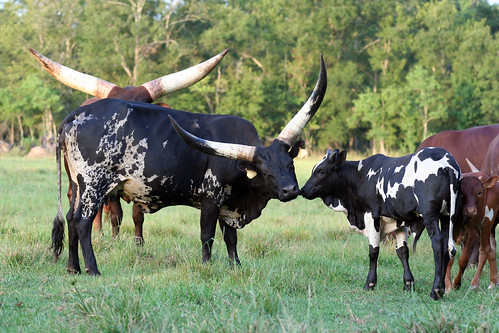
The strangest cow I’ve ever seen was a Watusi bull that was gazing in a pasture of “black angus” and “Durhams.”  To see an animal with horns like that was certainly unexpected.

This pasture was just west of the town of Glenville, West Virginia, just across the road from the Presbyterian church.

Watusi cattle are known for their long, thick horns, and in this part of the world, one very rarely sees cattle with horns. Horns cause trouble in pastures, stockyards, and cattle trucks. So they are either removed or the farmers raise polled breeds. (There are no ranchers east of the Mississippi. Don’t call them ranchers. They aren’t.)

That bull was truly a magnificent animal. He was wild and exotic, although a bit out of place.

***

One of the stories about cattle I heard growing up was the story of the Jersey steer who became a deer.

Some guys manage to lease some pastures in a remote part of West Virginia, and they turned out 15 head of various mixed cattle into the woods for a summer.

When the fall came, the men tried to round up all of their half-wild cattle and sell them at the stock sale. They managed to wrangle all but a single Jersey steer, who was so agile and quick and keen in his forest ways that he could escape.

When the novice cattlemen gave up on their endeavor, the Jersey was left alone in the woods– where he thrived.

Somewhere in his DNA, there was a wild aurochs bursting to come up, and he became as wily as any deer. He raided vegetable gardens and crapped in the river, just as any wild cow would do

He lived for three years as a wild creature, but one morning he happened to come upon some deer hunters, who promptly shot him. They had been told to shoot the feral nuisance, and when they saw him, they couldn’t pass up the opportunity to take down the wild Jersey of West Virginia.


Posted in domestic animals | Tagged beef cattle, cattle, English longhorn cattle |

  • Like on Facebook

    The Retriever, Dog, and Wildlife Blog

    Promote Your Page Too
  • Blog Stats

    • 9,396,750 hits
  • Retrieverman’s Twitter

    • one person followed me // automatically checked by fllwrs.com 5 hours ago
    • RT @TheWildLifepod: There’s an anglerfish in me bathtub https://t.co/efl7O5JbkE 4 days ago
    • one person followed me // automatically checked by fllwrs.com 6 days ago
    • @BronwenDickey Denny's? 6 days ago
    • one person followed me // automatically checked by fllwrs.com 1 week ago
  • Google rank

    Check Google Page Rank
  • Archives

    • September 2020
    • August 2020
    • July 2020
    • June 2020
    • May 2020
    • April 2020
    • February 2020
    • January 2020
    • December 2019
    • November 2019
    • October 2019
    • September 2019
    • August 2019
    • July 2019
    • June 2019
    • May 2019
    • April 2019
    • March 2019
    • February 2019
    • January 2019
    • December 2018
    • November 2018
    • October 2018
    • September 2018
    • August 2018
    • July 2018
    • June 2018
    • May 2018
    • April 2018
    • March 2018
    • February 2018
    • January 2018
    • December 2017
    • November 2017
    • October 2017
    • September 2017
    • August 2017
    • July 2017
    • June 2017
    • May 2017
    • April 2017
    • March 2017
    • February 2017
    • January 2017
    • December 2016
    • November 2016
    • October 2016
    • September 2016
    • August 2016
    • July 2016
    • June 2016
    • May 2016
    • April 2016
    • March 2016
    • February 2016
    • January 2016
    • December 2015
    • November 2015
    • October 2015
    • September 2015
    • August 2015
    • July 2015
    • June 2015
    • May 2015
    • April 2015
    • March 2015
    • February 2015
    • January 2015
    • December 2014
    • November 2014
    • October 2014
    • September 2014
    • August 2014
    • July 2014
    • June 2014
    • May 2014
    • April 2014
    • March 2014
    • February 2014
    • January 2014
    • December 2013
    • November 2013
    • October 2013
    • September 2013
    • August 2013
    • July 2013
    • June 2013
    • May 2013
    • April 2013
    • March 2013
    • February 2013
    • January 2013
    • December 2012
    • November 2012
    • October 2012
    • September 2012
    • August 2012
    • July 2012
    • June 2012
    • May 2012
    • April 2012
    • March 2012
    • February 2012
    • January 2012
    • December 2011
    • November 2011
    • October 2011
    • September 2011
    • August 2011
    • July 2011
    • June 2011
    • May 2011
    • April 2011
    • March 2011
    • February 2011
    • January 2011
    • December 2010
    • November 2010
    • October 2010
    • September 2010
    • August 2010
    • July 2010
    • June 2010
    • May 2010
    • April 2010
    • March 2010
    • February 2010
    • January 2010
    • December 2009
    • November 2009
    • October 2009
    • September 2009
    • August 2009
    • July 2009
    • June 2009
    • May 2009
    • April 2009
    • March 2009
    • February 2009
    • January 2009
    • December 2008
    • November 2008
    • October 2008
    • September 2008
    • August 2008
    • July 2008
  • Recent Comments

    The Evolving Natural… on So does the maned wolf break t…
    SWestfall3 on So does the maned wolf break t…
    Ole Possum on So does the maned wolf break t…
    kuymal on The Thylacine was more a marsu…
    Kerry Rogers on The Thylacine was more a marsu…
  • Meta

    • WordPress.com
  • Pages

    • About
    • Contact
    • Patreon
    • Premium Membership
    • Services
  • Subscribe to Retrieverman's Weblog by Email
  • Revolver map

    Map

  • Top Posts

    • The Alaskan Noble Companion Dog
  • SiteCounter


  • Donate to this blog

  • Top 50 Northwest Dog Blogs

    top 50 dog blogs

Blog at WordPress.com.

WPThemes.


%d bloggers like this: