(Source)
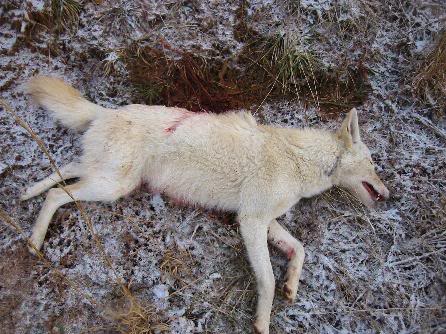
I don’t see any obvious black pigment on this coyote’s pelt, so it looks like we have a recessive red coloration in this coyote.
That would mean we have a coyote with the same coloration as a golden retriever. It also has a white tail tip.
The fact that this looks like recessive red means that this coyote is likely not an F1 coydog.





Some very interesting coyote colors here:
http://www.predatormastersforums.com/forums/ubbthreads.php?ubb=showflat&Number=605732
Dead animal warning.
it looks pretty darn similar to some of the native animals out here
http://muirmaid.net/learn.htm
also http://cameratrapcodger.blogspot.com/2009_09_01_archive.html (scroll down to “the cast of coyotes” and following photos).
or here http://bss.sfsu.edu/holzman/courses/fall01%20projects/coyote.htm (scroll down to deer feeding shot)
Most coyotes come in the “standard” flavor but there are washed -out color variations. They seem to have better camouflage in some of the sandy areas of the desert regions. The one in your photo is a more extreme “blanched version” but I’m not sure it’s an entirely unique color type.
Peggy Richter
I has no black pigment.
That means something. Black pigment doesn’t bleach out.
You have to do a little better than undergrad webpages.
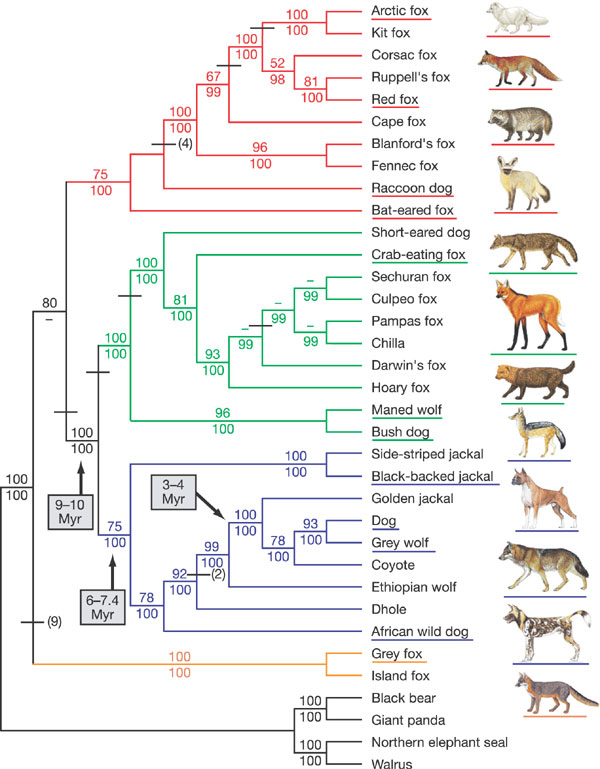
These are dholes, not coyotes.
That color phase is simply missing the dark back. It’s not uncommon. Neither is what is called a red phase coyote. They both still have some black hair and the light areas typical on the face.
So where are the coyotes with natty dreads?
That’s an interesting question.
The only traits that wild canids seem to get from crossbreeding with domestic dogs are coat color and dewclaws on the hind legs. Some Italian wolves have dewclaws on their hindlegs:
http://news.bbc.co.uk/2/hi/science/nature/3602741.stm
Jess alerted me to another possibility of some gold looking dogs that are actually genetic sables. They are born with black hairs, but these disappear as they mature. I think all Finnish spitz are this color. All the young Finkies I’ve seen have had black hair on them. But the adults, not so.
Sorry, I didn’t click the link. My bad.
Yes, what the collie people call “clear sable”. Also true of red basenjis (born a smutty brownish color) and a number of terriers and others.
From the photo of the dead coyote it is not possible to see if there might be trace of sabling on the forehead or dorsal midline, which would indicate not ee.
Some English shepherds are clear sables, but are actually e/e’s.
And some are clear sables, but they are actually this kind of sable.
It’s like that natural selection knocks out different coat types in dog/coyote hybrids. Feathered long-hairs are recessives, so they won’t pop up unless the coyote with long-haired dog ancestry mates with another.
Black is a dominant color and it is possibly linked to increased immune function, which is why the black color became so prevalent once introduced. The hind-dewclaws are also dominant.
If you breed coydog to coydog over several generations, real fertility issues pop up, so if any of these colors exist, they come about through breeding back to one of the parent species.
I’ve heard of the melanin/immune system link before; do you have any papers on it?
Well, it has been discussed in cats and in this case, moths: http://users.utu.fi/mjranta/reprints/Mikkola%20&%20Rantala%202010.pdf
The Barsh study also mentions this and suggests that it is a reason why black wolves have prevailed in some parts of North America:
http://www.nytimes.com/2009/02/06/science/06wolves.html?_r=1&ref=todayspaper
Gerbils:
http://www.ncbi.nlm.nih.gov/pubmed/11037123
a collie marked coyote might actually have a genetic ADVANTAGE in an urban/ suburban environment in that people might mistake it for a dog at first glance. Especially in the areas where “wild” intersects “urban” that may mean less chance to be shot or harassed. Even livestock owners are more hesitant to shoot a dog than a coyote.
Or we could be seeing more variation in coyotes as they establish breeding populations in different areas beyond their original range and different selection factors apply. I agree it’s likely that these are coyote/dog crosses, but it’s also remotely possible that color mutation/variance is common in canids and under true “wild” situations these animals don’t survive. That would be the same as with the “white” tiger and lion that originally were wild but can’t survive there. In a human -dominated environment, however, an oddball “doggy looking” coyote might well do better rather than worse. It’s clear that coyotes are well adapted as “trash” and urban hunters.
It would be interesting to look at this animal’s DNA and verify if it’s color phase is identical to dogs or not. It would be much more exciting if this were an example of evolution in action than yet another example of the interbreeding plasticity of the canid clade.
Peggy Richter
Yes it would. It would also have an advantage should it start hunting small dogs. Most people would gather up their toys and terriers if they knew a coyote was in the park, but if it’s marked like a dog, they might not do it until it’s too late.