
For a long time, I have wondered if some of the “domestic dog” remains that are found in Pre-Columbian sights were actually wolf-derived, Canis lupus familiaris dogs.
We do have evidence that the natives of Tierra del Fuego domesticated the culpeo, and that finding at least suggests that a possibility exists that some of these remains of Pre-Columbian “dogs” are not the same species as the domestic dog that exists throughout the world.
Peru is well-known for its dog mummies. These seems to found at virtually every archaeological site. And until recently, it was assumed they were just generic village dogs.
However, I have received the results of a study that analyzed the mtDNA of some of the golden-coated Peruvian dog mummies, such as the one depicted above. The researchers were trying to see if these dogs matched any extant wolf populations. Because modern wolves are not native to South America, it would have to be a Eurasian or North American wolf population.
Not only was there no match, the mtDNA sequence was very different from any wolf population. When compared to coyote mtDNA, the divergence was still very great.
Those findings suggested that these dogs were not only not domestic dogs as we know them, they were not even members of the genus Canis.
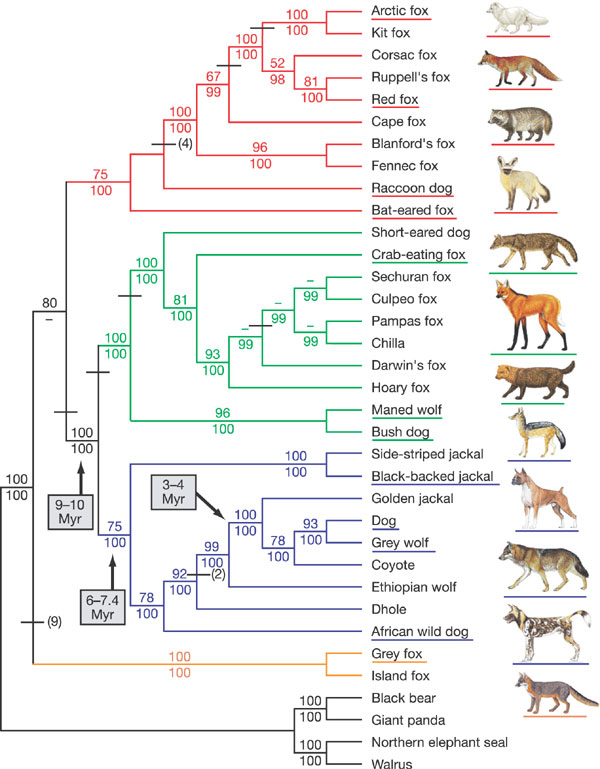
The researchers then compared the mtDNA sequences to other wild dogs from South America. These would be the only possible candidates for being the ancestor these domestic canids.
And when they found a match, it was amazing what they found.
These gold-colored canids had maned wolf mtDNA.
Maned wolves. Those stilt-legged canids that are native to South America but are not common in the region of Peru where these mummies were found.
The domestic maned wolves have all the traits we associate with domestic dogs. They have shorter muzzles, and although adults, they are about half the size of the wild maned wolf.
Maned wolves have been known to skulk near human settlements, and it is likely that some of these maned wolves adapted to scavenging at villages and eventually cities. They were probably bred down to be cute and docile as pets and sacrificial animals. For some reason, all of the domestic maned wolves that have been found in Peru have been solid gold in color. One wonders why such a mutation was selectively bred for, but it may have had something to do with ceremonial purposes.





This is incredibly cool. I saw a program on Maned wolves some years ago, where these monks (some religious thing) would leave fruit in front of the church for the Maned wolves, and they would come up the steps to eat it.
http://en.wikipedia.org/wiki/Solanum_lycocarpum