I have often wondered what it would be like to live in the same area as another species of the same genus as mine (Homo). It would be even more interesting if this other species were chemically interfetile with mine, but we rarely hybridize for various reasons (perhaps the women are too ugly.)
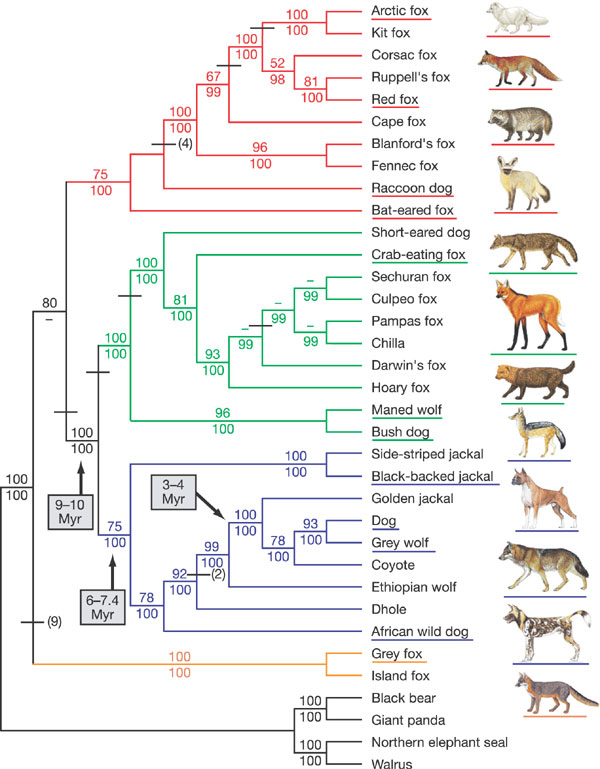
Most North America and virtually all Central American dogs know what this is like. Coyotes are generally chemically interfertile with dogs, but not all coydogs are able to reproduce. However, they are more likely to be fertile than other hybrids. Hybridization is actually not that common between dogs and coyotes, but there is evidence of dog genes entering the wild coyote population. It is not enough to say that many coyotes are hybrids. It is more accurate to say that there are coyotes that have dog genes in the same way that many modern humans of non-African decent have some Neanderthal genes. That does not make these non-Africans modern human/Neanderthal hybrids. It just means that there was a hybrid somewhere in the ancestry.
It is often said that coydogs are rare because of the breeding cycles of coyotes is very fixed, and dog and coyote hybrids tend to diverge from the normal coyote breeding season. That may have something to do with it, but I think there is a bigger reason: Most dogs hate coyotes.
Even the friendliest and most social dogs– the ones that readily play with other dogs– often view coyotes are the lowest form of canine existence. Miley hates coyotes but loves other dogs. I was actually surprised at her reaction to coyotes as she matured. I have no idea what causes dogs to hate coyote so much. Miley has had no bad experiences with them, so it must be something intrinsic to coyotes that brings out her antipathy.
Coyotes do have a different odor than domestic dogs, but that alone wouldn’t account for the behavior. If you put lots of doggy cologne on a normal dog, most other dogs won’t respond aggressively toward him.
I think it may have something to do with the coyote body language, which is very different from dogs. Coyotes regularly use a threat gape, which is very different from the dog’s snarl. It is likely that they have other body language differences that just set dogs off.
Perhaps this was the case with early modern humans and Neanderthals. The two species may have been able to interbreed, but they rarely did so. Of course, no one would ever suggest that coyotes and dogs were the same species, but it is possible that humans and Neanderthals were the same species– just very different subspecies. If we recognize only one species of wolf that includes the dog and the dingo, then we can see how one could possibly see the Neanderthal as a specialized Pleistocene member of our same species. Such classification has been rejected in the scientific journals, but we clearly recognize species that have as much diversity in appearance and genetics as existed between early modern humans and Neanderthals.
I’m still going to call Neanderthals a separate species, but I still think these questions have not been answered. Humans and Neanderthals aren’t much different than dogs are from the specialized big game hunting wolves from northern Eurasia and North America. Of course, there has been more of a gene flow between those wolves and dogs than there was between humans and Neanderthals– and because both wolves and dogs still exist, the gene flow continues today.





Maybe the looks and body language of a coyote is the dog version of the uncanny valley. Too similar, yet too different at the same time.