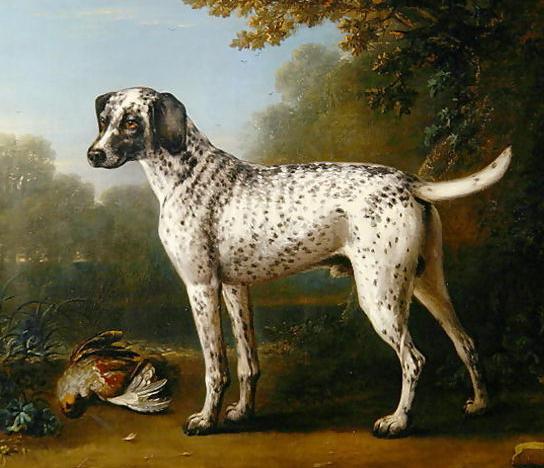
This painting is by John Wootton, an English painter who painted many sporting scenes.
I don’t agree that this dog is a hound for several reasons. The most of obvious signal that this dog is not a hound is the grey partridge (“Hungarian partridge”) displayed in front of the dog. This suggests that the dog was a bird dog. The tail appears to be docked, which was a common practice in English pointers in the early years.
And if this is a representation of an English pointer, it would be a very early specimen. Many of the earliest records of pointers in England date to the early part of the eighteenth century, suggesting that many of the ancestors of today’s English pointers were brought back from Spain or France after the War of Spanish Succession. Of course, there are records of pointers existing in England before this time, but the pointer really didn’t become common as a hunting dog for the shoot estates until the eighteenth century.
The dog strongly resembles a Braque du Bourbonnais, but it is the wrong color. Blue roan or blue-ticked is not a color associated with that breed– at least in its modern incarnation. Many members of that breed are also naturally short or bobtailed, and this dog doesn’t appear to have that feature. It looks docked in the same way that that German short-hair or a vizsla would be.
The fact that this dog is referred to as a hound also suggests a French origin. The term for pointer in French is “braque,” but braque sounds similar word in German, which is “Brache.” Brache always refers to several breeds of German scent hounds. Perhaps there was some confusion about what this dog actually was. After all, it was a common practice for the English to breed smooth-coated pointers from Europe to foxhounds to give them more speed and harder drive.
However, if this dog is an English pointer, it also suggests something about the origin of the Dalmatian. There is an official story about origin of the Dalmatian, but almost all of it is speculative and dubious. I don’t think for one minute that this dog is Croatian. William Jardine thought the dog was derived from a single import of a peculiarly marked hound from India, but judging from Jardine’s description in The Naturalist’s Library (1840):
From the general structure of the animal, we are of opinion it should be placed with the hounds; but though a very handsome variety, inferior to none of the above in elegance of form and beautiful markings, it is, with some dissent however, said to be without powers of nose or much sagacity, and therefore invariably entrusted to the stables, where it familiarises with horses. Having, in the general description of dogs, noticed the print of a specimen brought from India, with a white fur marked with small black spots, small half dejected ears, and a greyhound-like form, we have there expressed the suspicion that our present coach-dog may be derived from that individual, or from his breed, and we have accordingly given a representation of it.
Dalmatian dogs they are not, although a Turkish grandee might well have possessed specimens of the dog in that country. We figure it accordingly (pg. 193-194).
It is unlikely that any one dog from India could have founded the whole population of Dalmatians, but it makes a whole lot more sense that all of the dubious claims about spotted white hounds in Croatia. There is a native Croatian hound that clearly would have fit any of the descriptions of these hounds from that region that might be confused with a Dalmatian.
The FCI gave the Dalmatian’s patron country status to Croatia based upon the work of Thomas Bewick, who depicted a Dalmatian in his General History of Quadrupeds in 1792. (Its ears appear to be closely cropped.)

Bewick claimed the dogs were from Dalmatia, but keep in mind that Bewick was not a particularly educated man, who was never formally educated. He was apprenticed to an engraver, and that is how he made his living. He did read books by the leading naturalists of the day, and he did spend a lot of time in nature. But he could have been told just about anything about the origins of coach dog, and he would have not any way of verifying it.
And yet this is how we base our understanding of the Dalmatian’s origins.
Look at the engraving of the Dalmatian that Bewick did in 1792 and compare it to Wootton’s “Grey-spotted hound.” They have very similar features– including the spots. Jardine clearly states that Dalmatians had some affinity with greyhounds. Bewick’s dog has some affinities with the bulldog but also has the something like a greyhound’s head. Both bulldogs and greyhounds can have something like these ticked markings. This dog looks like a blend between the pointer in the Wootton painting and those two breeds.
My educated guess is that the Dalmatian’s origins are in England in the middle of the eighteenth century with pointer or setter crosses to bulldogs, foxhounds, or greyhounds. The Dalmatian started out as a mongrel pointer. The modern Dalmatian often exhibits the extended stalking behavior we see in English pointers, and there may have been some addition of English setter to the breed, which perhaps the origin of the long-haired Dalmatians.
I don’t know why the historical research on the Dalmatian is so flaky. It is one of those breeds that has an impossibly fantastic origin theory that one has to question it.
But then I guess you couldn’t call them “Dalmatians” and keep a straight face.
Dalmatians are likely an English breed that dates to the eighteenth century. They likely are derived from unusually colored pointer crosses.
That theory seems far less fantastic, and although somewhat speculative, it is more likely to be correct than the claim that these dogs are from Croatia, Ancient Greece, or Bengal. The model requires fewer dubious assumptions. Therefore, it is more likely to be correct.




To me the Bewick’s Dalmatian resembles the Great Dane, which was used as a coach dog as well.
The old Danish dog was much lighter tho’ strong hound than the dog of today.
The spotted canines as cart dogs came into fashion in France somewhere in the first section of the 1700s and the Britts followed later.
Nope.
That’s a big error that the earlier people who wrote about this made up. Great Danes are no relation to Dalmatians at all. I have a source that calls them Danish coach dogs, which is so stupid. Great Danes that are harlequin are merles. Dalmatians are white dogs with an unusual form of ticking.
Great Danes were used to hunt boar. That’s why their name in English was originally “boar hound.”
A big dog like that could never run the way a Dalmatian does. It would overheat and die. You have no idea how much endurance a Dalmatian has. They really are something.
Great Danes don’t have anything like this.
Great Danes were big game hunting dogs. They were never coach dogs. People in the old days made huge errors about dogs.
There’s a reason why the pointers were the outcrossed breed to Dalmatians to make the LUA dogs. They are relatives.