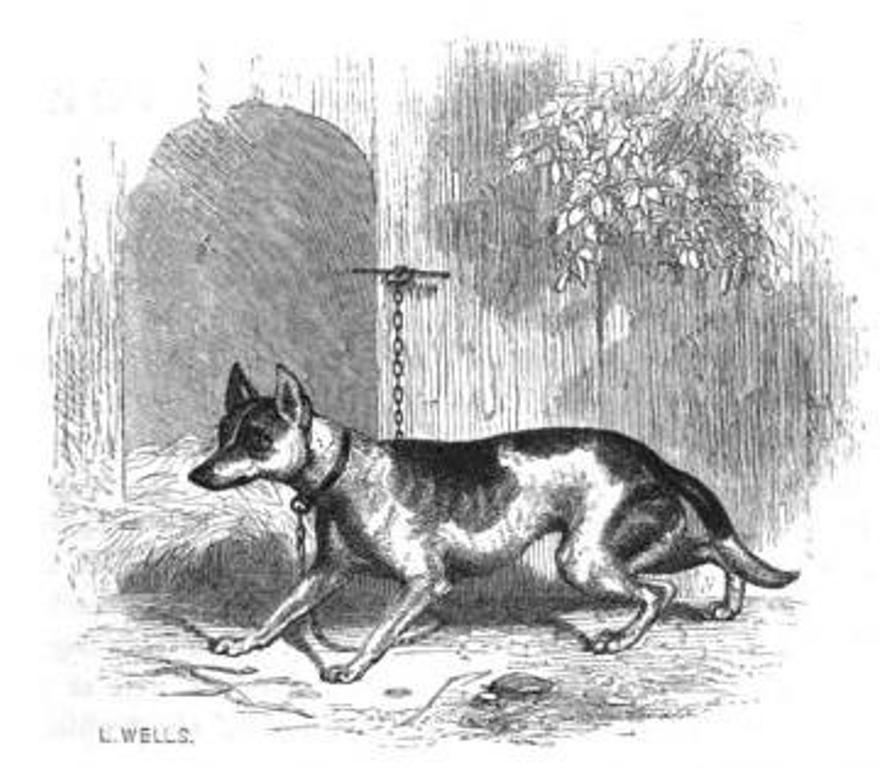
From The Dog in Health and Disease (1859). Stonehenge uses some correspondence between a Mr. Tomlin, who makes the claim about this hybrid. The image is supposedly of a creature that is 3/4 dog and one quarter fox that was derived from the original supposed F1 hybrid that wound up in the hands of Mr. Hewer of Reading.
Mr. Tomlin write of the supposed F1 crosses in an 1855 issue of a publication called Bell’s Life:
I venture to forward you one respecting the fox and dog cross, and, although somewhat out of season, it may, perhaps, prove interesting to the sportsman and the naturalist. In 1853 various accounts appeared in ‘Bell’s Life in London’ of the fox and dog cross, the fact being established by a gentleman of Kent, who then possessed a vulpo-canine bitch which had produce by a dog (vide ‘ Bell’s Life,’ Dec. 1853 and Feb. 1854). This bitch (half fox, half dog), now in my possession, had produce in the month of February last by a terrier dog. The produce are two dog-whelps and three bitches, some of which were (to ease the dam) suckled by a cur bitch. Two of the litter prove in nature shy as a fox; three of them dog-like in appearance, colour, and perfectly quiet, and follow well at heel. Still, they have the real fox muzzle and ‘fox action,’ about which (to those who have well studied it in the hunting-field) there exists but little mistake. Many there are who doubt the existence of any such animal as that between fox and dog. I am, however, in perfect condition to prove (by the living articles themselves) that the fox is merely a separate species of the genus dog, and intercopulates With the bitch, producing not a hybrid or mule animal, but one which will propagate its species to the very end of the chapter (pg. 166).
Mr. Tomblin describes the supposed hybrid bitch giving birth to a litter with a terrier:
In 1855 you were good enough to describe in ‘Bell’s Life’ some history of a vulpo-canine bitch in my possession at Peterborough which had bred whelps, and as you are at this period of the year ‘for the fox and nothing but the fox,’ perhaps you can spare a niche in your ‘fancy columns’ for a subject that may not be considered out of season. The vulpo-canine vixen is now, like all the fox genus, in full coat, and a beautiful-looking animal, higher on the leg than our common foxes, with more frame and size, and looks like going a slapping pace, and carries that unmistakable odour which accompanies ‘the beast of stinking flight.’ She bred a litter of whelps in the spring of the years 1855 and 1856 (got by a * lion-tawny-‘ coloured terrier dog), and goes ‘on heat’ only at one regular period. Her produce are endued more or less with the natural shyness and timidity of the vulpine species, and which it appears somewhat difficult to remove. The formation of their heads is faultless—long, and punishing—in fact, the appearance of these animals resembles terrier dogs, with the perfect head and countenance, back, body, and feet of the fox. The vulpo-canine bitch is now suckling four whelps (got by a good white terrier dog), and as their colours are likewise good — white ‘with black and pied ear-patches ‘ — it is likely to prove a better cross of its sort than the two former litters of whelps which the bitch reared, they being all of foxy, wild, dark-looking colours; and, as the terrier dog which got them was somewhat wicked and crafty in nature, I am now inclined to think that, ‘as like begets like,’ he was not altogether a suitable partner for the vulpo-canine bitch—an animal but one remove from the ‘veritable fox itself,’ as wild, too, as the wildest fox which ever broke away in a state of nature from any ‘ evergreen gorse covert,’ with a pack of hounds in pursuit, all eager for the fray (pg. 167).
Of course, this whole story is one giant flight of fancy. Red foxes can no more cross with dogs than they can with cats. There are plenty of domestic dogs that look like foxes. Virtually all of the smaller spitzes could be mistaken for a fox and could have easily “lined” a terrier.
But such an animal could be claimed to be part fox as a time-tested way of getting rid of a mongrel puppy. Many supposed “wolfdog” are just husky crosses that some unscrupulous person has claimed to be part wolf in order to get rid of them more quickly.
Of course, now that one of these supposed dog-fox hybrids has whelped a litter, Stonehenge is willing to thunder about how dogs and foxes are so similar. It is in this sort of intellectual milieu that Darwin postulated that some dogs were derived from foxes– as well as wolves and jackals.




Historical accounts of the McNab breed of herding dogs state that the McNab family used red and white “fox collie” dogs imported from Scotland (1866 – 1885) as part of the foundation for their line. They weren’t claiming actual fox ancestry, however, so that’s an interesting twist!
I don’t know of any drawings of the original McNab dogs but I could certainly see my “Belle” being described as a “fox collie”…
http://www.englishshepherds.net/Belle/snow1.htm .
~ Mary
Most of the supposed fox-dogs were out of terriers, not collies. I wonder if some of these crosses may have been corgi-terriers, although many corgis were actually drop-eared.
Like these dogs?
You have an extremely cool looking dog. It is so clear how a dog such as that could be mistaken for a fox.
Well ,“fox collies” was also used for creating the australian
Kelpie, they also had another name wich I don´t remember
at the monent .I don´t think most folks even at that time belived that they real had fox “blood” in them ,they just looked a bit like foxes compered to other working collie strains….
Noting that there is an altdeucher type called “fox” due to it’s red color, it’s likely that dogs called “fox collie” etc may have been “fox red” in color and nothing more. But the account points out that one can’t always assume that an early account is necessarily accurate. At least with the sporting dogs, there seems to have been a number of accounts by the people actually involved in using the dogs or breeding them. In herding dogs, many of the accounts (like those on the Bouvier, GSD and Belgians) weren’t by the shepherds/herdsmen involved but by those who were involved in creating the conformation / stud book version of such dogs. Even von Stephanitz, who did a fair amount of research, was not a herdsman — and it sometimes his descriptions / accounts seem pretty clearly that he wasn’t understanding what the people who did have the dogs meant, nor necessarily what was “ideal” vice “normal practice”.
It makes tracking down what the original dogs were like a bit of a challenge.
Peggy Richter
Well acording to the book Vallhundar by Birgitta Östergren
(wich probably only have been published in swedish) who
likely have studied the history of the Kelpie breed more than anyone else outside australia .The fox collie was prick eared ,short haired and with a more fox like head than other collie types.
These oddly remind me of Kelpies:
http://en.wikipedia.org/wiki/Lapponian_Herder
Maybe not this particular dog, but maybe the Norse settlers to Britain had a similar dog that helped create the “fox collie.”
Stonehenge in the other book «The Dogs Of Great Britain, America, And Other Countries. Their Breeding, Training, and Management in Health and Disease» write that «Many dingoes have been crossed with the terrier, and have been exhibited as hybrids between the dog and fox, which latter animal they closely resemble, with the single exception of the pendulous tail.»
[…] It’s because the two aren’t closely related to each other– the exact same reason why there are no dog and red fox hybrids. (No matter how many times people claim they exist.) […]