From Art Daily:
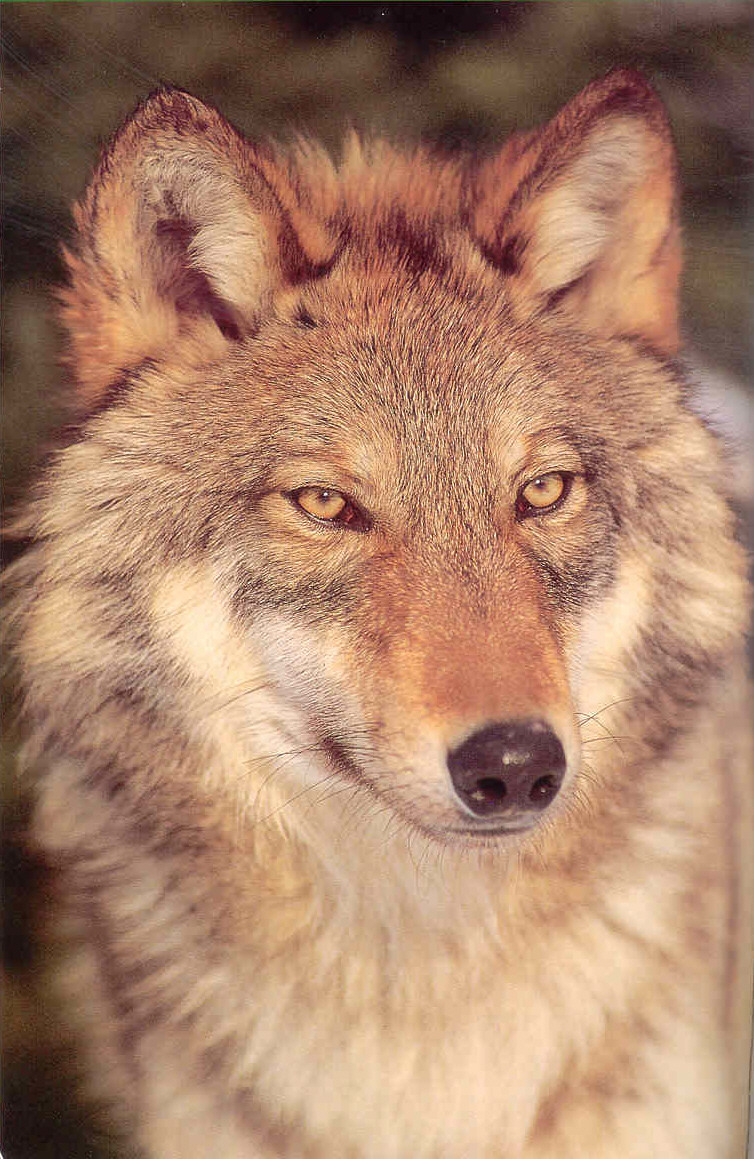
A State Museum scientist has co-authored a new research article, representing the most detailed genomic study of its kind, which shows that wolves and coyotes in the eastern United States are hybrids between gray wolves, coyotes and domestic dogs.
Dr. Roland Kays, the Museum’s curator of mammals, was one of 15 other national and international scientists who collaborated on the study that used unprecedented genetic technology, developed from the dog genome, to survey the global genetic diversity in dogs, wolves and coyotes. The study used over 48,000 genetic markers, making it the most detailed genomic study of any wild vertebrate species.
The research results are especially relevant to wolves and coyotes in the Northeast. The study shows a gradient of hybridization in wolves, with pure wolves in western states and increasing hybridization as you move east. Wolves in the western Great Lakes area averaged a genetic makeup of 85 percent wolf and 15 percent coyote, while wolves in Algonquin Park in eastern Ontario averaged 58 percent wolf, and the ‘red wolf’ in North Carolina was only 24 percent wolf and 76 percent coyote. Populations of eastern coyotes, which only colonized the region in the last 60 years, were also minor hybrids, with some introgression of genetic material from wolves and domestic dogs. For example, Northeastern coyotes, including those in New York State, had genetic material primarily from coyotes (82 percent), with a minor contribution from dogs (9 percent) and wolves (9 percent). Midwestern and southeastern coyotes were genetically 90 percent coyote, with an average of 7.5 percent dog and 2.5 percent wolf.
The advanced genetic techniques used in this study also allowed the scientists to estimate when the hybridization initially occurred. Kays said “In most cases this breeding across species lines seems to have happened at times when humans were hunting eastern wolves to extinction, and the few remaining animals could find no proper mates, so took the best option they could get.” Kays continues, “The exceptions were an older hybridization between coyotes and wolves in the western Great Lakes dating from 600-900 years ago, and a coyote-dog hybridization in the eastern U.S. about 50 years ago, when coyote were first colonizing eastern forests.”
This study also provides fresh data on the controversy over the species status of the Red Wolf in North Carolina, and the Eastern Canadian Wolf in Ontario. Both are medium-sized wolves that some have argued represent unique species. However, this new detailed genetic data shows both are the result of hybridizations between coyotes and wolves over the last few hundred years, and do not share a common origin in a unique eastern wolf species.
This research is also relevant to a recent U.S. Fish and Wildlife proposal to remove the western Great Lakes wolves from the Endangered Species Act by showing that those wolves are only marginally hybridized with coyotes, should be considered a subspecies of the Gray Wolf, and have no genetic ties to a more endangered form of eastern wolf.
The research is published online in Genome Research, an international, peer-reviewed journal that publishes outstanding original research that provides novel insights into the genome biology of all organisms, including advances in genomic medicine.
This study follows another research paper co-authored by Kays last year in the journal Biology Letters, which used museum specimens and genetic samples to show that eastern coyotes hybridized with wolves to rapidly evolve into a larger form over the last 90 years, dramatically expanding their geographic range and becoming the top predator in the Northeast. This hybridization contributed to the evolution of coyotes from mousers of western grasslands to deer hunters of eastern forests. The resulting coy-wolf hybrids are larger, with wider skulls that are better adapted for hunting deer.
You’ve seen some analysis from this study already. I already posted on the same study, paying close attention to the red wolf findings.
The unique Eastern wolf hypothesis has been popularized through the past decade. If one looks at the various maps of different wolf “species,” the region of the country in which I live could have had three possible wolves– red wolves, gray wolves, and “Eastern wolves.” It currently has coyotes with some wolf and dog ancestry.
This study shows that there was some Pre-Columbian hybridization between wolves and coyotes. Why this hybridization occurred is not clear– other than 600-900, there were coyotes or coyote-type animals living near wolves in the Great Lakes region.
This hybridization also happened only in the Southeastern and Eastern populations of wolf. The Western, Northern, and Mexican wolf populations are free of coyote blood. Why the Mexican and Western wolves don’t have coyote ancestry isn’t entirely clear either. Western wolves are generally larger animals that are derived from the “moose-killer’ type of wolf that was among the last types to colonize North America from Eurasia. The coyotes of the West are quite small and probably aren’t suitable mates for such large wolves. These large wolves also kill coyote and often eat them if they happen to share the same range. The wolves of Eastern North America are smaller and likely represent an earlier colonization. Although larger than coyotes, they would have an easier time breeding with them. But Mexican wolves are also smaller, but the only evidence of coyote and Mexican wolf hybridization has been found in coyotes, such as this “chupacabra,” which had some Mexican wolf ancestry on its father’s side.
It looks like the Eastern wolf hypothesis, which I always thought was touchy, is probably not correct at all.




I can’t imagine what pressures would have pushed wolves and coyotes to breed with each other 6-900 years ago; that would be an interesting line of research.
Smaller game in the eastern US versus larger in the west = size variance between the two wolves?
Actually, it’s thought that the wolves that colonized the Eastern US were an earlier “more primitive” form of wolf, which was smaller than the one that evolved as a big gamer hunter in Eurasia and colonized later.
In the Old World wolves, the division is between smaller “southern” wolves– Indian, Iranian, Arabian, and likely African– and the big northern wolves. The difference is in head size, body size, and jaw strength is greater in Northern wolves. The southern wolves have smaller heads and bodies and less jaw strength.
This same dichotomy exists in New World wolves with the Eastern wolf subspecies and the Mexican wolf showing more primitive southern traits than the northern wolf.
The original mosbachensis wolf looked more like an Indian wolf, which is why I used the term primitive to describe them.
Those in Northern Eurasia and Alaska evolved to be larger. There was actually an even more powerful subspecies of wolf that lived in Alaska during the last Ice Age. It possibly hunted mammoths.
Blind chance is often dismissed as a factor in the fate of wild animals, we are so ingrained with the concept of survival of the fittest; something as simple as a very bad distemper outbreak could easily have killed enough animals in an area to affect their reproductive choices.
there’s a new report out regarding apparent interbreeding between the Columbia and wooly mammoths
http://www.livescience.com/14372-woolly-mammoth-interbred-columbian-elephants.html
— this is related to the wolf issue because I think it is very easy to try to both “lump” or “split” species — humans like things clearly defined so we tend to “black/white” distinctions. But I think it’s becoming clear that Nature is more messy. It really comes down to 3 options:
1. The MTDNA mutation rate isn’t consistent and one can retain “the same” MTDNA even long after a species split and therefore using MTDNA to determine “time of separation” is iffy.
2. Some MTDNA sequences may provide a genetic/evolutionary advantage and therefore are uniquely conserved, even across species and therefore using MTDNA to determine “time of separation” can sometimes lead to false conclusions.
3. Species may interbreed more than supposed so it is risky to make conclusions about species splitting/lumping based solely on DNA.
Related to the red wolf, I think it is probably the case that the existing animals are wolf/coyote hybrids. I think it may be necessary to check the fossil record and hopefully to pull DNA from fossils to see if there “never was a red wolf”. Given that the first thing colonists did on arriving in the New World was attempt to exterminate any predator, it’s entirely possible that there was a real “red wolf” that was quickly exterminated or driven to such fragmentary populations that interbreeding with more populous coyotes was inevitable. After 400 or so years, there’s no “originals” left.
I think it would be possible to falsify all three of these options — and my guess is that all three are true to some extent.
I don’t think DNA can falsify the fossil record. I think that when there appears to be a conflict we aren’t fully understanding the fossils or the DNA or both. The initial assertion that Neanderthals “didn’t” interbreed with H. Sapiens was based on MTDNA. Other genes show they did, as did the fossil record.
Peggy Richter
There is a powerpoint that will answer much of this. There is no “ghost species” either.
The authors were able to estimate when hybridization began. Only one of these populations had significant hybridization before Columbus, and the red wolf is very recent in its hybridization began. Scroll down to the diagrams.
Fossil record is fine, but big genome-wide assays are far better. Especially when you’re dealing with any species of dog. They have the ability to rapidly adapt their morphology to fit environments, and it’s very easy for unrelated animals to have very convergent phenotypes. For example, there are different lineages of mastiff and sight hound that appear to be largely unrelated. Also found through this same methodology.
I agree there isn’t a ghost species. I was just thinking there might have ONCE been a real “red wolf” (just as theoretically there is a “real” Florida puma that is different from the California pumas). with some unique DNA / characteristics. It would be interesting to know if there EVER was a unique “wolf” that existed in the area purported to be occupied by the red wolf. Given the easy confusion between wolf, coyote and native Amerindian dogs, I would be happy if it were some unique coyote subspecies. I’m just curious if there EVER was an “original”. As with the Mexican wolf, it’s all too easy for some to make a decision before the full information is available (it is heartbreaking to think that a preserved gene pool supposedly safe in a zoo was eliminated because someone thought they weren’t “real” wolves ).
I do think that the more we know, the more it’s clear that all too often there are muddled boundaries between species — something that should have been expected if evolution is still ongoing. Determining what is or isn’t a unique species in order to provide for unique preservation for them (endangered species list, etc) may require more than arguing “unique” DNA.
Peggy Richter.
[…] No unique “Eastern wolf” species (retrieverman.wordpress.com) […]
[…] of the existence of an eastern population of coyotes. I think the corpus of the evidence– particularly the genetic evidence–suggests that coyotes did exist in the East, but they were extirpated with the wolves. As […]
[…] The s0-called red wolf is a recent hybrid between the coyote and the wolf, and the proposed Eastern wolf species is a wolf with some coyote ancestry. Although some Indian and Himalayan wolves have unique mtDNA sequences, genome-wide assays have not […]
[…] No unique “Eastern wolf” species […]
[…] of wolves that were derived from wolf and coyote hybrids, like the so-called red wolf and the proposed Eastern wolf species.Virtually all coyotes in the East have some wolf […]
[…] of coyote that was exterminated along with the wolves that were native to the same region. And the so-called Eastern wolf species has been found to be a wolf with some coyote ancestry. What we’re calling an Eastern coyote today is primarily Western coyote with some wolf and dog […]
[…] I don’t think the wolf that Hamrick killed was a red wolf or an Eastern wolf. The best science on the genetics of these animals shows that they are recent or relatively recent wolf and coyote hybrids. […]
[…] No unique “Eastern wolf” species […]
[…] We honestly don’t know how much hybridization has happened between bobcats and Canada lynx. Currently, the suggestion is that hybridization isn’t common, but the genetic studies on bobcats and Canada lynx are somewhat limited– especially when compare them to wolves and coyotes, which recently were recently examined in the most in depth genomic assay ever performed on wild animals. […]
[…] the African wild dog. This name has been bandied about for the proposed but now largely falsified Eastern wolf species, and using this name for the African wild dog would just make things very […]
[…] For example, a study that involved a large sample of nuclear DNA from coyotes and wolves from many different populations found that the s0-called red wolf (supposed Canis rufus) is actually almost entirely coyote in its make-up. It does have some wolf ancestry, but this wolf ancestry comes from the Holarctic wolf (Canis lupus), not any supposed endemic North American wolf species. […]
[…] exists for all the proposed new species of wolf that have been bandied about over the years. The Eastern wolf and red wolf of North America are actually wolf and coyote hybrids, and the genome-wide analyses have failed to find the uniqueness of Indian and Himalayan wolves, […]
[…] However, one should keep in mind that virtually all coyotes in Eastern North America are part wolf, and virtually all wolves in Eastern Canada have coyote mtDNA, which has led to some foolish assertions about these animals– most specifically that they represent a unique “Eastern wolf” species. […]
[…] No unique “Eastern wolf” species […]
[…] No unique “Eastern wolf” species […]
[…] No unique “Eastern wolf” species […]
[…] No unique “Eastern wolf” species […]
[…] No unique “Eastern wolf” species […]
[…] No unique Eastern wolf species […]
[…] seen the validity of some potential species collapse under these analyses, the red wolf and the Eastern wolf are two that have fallen, as has the golden moon bear of Southeast Asia. A gold-colored phase of […]
[…] isn’t that different from what people have tried to do with the red wolf and the so-called Eastern wolf species. Both have ancestry from both wolves and coyotes, but that does not make them unique species at […]
[…] Compared to wolves and coyotes, we know next to nothing about how the different populations of red fox are related to each other. We’ve only recently been able to determine how coyotes colonized Virginia through the Great Lakes and Canada, and we’ve also been able to figure out that certain propose wolf species are actually derive from recent hybridization between coyotes and wolves. […]
[…] No unique “Eastern wolf” species […]