Feeds:

Archive for July, 2011

The dog eating leopards of British India

Tibetan mastiff-type dog wearing a leopard-proof collar in the Himalayas.

From John Henry Baldwin’s The Large and Small Game of Bengal and the North-western Provinces of India (1876):

In general appearance (as already mentioned when speaking of the panther) the Indian leopard so much resembles the panther that they are often confounded, and to the present day classed by some as one and the same animal. [NB: Panthers are just the black color phase of leopard]. In the Himalayas the leopard is very common, and a perfect pest, continually carrying off dogs close to the outskirts of our hill stations. A dog that is in the habit of leaving his master and wandering from the foot path, when travelling in the hills, is almost certain, sooner or later, to be carried off. I have known of many fine sporting dogs taken when shooting pheasants and chikor [chukar].

Leopards are in the habit of watching foot-paths, from some hiding place above, whence they can view everything that passes. As soon as they perceive a dog or goat loitering behind or astray, they steal rapidly and silently down, and before poor ‘ doggy ‘ can join his master, or an unfortunate goat his comrades, he is seized by the throat and swept off the path without having time to utter a cry or offer the slightest resistance. A good stout dog is almost a match for a leopard, if brought face to face with him on open ground, but the cunning cruel cat creeps up and buries his fangs into the neck of his prey when he least expects him, and once in the fatal grip, a dog or any other creature hardly ever escapes. I remember, however, a plucky little terrier belonging to Colonel D—s of the 37th, making his escape from the clutches of a leopard, and returning to his master with a wound in his throat.

Two moderate-sized setters, the property of a gentleman at Mussoorie, turned on a leopard which attacked one of them, and speedily got the better of their assailant. They so worried the beast that it was unable to make its escape, and was easily dispatched.

It is not uncommon for the Thibet sheep dogs [Tibetan mastiffs]—large powerful animals (something like the Newfoundland breed with heavy ‘jowls ‘) and specially retained to guard flocks and herds—to be carried off by leopards; sometimes these dogs escape through wearing broad spiked iron collars. I remember seeing a collar deeply indented by the teeth of a leopard; the wearer had escaped with his life after being dragged some distance, but was grievously wounded.

Leopards are seldom seen in the daytime. I have only on three occasions seen them in the Himalayas, although I have travelled and wandered a great deal in our hill ranges; yet they are common enough.

The first thing that takes your eye in the early morning as you leave your tent, is the scratch on the turf from the foot of a leopard; if you examine the outskirts of your tent, you will likely enough find his ‘pug,’ where he has been sniffing under the canvas for ‘Dash’ or ‘Juno;’ and the sap yet running from a neighbouring tree shows that he has only an hour or two before been stretching his claws on the bark. I had a setter whose mother had been taken by a leopard, and who himself had had more than one narrow escape. This dog always slept on my bed, and more than once has awakened me on a dark night by his growling and trembling all over, and nestling closer to me, evidently from fear of some brute close at hand, probably a leopard. The first expedition I ever made to the hills I lost a pet dog named ‘Snip,’ carried off by a leopard; he was by no means a well-bred dog, rather the contrary; a thick-built brown terrier, rather bandy-legged, curly-tailed, with a pair of prick-up ears, and brown intelligent eyes. I bought him from a soldier in the barracks at Allahabad when a pup, for one rupee, and though not a valuable dog, he was a prime favourite of mine. For several months this poor dog was my only companion; we always shared our meals together, and sometimes both Snip and I had to put up with very ‘short commons,’ and retire to rest after only a scanty meal. One windy wet night, having collected sundry scraps, and filled a plate principally with rice for my dog, I placed the dish at the entrance of the tent, and soon Snip was in the full enjoyment of his meal. Having tied a lantern on to the tent pole and lit a cigar, I took up a book and lay down on my bed. In another minute I was startled by the sharp cry of my poor dog, and jumping up, I rushed out of the tent. I could see a dark object making off: catching up a lighted piece of wood from a fire burning outside, I hurled it at the animal; but although the sparks from the burning wood striking the ground almost between the creature’s feet showed it to be, as I expected, a leopard, the animal would not drop his prey. I ran after it shouting, but the brute disappeared in the darkness down the face of a steep decline. I went back, got my gun, a lantern, and two men with torches. We searched everywhere, called the dog by his name and whistled, but in vain, and in half an hour we returned wet through from a fruitless quest (pg. 68-70).

Leopards still like to eat dogs. Some leopards in India and Pakistan specialize in hunting village dogs. They are just far more numerous than natural prey.

But dogs probably should be considered natural prey for leopards, for domestic dogs have lived in India for thousands of years. And leopards have been hunting them.

Westerners who colonized leopard territory during the Age of Imperialism frequently found their improved domestic hunting dogs were often carried off by the spotted and black cats. Most native dogs had sense to pay attention to leopards, but domestic dogs coming from Western Europe had no predators and no reason to be cautious. Plus, many of them had grown up chasing cats, and leopard would have just appeared to have been a really big pussy cat that needed to be chased.

I wonder how many leopards came to specialize in hunting those naive cat-chasing European dogs. It could have been many leopards learned to take advantage of dogs in this manner. Of course, the hunters could have always turned tables on the cat by releasing packs of scent hounds to tree the leopards, which is precisely what happened.

See related post:

Read Full Post »

Canis lupus lupaster

Formerly Canis aureus lupaster-– the African wolf subspecies.

Read Full Post »

Canis lupus pallipes (supposed Canis indica)

Indian or Iranian wolf.

Read Full Post »

The Cuberow

From Richard Lydekker’s Game Animals of Africa (1908):

On account of its rarity and zoological interest a few lines may be devoted to the cuberow, or so-called Abyssinian wolf, of the highlands of central Abyssinia, which, although described by Ruppell so long ago as 1835, was scarcely known in England, except by its skull, till a few years ago, when skins were brought home by Major Powell-Cotton.

Although called a wolf by the older writers, the cuberow is regarded by Mr. Oscar Neumann (as quoted by the Hon. Walter Rothschild in the appendix to Powell-Cotton’s Sporting Trip to Abyssinia) as an overgrown fox; its habits, gait, and actions generally being described as essentially those of a fox. The length and slenderness of the muzzle of the skull (in which the premolar teeth are small and widely sundered) is another fox-like character. More important is the fact that the skull is fox-like in having the upper surface of the projection behind the socket of the eye hollow instead of convex.

Mr. Pocock, in the work cited under the heading of jackals, refuses, however, to admit the foxy affinity of the cuberow, and places it between the wolves and the jackals, although remarking that it differs more from the former than does the Egyptian representative of the latter. It is certainly neither a wolf nor a jackal.

In size the cuberow is stated by Mr. Pocock not to exceed the Egyptian jackal; while its prevailing colour is given as light yellowish red speckled with black. The tail, which is black-tipped, is darker above than the back; the lower surface of its basal portion, together with the margins of the mouth, the chest, under-parts, and the inner surfaces of the limbs being white. The total length of the animal is about 50 inches, of which 10 are taken up by the tail.

Even in its native home, the mountains of Simien, the cuberow is a rare animal, although several examples were seen alive by Major Powell-Cotton during his adventurous expedition to that region (pg. 462),

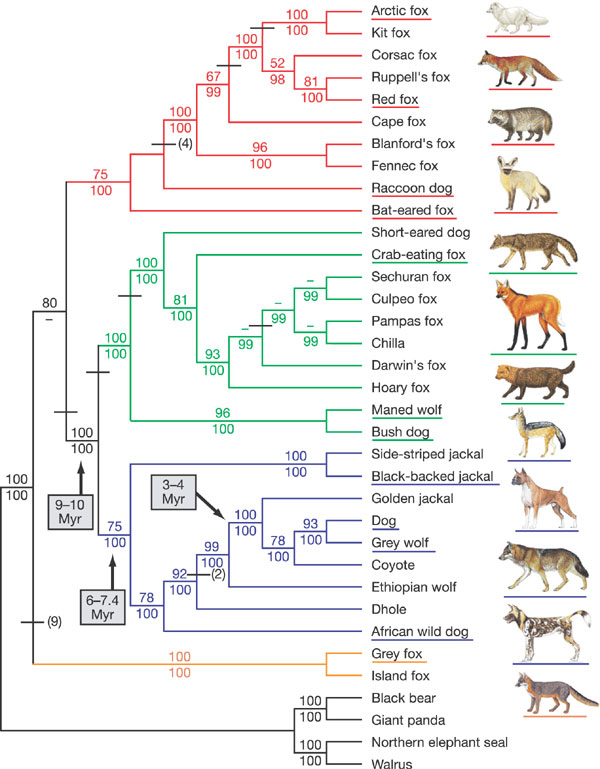
This animal is currently regarded as the Ethiopian wolf (Canis simensis). Its exact relationship to the other wolf-like canid isn’t exactly clear, but it is interfertile with domestic dogs. Some earlier mitochondrial DNA studies have suggested that is nothing more than an early offshoot of the Canis lupus line (hence the current name of “Ethiopian wolf”), while the genomic analysis study on the dog family suggests that it split off from the other wolf-like canids before the golden jackal did.

Whatever its exact position within the dog family, this account by Lydekker shows that the Ethiopian wolf was quite rare a hundred years ago. Although it lives in packs, it lives almost exclusively on rodents– the real Farley Mowat wolf– but that hasn’t stopped it from being persecuted for being a livestock killer. Its current problems are almost exclusively the result of its interactions with domestic dog, which carry canine diseases and occasionally “pollute” the gene pool through crossbreeding.  A dog-born rabies outbreak in Bale  Mountains National Park more than halved the population, which had the largest extant population of these dogs.

It is currently the most endangered of all wild dogs, and it may follow the warrah or Falkland Islands wolf into extinction. If it does,  the Ethiopian wolf and the warrah will be the first dog species to become extinct within historic times.

It is fascinating that so many people regarded this animal as a fox for no other reason than its red coloration. Would the same people have classified the Pomeranian or the shiba inu as a fox?  What about the darker golden retrievers?

Of course, its name has changed quite a bit over the years. When I was a kid, I saw a PBS Nature program about these animals, and it referred to them as the “Simien jackal.”  The animals were once quite common in the Simien Mountains of Ethiopia, which is where the other population of these wolves can be found. It made sense that they were jackals, but unlike golden jackals, it was noted that it was weird that they lived in large packs and lived almost exclusively on a type of mole-rat.

And now that it seems that the consensus seems to be shifting away from the theory that it was an early offshoot of Canis lupus, I wouldn’t be surprised if we starting calling it a jackal once again.

I would have called it the red wolf, but that name has already been taken– by a coyote!

Read Full Post »

Don’t be so bittern

Oh but I was born this way.


Read Full Post »

Puerto Rican anoles are bird brains

From Science Daily:

Tropical lizards may be slow. But they aren’t dumb. They can do problem-solving tasks just as well as birds and mammals, a new study shows.

A Duke University experiment tested Puerto Rican anoles on several cognitive tasks and found they can learn and remember to solve a problem they’ve never faced before. The results challenge the scientific stereotype that reptiles have limited cognitive abilities and methods for finding food.

The lizards’ success on a worm-based test normally used on birds was “completely unexpected,” said Duke biologist Manuel Leal, who led the study.

He tested the lizards using a wooden block with two wells, one that was empty and one that held a worm but was covered by a cap. Four lizards, two male and two female, passed the test by either biting the cap or bumping it out of the way.

The lizards solved the problem in three fewer attempts than birds need to flip the correct cap and pass the test, Leal said. Birds usually get up to six chances a day, but lizards only get one chance per day because they eat less. In other words, if a lizard makes a mistake, it has to remember how to correct it until the next day, Leal said. He and Duke graduate student Brian Powell describe the experiment and results online in Biology Letters.

Leal’s experiment “clearly demonstrates” that when faced with a situation the lizards had never experienced, most of them were able to devise a way to solve the problem. Their ability to “unlearn” a behavior, a skill that some mammalian species have difficulty in, is the mark of a cognitively advanced animal, said Jonathan Losos, a biologist at Harvard who was not involved in the study.

The results “should cause researchers to re-evaluate what they think they know about the evolution of animal cognition,” Losos said.

Leal tested the cognition of the Puerto Rican anole, Anolis evermanni, after seeing sparrows flip a cap to get a worm and wondering if lizards could do the trick, too.

“They’d put their snout under the little plastic chip and then quickly bump it,” Leal said. “They don’t do this in the wild.”

Even when Leal covered both wells, the lizards chose to flip the cap covering the well with the worm. They had learned to associate the color or brightness of the chip with their reward.

To see if the lizards could reverse this association, Leal next placed the worm under the other cap. At first, all the lizards bumped or bit the formerly lucrative blue cap. But after a few mistakes, two of the lizards figured out the trick. “We named these two Plato and Socrates,” Leal said.

The lizards’ performance doesn’t necessarily mean that reptiles are smarter than birds, said McGill University biologist Louis Lefebvre, who studies learning and behavior in birds and was not involved in the new study. He said a better way to use these new results would be to compare cognitive abilities among reptile species, rather than between reptiles, birds and mammals.

“We know birds and mammals have bigger brains and that within bird species and within mammal species, the bigger the brain is, the higher the chance of that larger-brained species making it when moving to a new environment,” Lefebvre said. “It may be the same with lizards.”

Research has shown that large-brained lizards are better than small-brained lizards at colonizing new areas. “My guess would be that the lizard genus in which Manuel Leal has shown fast learning would be among the larger-brained lizards,” Lefebvre said.

Compared to other lizards, anoles are better at exploiting diverse habitats and they exhibit complex behavior, factors that may favor the evolution of higher-level mental processing. The lizards’ ability to perform on the lab tests may also be an indication of the traits that allowed the group to successfully spread across the tropics, Leal said.

He plans to test other species of lizards and compare their brain to body size later this year.

Having kept a few green anoles (Anolis carolinensis) as pets, and they do have something like an intelligent expression in their eyes.


Read Full Post »

Taming adult wolves

Woolpy and Ginsburg (1967) were able to tame adult wolves. These wolves became fully social to all people and would greet everyone with a gentle face bite, which may be an inherited greeting motor pattern in northern wolves.

It is often said that adult wolves cannot be tamed. The animals are just too emotionally reactive and fearful to ever accept human contact, so if a facility wants to have wolves that can be handled, it must take them from their mothers at an early age, usually said to be before they are three weeks old.

However, there have been those who have tamed adult wolves. The most notable attempts were done by Jerome Woolpy and Benson Ginsburg of the University of Chicago.  Their success in taming adult wolves was described in The American Zoologist in 1967, but it is still often said that adult wolves that have not been socialized to people as puppies are impossible to tame.

The issue is not that it is impossible.   The issue is that it requires some special housing equipment and lots of time and patience to do so.

It should be noted that even though Woolpy and Ginsburg were able to tame these adult wolves, it does not automatically follow that they became exactly like domestic dogs. Although these wolves became very friendly toward all people, it is unlikely that these wolves could be used to do much of the specialized work that we ask of domestic. However, it is inaccurate  to claim that it is impossible to tame an adult wolf.

Woolpy and Ginsburg based their 1967 paper on their experiences with seven wolves. Three were socialized as neonatal whelps and were in constant contact with people throughout their lives.  Three were socialized as young puppies and adolescents and then turned out with other wolves that had not been socialized, and one was an adult wolf that had received no human contact until it was five years old. All were able to become socialized to people, and those that were socialized as adults were friendly toward all people. However, those three that were socialized as puppies and then turned out with other wild wolves were not social toward people at all. These wolves had to be tamed in the same way as the five-year-old.

The authors describe their socialization of adult wolves as follows:

So adult wolves can be tamed. It just requires a lot of time and expertise (and a bit of courage).

Granted, this was a very low n study, and three of the wolves that were tamed as adults had initially been imprinted on people as very young puppy.

But one was tamed as a “middle-aged” adult that had no prior experience with people.

So it can be done.

I believe the researchers were able to repeat these results with other wolves, for these researchers worked extensively with captive wolf colonies.

Other researchers haven’t had so much luck.

And I think there is a very good reason for it.

At the time, it was assumed that the only way one could handle wolves was to be very rough with them. In much of the captive wolf husbandry literature, it discusses how important one must establish dominance over the wolves to deal with them. Some wolf experts and pseudo wolf experts like to use lots of physical force  and dominance displays in dealing with their charges. And those actions are just the ones used with the socialized wolves.

The unsocialized wolves are often netted and gripped with catch poles to vaccinate them and to tranquilize them for physical exams or transport to new facilities.

The use of these differing but harsher techniques on both socialized and unsocialized wolves doesn’t really endear the wolf to its care-takers.

If you read what Woolpy and Ginsburg actually did, there was none of this “I am the alpha wolf” mentality.  There was also no assumption that an adult wolf couldn’t learn to accept people as social partners.

They simply asked the wolf to be friends.

Of course, it took a while to ask the wolf the question.

But once the wolf understood what was being asked, it answered in the affirmative.

***

Now, I should warn that it is not a good idea for amateurs to catch wild wolves and coyotes and try these techniques.

Not only is ownership of these wild canids illegal in many states and municipalities, it is really not wise for amateurs who have very little experience to try to pet wild animals of any sort.

***

It should also be noted that all of these wolves were large hunting wolves from northern North America, and all had come from wild populations that had been historically persecuted.

All of these wolves had very strong fear reactions, which is one reason why the socialized wolf pups lost their friendliness to people when they were house with unsocialized wolves for an extended period of time.

It is unlikely that the ancestral wolves had such strong fear reactions, and therefore, it would have been easier for ancient hunter-gatherers to form relationships with them. Most wild dogs that are not heavily hunted are very curious about people, and it is likely that ancient wolves were much more likely to approach people out of curiosity than modern wolves are.

These wolves could have been socialized as adults. It should not be assumed, as some often do, that the original wolves that were domesticated were neonatal puppies. Adult wolves could have been tamed, even without the specialized techniques that Woolpy and Ginsburg used.

Read Full Post »

« Newer Posts - Older Posts »

Follow