
These two bush dogs trying to increase the numbers of their species, which is considered near threatened in the wild.
These little dogs form packs of up to 10-12 individuals, and although they weigh only 10 to 18 pounds, they’ve been known to bring down tapirs and peccaries.
Bush dogs, dholes, and African wild dogs have an extra long “blade” on their lower carnassials that allows these wild dogs to more efficiently slice through flesh. These blade is called the “trenchant heel.”
Dholes and bush dogs were once thought to be close relatives. Not only do they share the trenchant heel, they also are unique among canids in that they have only 40 teeth. All other dogs have 42. However, dholes are also relatively small, weighing only 22 to 55 pounds, and bush dogs are the smallest of all pack hunting canids. But both the dholes and bush dogs have reputations for killing prey much larger than themselves. There is a common legend that dholes kill tigers, even though it’s much more likely that the tiger would stalk dholes. Amur tigers keep the northernmost dholes at relatively low densities, but Amur tigers are known for their penchant for eating both wolves and dogs. A dhole would just be a wolf of another flavor.
But when you combine the dentition with the legendary behavior of both species bringing down large prey, it is easy to see why people put the two together.
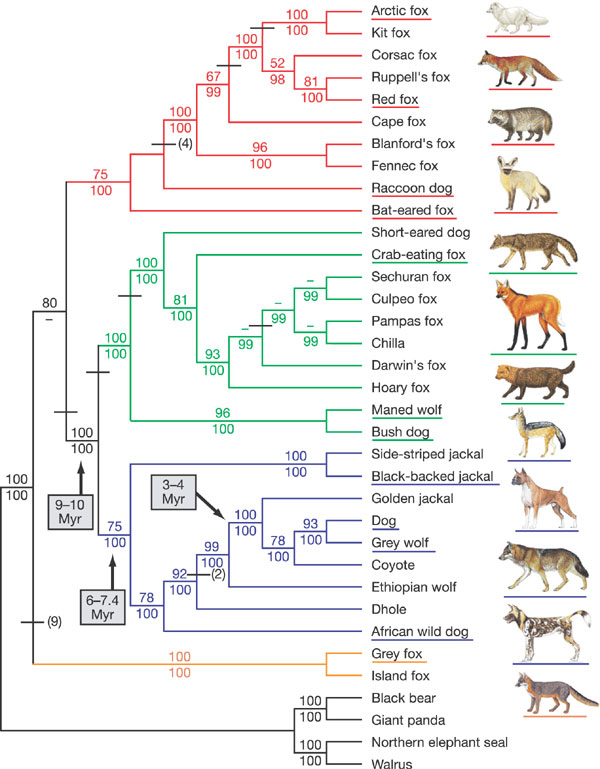
But now we know that the bush dog, despite its short legs, is actually most closely related the rangy maned wolf of South America– which is not a true wolf at all but a member of the South American canids clade. The dhole is very closely related to the genus Canis, and it probably should be classified within it. Its exact relationship to the African wild dog is still debated, as is the exact natural history of the dhole.
But it’s obvious from the genetic studies, that dholes are not related to bush dogs at all. (See this phylogenetic tree, which was drawn from sequencing the dog genome to see where the various dog species.)
***
This post is working up to something else, so be ready for it.





Dholes are a beautiful animal. I don’t know why Rudyard Kipling chose to paint them as bad guys in his Red Dog story of Mowgli.
Bush Dogs I heard first in a book called ‘Know about dogs’, printed from Australian in 1979 or so.
They are many wild rumors about dholes. The story of them regularly attacking tigers is just malarkey.
At one time they were considered a possible ancestor of the domestic dog, in part because they look like certain dogs from East and South Asia and the dingo.
It is incredible to see such a small animal as Dhole pairing up and taking down Cheetal (Axis Deer?) and Sambhar deer. I salute them on their hunting strategy and gal.
Yeah, They are called chital in English, but in Texas, they get called axis deer.
Which makes me think they were on the wrong side of World War II.
If the dholes are impressive, think about a pack of 15-pound bush dogs attacking a tapir or a peccary.
“Which makes me think they were on the wrong side of World War II.”
LOL
“If the dholes are impressive, think about a pack of 15-pound bush dogs attacking a tapir or a peccary.”
That would be impressive indeed. The closest I have come is seeing 5 Fossa allying to hunt a big beautiful Lemur. I was unable to follow the hunt through though. I was in my early teens and on the wrong side of the Allies. I could not bare seeing the final assault.
The bush dogs are kind of cute. This incited me to google them.
I can see why indigenous people in South America often keep these dogs as pet.
They are kind of like a naturally occurring dachshund!
Bush dogs are conspicuously absent from being documented to occur in Suriname, a country I visited in 1990s. John Walsh, in his epic book on rescuing animals from dam construction related flooding of forests in that country – ‘Time is short and water rises’ – did not come across any.
The book itself is awesome and gives many accounts, some quite emotionally, about the deserted village dogs that the rescuers saved from drowning and subsequently kept as pets and assistants throughout the project.
[…] it was once accepted that the bush dog of South America was actually a species of dwarf dhole. Dholes and bush dogs have similar dental features, so it was assumed that there was some relationship between them. Genetic evidence has shown that […]