This is the original version, but I prefer the various bluegrass covers.
It’s so much better in bluegrass that one would have thought it would have started out as a bluegrass song.
It didn’t.
Posted in music on November 19, 2011 |
This is the original version, but I prefer the various bluegrass covers.
It’s so much better in bluegrass that one would have thought it would have started out as a bluegrass song.
It didn’t.
Posted in dog domestication, domestic animals, domestication, wild dogs, tagged Dmitri Belyaev, fox, marbled foxes, pearl foxes, piebald deer, red fox, Siberian fox farm experiment, spotted foxes on November 19, 2011 |
The following foxes have nothing to do with Dmitri Belyaev Siberian fox farm experiment:

Pearl foxes. Marked like border collies but not selected for tameness.

Irish marked marble fox, full body view.

Marbled fox. Almost entirely white.
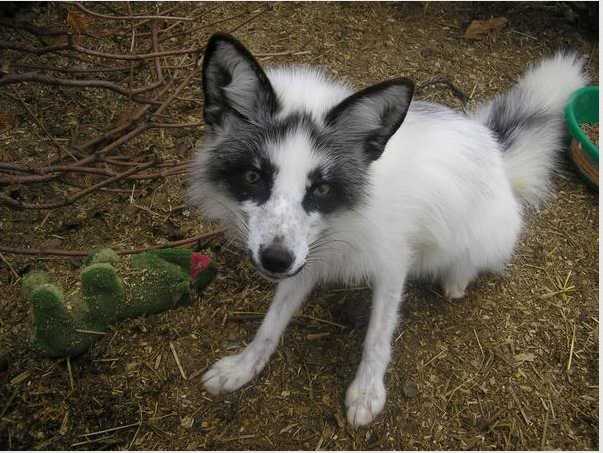
Another marbled fox. These foxes are sometimes sold to rubes as arctic foxes. They are nothing more than red foxes with unusual coat colors. Arctic foxes are white only in winter. These foxes are always predominantly white.
These phases not result from their ancestors being systematically selected for flight distance or decreased aggression towards humans.
They resulted simply from unusual sports that popped up in farm fox breeding operations, and then the owners began to select for these color varieties. They normally aren’t uniform enough to make good pelts, but they often sold to roadside zoos.
These colors probably popped up as a consequence of being bred in captivity. Belyaev suggested that his team was actually selecting for for genes that affect neurotransmitters that also affect melanin production. So in this hypothesis, the selection for “tameness” increased the likelihood of producing spots. But captivity produces a series of selection pressures on wild species that might be connected to selecting for both neurotransmitters and spots. It’s not tameness as defined by this experiment that affects morphology. It is simply being bred in captivity that produced the spots.
Again, we actually don’t know the exact genetic basis behind the spotting, but we do know that these are phases that have been selected for in captivity.
Mark Derr in How the Dog Became the Dog points out that the control population of foxes in the Belyaev experiment also produced these spotted forms. It was not the selection for tameness or docility that produced the spots.
The truth is we just don’t know why they are spotted. The neurotransmitter-melanin hypothesis is worth exploring.
However, wild animals have been born with spots.
As I mentioned earlier, the leopard complex in horses existed when horses were wild animals. There were “Appaloosa” horses 25,000 years ago. People were hunting horses in those days. They weren’t selecting them to be tame at all.
There are also piebald white-tailed deer. They are rare, but they are just as wild as the ones without spots.

It is possible that spotting is less of a problem for large ungulates in the wild than it would be for predatory mammals, even among those– such as wolves and foxes– that don’t use their coloration as camouflage. Animals with lots of spots would have a hard time hunting for whatever reason, and nature would strongly select against these colors.
However it may be that spotting is of no consequence with certain species of ungulate.
Of course, there is research that shows that most ungulates are uniform in color because predators tend to select those that are aberrant. That’s why you don’t often see white gnus or dalmatian-spotted gazelles.
The truth is we simply don’t know why some animals develop spotted pelts.
We have many hypotheses.
But the truth is likely quite complex.
And artificial selection is too often ignored as an agency.
The fox farm experiment likes to make a lot of hay out of the coat color changes in the domesticated foxes, but it doesn’t answer why marbled and pearl foxes turned up in populations that were never selected for tameness in this fashion.
We are simply not served well by such reductionism.
Posted in Absolute Piffle, tagged pug on November 17, 2011 | 4 Comments »
Posted in dog breeding, dog health, tagged boxer, homozygous bobtail, natural bobtail, Nova Scotia Duck-Tolling Retriever, Pembroke Welsh corgi, tail-docking on November 17, 2011 | 18 Comments »

This is a homozygous natural bobtail Pembroke corgi that was born alive. You can tell from its profile that it has something very wrong with its back end.
Over at BorderWars, Christopher Landauer has taken down one of the great myths that breeders of dogs with a certain type of natural bobtail often like to perpetuate. (I should warn you that the images on this post are quite graphic. Reader discretion advised.)
The myth is that although this trait is a considered lethal when inherited in a homozygous manner, these homozygous natural bobtails are never born.
This myth has gained certain currency in Europe, where tail docking is becoming illegal in country after country. If docking is illegal, then many breeds are going to have to breed for a consistent tail type and carriage. When breeds have been docked for generation after generation, no one has selected for any kind of consistency in the tail, which makes the dogs harder to show. If a breed has a wide variety in phenotypes, it’s very difficult for judges to make a selection about which dog is truly meets the standards.
So it might be a good idea to produce lines of dogs that don’t produce any tails at all. Dogs that are born pre-docked.
Sounds like a wonderful idea, eh?
The first breed to undergo an experiment to produce natural bobtails was the boxer. Dr. Bruce Cattanach bred a white boxer to a Pembroke corgi with a natural bobtail. After just a few generations of breeding back to the boxer breed, he was able to produce naturally bob-tailed dogs that were virtually indistinguishable from high quality conformation boxer in the UK.
This particular outcross was performed without any consultation of the German Boxer Club. Germany is the patron country of the boxer in the FCI, and the German Boxer Club refused to accept any dogs that are naturally bobtailed. The German and FCI standard now disqualifies any dog that is naturally bob-tailed, and all the boxers I saw in Germany had long, whip-like tails.
This particular outcross is essentially a failure on breed politics grounds. The majority of boxer clubs in the world will not accept these dogs. And there is really no health or working reason to dock a boxer. Most boxers are family pets. They aren’t running over fields covered in thorn bushes that might damage their tails, as would be the case for a German short-haired pointer, and they aren’t guarding flocks of sheep from wolves that might try to catch them by the tail, as would be the case for a Central Asian ovtcharka. Boxers look fine with tails. The only downside to a boxer with a tail is that it might be mistaken for a pit bull and result in some bizarre hysteria.
But even if this natural bobtail didn’t totally fail breed politics, there are actual health and welfare reasons to be skeptical of it.
Cattanach contends that natural bobtails are not a problem in terms of health.
However, as you will see in Chris’s post, there are risks of breeding natural bobtails together.
Although homozygous natural bobtails are rarely born, they still are born on occasion.
And when they are born, they have severe deformities.
The dog pictured above was a homozygous natural bobtail that was born in a natural bobtail to natural bobtail breeding. It was euthanized shortly after birth. It was born with no anus, no tail, and an open hernia that leads into the spinal canal. This animal simply could not have survived.
This is the photo of the back end. I should warn you that this image is quite graphic, and it may be disturbing to some readers.

No anus. No tail. And an open hernia into the spinal canal.
Another homozygous natural bobtail corgi was also born. This one also had no tail and no anus. Its intestines and lungs were full of gas, and it had severely wasted muscles in its hindquarters. It also had a kinked spine.
Any breeding can produce dogs with deformities. My uncle bred a puddin’ Jack Russell that was half puddin’/ half JRTCA to a bitch that was derived English farm stock that likely included some border terrier or Patterdale ancestry. The two dogs produced three litters. The first one had two healthy puppies. The next had three. The fourth had five, but one of these had spina bifida and had to be euthanized. This was an entirely outbred litter, and neither parent had any defects or disease. But a birth defect still happened.
However, when one breeds natural bobtail to natural bobtail one is accepting a relatively higher risk that a truly deformed puppy might be born, and in this situation, we have to consider the ethical implications.
Now, we do have lethal traits that are inherited in a somewhat similar way to this form of natural bobtail. The dominant hairless dogs– the xoloitzcuintli, the so-called Chinese crested dog, and the Peruvian Inca orchid–are hairless because of a mutation that in theory is inherited the way it is often claimed that natural bobtails are. These hairless dogs do not produce solely hairless offspring when bred together. That’s because homozygous hairless puppies are never born. They die before they ever develop into puppies. All of these hairless dogs are heterzyous hairless, and they all carry the recessive coated trait. In every hairless breed of this type, there will be coated puppies born. It’s very simple.
Cattanach claims that the natural bobtail is just like this hairless trait.
But the two corgi pups show that it is not.
If it were just like the hairless dogs, these two puppies would never have been born.
And because they were born alive, there is a real welfare consideration that has to be made.
The German Boxer Club made the right decision. As Europe pushes harder against tail docking, the future is going to be with long-tailed boxers, not gimmicks with natural bobtails.
***
I find it particularly interesting that Cattanach has come out against the Australian shepherd/Nova Scotia duck-tolling retriever cross-breeding program.
This particularly program is controversial, and it is totally failing breed politics. But it is an outcross for an entirely different reason.
Nova Scotia duck-tolling retrievers have low MHC/DLA haplotype diversity. These MHC/DLA genes control immune response, and because tollers have such low diversity, they have very real issues with autoimmune disorders.
The only way to increase diversity in haplotypes is to outcross or bring in unregistered dogs from Nova Scotia– which may or may not have diverse MHC haplotypes.
This crossbreeding has been criticized for using an Australian shepherd, a breed that comes in merle and is sometimes more reserved in temperament than toller people might like.
Also, one person in Germany is doing the crossbreeding, and one person doing the crossbreeding on his own cannot save the entire breed. His dogs likely won’t be included in the bloodlines of the breed.
However, he is doing something. And its for the health of the breed. Maybe the breed clubs will accept his dogs one of these days.
However, this is a beautiful example of cognitive dissonance within the dog fancy.
Cattanach claims that it’s okay to outcross to a corgi to introduce a cosmetic trait into boxers– even if this cosmetic trait can result in severely deformed puppies. And even if this outcross winds up failing totally when it comes to the politics of the boxer fancy, he still promotes it as a sucess.
But if anyone tries to outcross another breed for health reasons, it’s a bad idea.
It’s really interesting the amount of cognitive dissonance that exists within the dog fancy at large.
It’s everywhere.
Posted in Uncategorized, tagged Romanian hamster on November 16, 2011 |

This is a Romanian hamster (Mesocricetus newtoni). It is found in Bulgaria and Romania near the Black Sea.
It was heavily persecuted because of its depredations on agricultural enterprises, and it is now regarded as “near threatened” by the IUCN.
I don’t know how to distinguish this species from the golden hamster.
If it’s running in the wild in Romania or Bulgaria, that might give me a clue.
But other than that…
I should note that this species has a gestation period of only 15 days. Golden hamsters have a gestation of 16 days, which means that the Romanian hamster has the shortest gestation period of any placental mammal.
Posted in domestic animals, domestication, wildlife, tagged Brandt's hamster, golden hamster, Mesocricetus, Syrian hamster, Turkish hamster on November 16, 2011 | 3 Comments »
Our mystery animal is a Turkish hamster (Mesocricetus brandti).

It is very closely related to the golden or Syrian hamster (Mesocricetus auratus). If someone presented this animal to me, I would have a hard time distinguishing it from a paler than normal wild-type golden hamster. However, most wild-type golden hamsters are quite richly gold in color.

Wild-type golden or Syrian hamster. Note the rich gold coloring.
Domestic golden hamsters come in several phases. One really common phase is cinnamon, which is the wild-type coloration without any black hair mixed in. This phase also lacks the black pigment on the ears and on the skin and eyes of the wild-type golden and the Turkish hamster. However, one could mistake this phase for a Turkish hamster.

However, it gets more tricky when one is confronted with a golden hamster that is paler gold than a normal wild-type golden hamster.
I would have a hard time telling a Turkish hamster from some of these paler gold wild-type hamsters.

Now, the hamsters themselves don’t really have this problem.
In the wild they don’t share the exact same range. Turkish hamsters are relatively widespread through from Anatolia through Transcaucasia into Iran.
Golden hamsters, which are often called Syrian hamsters, are found only in northern Syria and a small portion of adjacent Turkey.
These two animals very strongly resemble one another, and they are fairly close relatives.
However, they do not interbreed.
Let me rephrase that.
In captive situations, the two species have bred, but no offspring have been produced.
Both species have been kept as laboratory animals, but only the golden hamster has been docile enough to be placed on the pet market.
The Turkish species is known for being quite prone to biting, and like the golden hamster, it is solitary.
Now, one should keep in mind that golden hamsters are not known for being particular docile animals. As a child, I kept many golden hamsters, and I can attest to how fractious they can be at times. The show and pet strains of hamster that are relatively common in the United Kingdom that are known for their docility were not available on the North American pet market at the time. So I essentially had wild hamsters for pets.
If Turkish hamsters are more likely to bite than “wild” golden hamsters, it’s probably a good thing that they aren’t available on the pet market.
It’s really quite a shame, for Turkish hamsters have a greater genetic base than golden hamsters. Because they are more widespread, there are more populations to select from. All golden hamsters on the pet market descend from a single litter that was collected near Aleppo in 1930. In Europe, there is a colony of golden hamsters that are more genetically diverse than this population. This other colony was captured in Syria during two expeditions in the late 90’s. It’s not easy to get into Syria these days, so it’s not likely that any new golden hamster lines will be brought into the domestic population in the West.
But they have not contributed any genetic material to the pet market.
It’s kind of a shame that Turkish hamsters are so difficult to tame– and cannot interbreed with goldens. The Turkish species would have a much more stable gene pool, and in theory, it could have provided some genetic material to the domestic Mesocricetus lines. The Algerian hedgehog and the four-toed hedgehog have been crossbred in captivity to produce the domestic African pygmy hedgehog, and something similar could have been done with Turkish and golden hamsters– if only they were interfertile.
In this way, the two species of Mesocricetus hamsters are like the white-footed mouse and the deer mouse. These two species of New World mouse are very similar, and I personally can tell them apart. But they cannot interbreed, even though they are superificially similar and belong to the same genus.
If only Turkish hamsters were nicer.
Posted in out of place animals, wildlife, tagged Australia, Kakadu lion, Kakadu National Park, Lion, Northern Territory lion on November 15, 2011 | 4 Comments »
Here they are:

Um.
Well, here’s the story from The Northern Territory News:
There may be lions galore roaming the Top End. West Australian Mary Ford sent the NT News a photograph showing what appear to be big-cat paw prints.
She said the picture was taken at the entrance to Kakadu National Park in 2008.
But world-renowned experts say the prints show an animal without retractable claws, which means they probably belong to a big dog – or maybe a cheetah?
Three drivers said they had to stop when a lion crossed the Stuart Highway at Pinelands, on the outskirts of Darwin, on Sunday.
The NT News reported yesterday on speculation that the animal had escaped from a private collection in Humpty Doo
An impeccably informed source said: “Surely the good people of the Doo would hear a lion roar and ask, ‘What the hell is that? And then call the police.”
Readers share his scepticism.
Mad Bull of Alice Springs wrote on ntnews.com.au: “Maybe the roar heard was from Green voters because at the next election they will be silenced.”
Humour-challenged Brian of Thailand posted: “You have excelled this time with your crap.”
But Emma, who is intelligent enough to understand that something is humorous without having to be told “this is funny”, wrote:”Hahahahha. Love it.”
And commenter Dick Handcocks, who describes himself as “brother of Leon of The Doo”, said: “I’ve noticed a lot of fat hippos walking down Mitchell Street, especially when the US navy is in town.
“Good old Darwin is full of a variety of animals and plankton. Some breed out of control – their existence is supported by the taxpayer and Centrelink.”
Well. Whatever may have been seen in the Northern Territory, I can say definitively that these are not “lion tracks.”
Your mystery animal is some version of Canis lupus, either Canis lupus dingo or Canis lupus familiaris.
It’s a dog or a dingo.
Which may or may not be after your baby.
Just for comparison here is a dog track:

See how it’s oval shaped and the toes are arranged to a point? See the claw marks?
That’s how you know you’re looking at a dog’s tracks.
This is an actual lion track that is juxtaposed with a human hand:

Even if we ignore the size, the toes range outward. There are no claw marks with the tracks, because lions can retract their claws.


 | williewestfall on Bobcat scat |
 | cyborgsuzy on Forgive the gratuitous ne… |
 | retrieverman on Forgive the gratuitous ne… |
 | pondpawed on Forgive the gratuitous ne… |
 | Eugenie on Tailgate |





