Painting by John Ferneley Sr (1823).
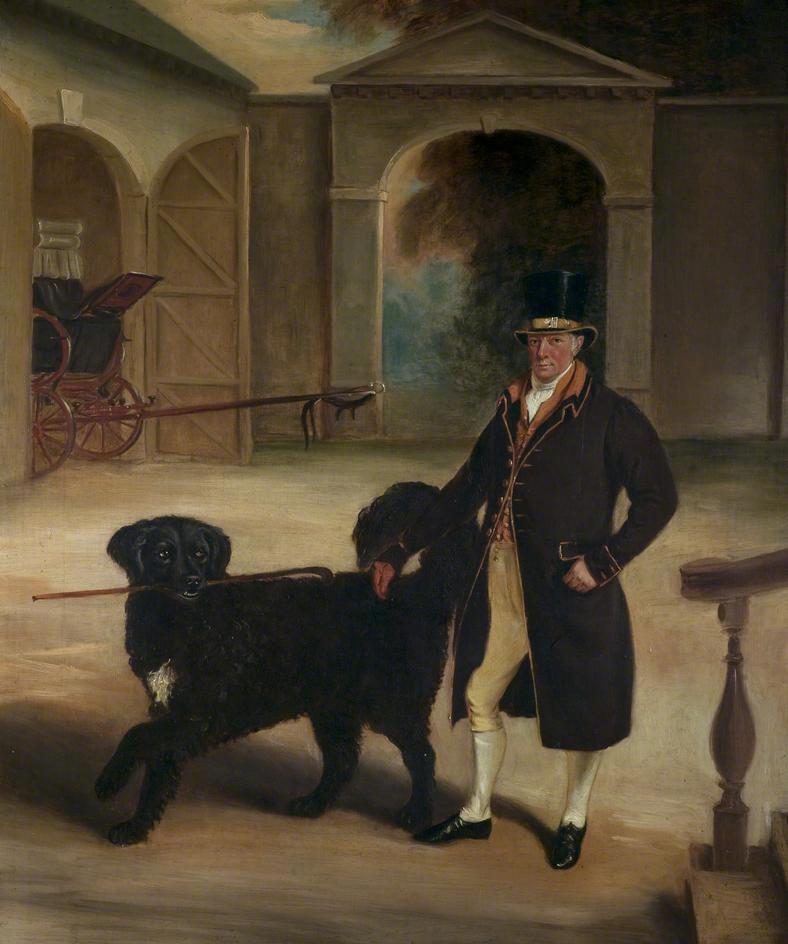
This dog looks like a large St. John’s water dog or a very large wavy-coated retriever.
This type of Newfoundland started out as nothing more than an “improvement” on the St. John’s water dog that made if more palatable to the British dog buying public.
Retrievers and Newfoundlands are derived from the same root stock, and the initial difference between the two was trifling.
The big difference is that sportsmen who wanted a retriever began to breed smaller and more agile dog– often crossing their dogs of this stock with water spaniels, collies, and setters.
The people who wanted a pet Newfoundland bred for a larger and larger dog. By the middle part of the nineteenth century, virtually all Newfoundlands available in England on the pet market were big black and white dogs. There were predominantly solid colored dogs around, but a huge chunk of these were in the stock being selectively bred for retrievers.
The dog at the base of the retriever/Newfoundland family is what is sometimes called a St. John’s water dog. It was a working dog in Newfoundland that was about the same size as a Labrador or golden retriever.
But this dog was a landrace that was derived from several different dog stocks. There is some debate as to what these dogs looked like, but the general consensus is the pet Newfoundland in England was very different from the working dog of Newfoundland.
The Newfoundlanders eventually came to breed only smooth-coated dogs, and the last “pure” representatives of that landrace were all smooth-coated and almost entirely black in color. There may have been rather large dogs in Newfoundland, but I doubt that true giant dogs ever existed there– until the pet Newfoundland was re-imported as an “improved” European breed.
In essence, the giant Newfoundland is a creation of the demands of the pet market as much as the giant Labrador retrievers of today are.
I am not doubting whether the St. John’s water dog was used to haul loads in the interior. I am fairly certain that the robust bodies of many Labrador and golden retrievers and of historical wavy and flat-coated retrievers are reflection of this utility as a hauling dog.
But a giant dog would not have been of much use in a society that was primarily focused upon fishing, hunting, and trapping for survival. Big dogs eat a lot, and they have real issues with their joints as they mature. Such an animal couldn’t be used for hauling until it was several years old, and it would not have been of much use for the amount of food it consumed.
I would treat this Newfoundland as a sort of missing link between the St. John’s water dog and “the improved” pet Newfoundland.




Calling the “improved” Newfoundland dog a “pet dog” is a little misleading, as they were not really house pets as we think of pet dogs today, but rather were kept more as decorative objects to grace the grounds of the manor, to impress visitors to the estate,. to accompany the coach, and to occasionally serve as deterrents to unwelcome comers with a mind to snag a valuable. Those Newfoundland dogs would far more likely be found in the stable than in the drawing room; as indicated by the familiarity expressed between coachman and dog in the Ferneley painting.
A pet in terms of conspicuous consumption.
I can tell you that a great many people kept them for no purpose other than to be a family for their children. Nana from Peter Pan was a Newfoundland. President Grant had one for his children.
They were more like collies before they were collies and retrievers before they were retrievers.
This was the dog that everyone had to have in the nineteenth century. Some people kept them as you say, but Lord Byron and others certainly kept them as pets as we would today.
Yeah, we tend to prefer the smaller dogs (they tend to live longer), although being in the ‘rescue’ end of things, we don’t always get that choice. We’ve been maintaining Sammie at about 130lbs. He’s 5 years old now, but people still frequently ask me if he’s a puppy because he’s so frisky and doesn’t carry a lot of weight.
Based on his frame, height and length, if he did carry the weight so common to this breed he’d probably be about 180 or 190. The biggest ‘dog’ we’ve had, Jamila, was 167lbs but she was specifically bred for show (too nervous to show though) and her sire was a lean 200+lbs.
I can’t speak for other giant breeds, but I can tell you that properly fed Saints don’t eat as much as a good sized GSD once they’re grown.
How much do they eat while they’re growing? That’s a completely different bowl of kibble.
Yeah. They eat a lot as they grow, and the mainstay of the diet of these water dogs was offal and bones from fish, seals, and other marine mammals.
Not anything like modern balanced dog diets.
Barry the famous St. Bernard weighed only about 90 pounds.
Based on my personal experience and observations, both Saints and Newfies (the newer kind), are extremely people-oriented and tend not to do well when kept as out-side, stable dogs (unlike the Pyrenees, which generally don’t want to be inside.) These giant puppies really want to be part of the family and languish when kept apart from their people.