
This bird is a melanistic common or ring-necked pheasant (Phasianus colchicus). This is a hen pheasant.
She’s much darker brown and has more black on her plumage than a typical hen of this species. She’s not really as black as one might expect a melanistic animal to be.

A typical hen pheasant for comparison.
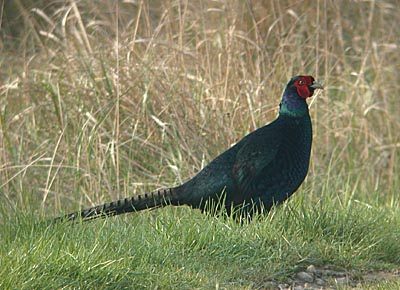
The cock melanistic pheasants are really black. Well, they are black in that their whole bodies are the same color as a typical cock pheasant’s head– black with a greenish sheen.




[…] The Answer. Share this:TwitterFacebookRedditPrintDiggStumbleUponLinkedInEmailLike this:LikeBe the first to like this post. […]
So I did get it right. :)
This melanistic hen is very striking though, she’s looks so pretty.
What’s the current wisdom on the survivability of melanistic prey animals? I would imagine that there might be some situations where it it might be an advantage and others (such as a snowy landscape) where it would be a liability.
These pheasants don’t survive very well, but I can tell you that melanistic gray squirrels do fine. 1/3 of the gray squirrels here are black.
Black wolves, which get their black coloration from dogs, are thought to have a heightened immune system. The gene for melanism belongs to a family of genes that affects the immune system: http://www.wired.com/wiredscience/2009/02/blackwolves/
I’ve seen similar studies on black leopards that have made the same claim.
Hello, last Sunday (1st April) I saw what must have been a melanistic cock pheasant on a back road in the Scottish Borders. I slowed my car to have a closer look: my impression was that the body and wings were purplish rather than deep green in colour. A lovely bird, slightly smaller than the usual pheasant. Incidentally, I think I saw a ptarmigan on the same road a week or two ago (March); do they stray so far south?
The red grouse of Scotland is a subspecies of what North Americans call “willow ptarmigan.” They don’t normally turn white in winter, unlike the other subspecies, so it might have been an albino or leucistic red grouse. Or it could have been a vagrant from another subspecies of willow grouse that turns white in the winter.