Feeds:

Archive for December, 2011

Rudolph the fang-toothed deer

From left to right: Siberian musk deer (which isn't a true deer), Reeves's muntjac, and a Western roe deer.

The notion of tusked deer is a bit foreign to North Americans, but people living in the UK will know that two small deer that were introduced from Asia, the Reeves’s muntjac and the Chinese water deer, actually possess sharp canine teeth.

It is thought that the ancestral deer was very similar to the so-called musk deer of Asia.  Musk deer have several features that true deer lack, and one of the most notable is their lack of antlers.  Musk deer have very well-developed canine teeth, and they look almost like saber-tooth cat crossed with a deer.

Musk deer are solitary animals, and if they meet, they use these long canine teeth on each other.

Just as it is the male true deer that typically have the antlers, it is the male musk deer who have the really impressive canine teeth.

The reason why it is thought that modern deer were much like musk deer is that many smaller species of deer in which the males possess impressive canine teeth.

The water deer of Asia has the long canine teeth, and neither sex has antlers. Water deer can form small groups, but they are less social than other true deer.

Reeves’s muntjac, which is native to temperate parts of Asia, has smaller canine teeth than a musk deer, and the bucks have antlers.  These antlers are quite small compared to other species of deer, and they use them primarily as a way of knocking their opponents off balance. After they knock their opponents off balance, they use their canine teeth on them.

Most modern deer have lost their canine teeth entirely. The antler has become the primary weapon.

But before deer had antlers, they had fangs.

And some still have them today.

The species we call reindeer or caribou (depending upon location and whether one is wild or domestic) probably could have had some use out of fangs.  Both sexes of caribou/reindeer possess antlers, which they use against each other.  It is thought that this species of arctic deer developed this trait– which is normally a trait of sexual dimorphism in other species– in order to give the females better tools to fight off other deer when the foraging gets tough in the winter.  Antlers take a lot of energy and nutrients to grow every year, so as weapons, they are pretty costly to the animal. Fangs really aren’t that costly, and they have them all the time.

Deer likely evolved super ornate antlers as a result of sexual selection.  The females are just more attracted to males with more ornate head weapons.

Caribou evolved from deer that had gone down this evolutionary road, so the trait of both sexes possessing antlers had to be built out of that lineage.

So female caribou have to devote energy and nutrients into growing antlers and into feeding their offspring. No other female deer has this problem.

That’s a major tax on any animal.

Ah, yes, we have another example of why intelligent design is crap.

And intelligent designer would have given caribou fangs.

But I don’t think Rudolph would be all that cute if he had the dentition of a saber-toothed cat!

Read Full Post »

The ratel or honey badger

From Brehm’s Life of Animals (1896):

The Ratel, or Honey Badger (Mellivora capensis), attains a length of Described. twenty-eight inches, ten of this forming the proportionately long tail. The hair is long and wiry; forehead, back of head and neck, back, shoulders and tail are ashy gray, while the snout, cheeks, ears, throat, breast, underpart and legs are grayish black, the line of demarcation between the two colors being very distinct. Usually a light gray stripe separates the coloring of the back from that of the under surface of the body, distinguishing the African Ratel from its Indian cousin [the Indian subspecies of the honey badger]. The Ratel lives in in subterranean, which it excavates for itself with incredible dexterity. It is so slow and clumsy that it could never escape its enemies, were it not for this ability to bury itself, at least in soft ground, digging a burrow so quickly as to hide before its antagonist has had time to attack it. Its habits are nocturnal and it seldom sallies forth in the daytime. On our hunting trip to the Bogos country we saw the Ratel twice, both times in the evening, before sunset. At night it prowls around slowly, at its own will, preying on small mammals, especially Mice, or birds, Tortoises, Snails and worms; digging out roots or tubers, and looking for fruit. One preference determines its whole mode of life and gives it a distinguishing name: it is passionately fond of honey and, therefore, is a zealous hunter of Bees. In the treeless regions of Africa, Bees settle in all kinds of deserted holes in the ground, just like the Humble-bees and Wasps. Such a nest is the most welcome thing a Ratel can find, and when discovered the creature proceeds to destroy it with marked satisfaction. The Bees defend themselves as well as they can, seeking to wound the enemy with their stings, but its hairy, thick hide is an excellent shield, for it lies more loosely on the subcutaneous layer of fat than that of any other animal. The Ratel is said to be really able to turn around in its skin. Bees are utterly powerless before such an enemy, which greedily digs around in their abode and feasts on its contents.

The Ratel is not only fond of honey, but also looks for more substantial food. Carmichael says that owners of poultry-yards regard it as one of the most destructive creatures to be found. In Algoa Bay several peasants were once quarreling over some eggs, which Hens had laid outside of their coops, when a Ratel put an end to the contention by killing all the Hens—there were about thirty of them — in a single night, and carrying three away to its den (pg. 172-173).

So essentially, the honey badger takes what it wants.

Source.

Read Full Post »

Merry Christmas!

My holiday card to all of you:

Reference for those of you have not seen National Lampoon’s Christmas Vacation.


Read Full Post »

Black-backed jackals in love

Read Full Post »

Squirrel attack scene from National Lampoon’s Christmas Vacation

This squirrel is an obvious secular progressive who says “Happy Holidays” instead of “Merry Christmas.”

Source.

Read Full Post »

Dog breeding for extremes

Thanks to Chris Miele for sending this one along:

Source.

Read Full Post »

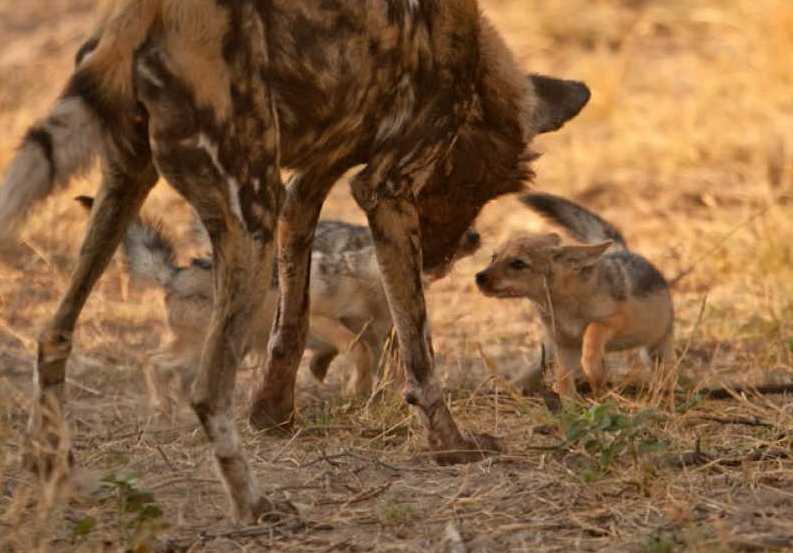
African wild dog feeds black-backed jackal puppies

The lone wild dog of Mombo in Botswana feeds some black-backed jackal puppies.

Wild dogs and jackals feed their pups through regurgitating what they’ve eaten.

Under normal conditions, these jackal pups would be doomed if a wild dog showed up at their den.  African wild dogs normally kill black-backed jackals and their pups. This one found herself without a pack of her own species, so she settled with joining up with a pack   of a distantly related species.

See related post:


Read Full Post »

« Newer Posts - Older Posts »

Follow