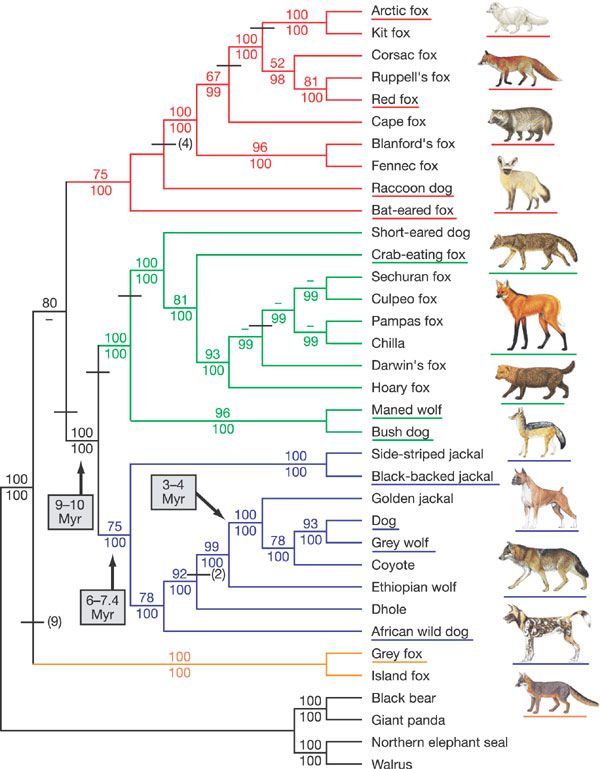
This phylogenetic tree comes from a study that used a high quality draft genome sequence of the domestic dog to make important comparisons within domestic dog breeds and also to make some comparisons with their relatives.
One of the most interesting discoveries in the this study was that the genus Canis as it is currently classified is paraphyletic.
Paraphyly is a major problem in cladistic taxonomy, for the goal is to have genera, orders, and families all to reflect common ancestry.
But if one looks at the species currently classified as belonging to the genus Canis on this phylogenetic tree, there is a gap between the two endemic African jackals– the side-striped (Canis adustus) and black-backed (Canis mesomelas)– and the other species in the genus Canis– the Ethiopian wolf (Canis simensis), the golden jackal (Canis aureus), the coyote (Canis latrans), and the Holarctic wolf/domestic dog/dingo/New Guinea singing dog species (Canis lupus). This clade of Canis includes the interfertile Canis, where hybridization is possible between all members.
The two endemic African jackals cannot cross with any other members of the genus. Let me repeat that: there are no black-backed jackal or side-striped jackal hybrids with domestic dogs or any other dog species. Some people claim that pariah and village dogs from Africa have ancestry from these jackals, but no genetic evidence has been provided to confirm the existence of these hybrids.
If one follows that phylogenetic tree, the gap between the two groups of Canis is filled with two species. These are the so-called “hunting dogs,” which we call the dhole (Cuon alpinus) and the African wild dog (Lycaon pictus). The most common hypothesis about the origin of these dogs is they are both derivatives of an extinct wolf-like dog that was called Xenocyon lycaonoides. There is some debate about whether both of these dog descend from them, but the bulk of the literature suggests that they derive from this species. Xenocyon filled the same ecological niche as wolves eventually did, but it was not part of the wolf lineage.
The conventional thinking on Xenocyon is that it evolved into the dhole and African wild dog species, but there is at least one study that suggests that the African wild dog derived from a different lineage. I am a bit skeptical of this study because it was based upon tooth morphology. Tooth morphology is one aspect that has led us to believe that African wild dogs and dholes are related, but one should keep in mind that tooth morphology once led us to believe that dholes and African wild dogs were closely related to the South American bush dog (Speothos venaticus), which we now know is part of the South American canid clade. If these tooth adaptations can evolve from that such disparate lineages, I don’t see why they couldn’t have evolved from unrelated lineages in the past.
Whatever the exact ancestors of the dhole and the African wild dog, they create a gap in the phylogenetic tree between the interfertile Canis and the endemic African jackals.
That means that we have to make Canis monophyletic.
The easiest way to do this is to get rid of the genera Cuon and Lycaon. The African wild dog becomes Canis pictus (the painted dog) and the dhole become Canis alpinus (the mountain dog). I don’t recommend going with Canis lycaon to denote the African wild dog. This name has been bandied about for the proposed but now largely falsified Eastern wolf species, and using this name for the African wild dog would just make things very confusing.
If Cuon and Lycaon are no longer unique genera and the species within them are reclassifed as Canis, the entire genus becomes monophyletic.
I would recommend this recourse.
However, one could keep Cuon and Lycaon if one created a unique genus for the black-backed and side-striped jackals. Several genus names have been proposed for jackals, but I don’t know if we have a good system for coming up with one. The study that suggests that Xenocyon and the African wild dog suggests that we use the Lupulella for these two jackals, which would connect with what have been called primitive jackals that were living in Northwestern Africa during the Pleistocene. These primitive jackals had morphology that was very similar to the modern raccoon dog (Nyctereutes procyonoides). Black-backed jackals in their current form trace to the early Pleistocene in East Africa, so they likely didn’t derive from these primitive ones in Northwest Africa. And it is unlikely that side-striped jackals evolved from them either, for it is a newer species than the black-backed jackal and is usually considered a sister species with the black-backed jackal. Indeed, it is also possible that side-striped jackals derived from black-backed jackals that were adapted to living in dense forests.
The skull morphology of the ancient Lupulella suggests that it may not have been a jackal at all, but it may have been a dog derived from the raccoon dog lineage that just happened to have some features in common with modern jackals.
Raccoon dogs and bat-eared foxes are currently considered basal foxes. At one time, they were both considered basal to the entire dog family, but now the only odd-ball basal canid species are the gray foxes in the genus Urocyon. It is at least as likely that the extinct Lupulella species were jackal-like derivatives of the raccoon dog lineage, and combining modern black-backed and side-striped jackals with these species is not well-advised.
Therefore, the best course of action is to move the African wild dog and the dhole into Canis.
However, I do think we need to create subgenera within Canis to denote phylogenetic relationships. These subgenera should create three clades: one for the interfertile Canis, one for the hunting dogs, and one for the two endemic African jackals.
This is perhaps the best way to do away with a clumsy paraphyletic genus.
And one should understand that the genus Canis is not the only paraphyletic clade in zoology. The truth is we have lots to figure out about the exact evolutionary relationships that exist between different species. There are some species, like the South American red brocket deer (Mazama sp.), that likely contain several different species from very distinct evolutionary lineages that have been combined within the same species based upon nothing more than superficial reasons.
With Canis, fixing this problem is pretty easy. However, it might be difficult to get the scientific names changed to reflect phylogeny properly.




Morphology can be a real red-herring. But before DNA testing it was all we had to go on outside of interfertility. But now we have DNA. I suspect that the time has come for taxonomists to start thinking about dropping morphology as a tool for classification and reorganizing the tree of life based on DNA alone.
A lot of these studies are in paleontology– the Lupulella species study is in paleontology.
That kinda queers it for them then I guess–unless they can get some DNA from bone marrow.
[…] dog looks very much like an African wild dog, which is called Lycaon pictus (but should be called Canis pictus). The title of this post comes from the African wild dog, for the coloration is so similar that […]
[…] dog looks very much like an African wild dog, which is called Lycaon pictus (but should be called Canis pictus). The title of this post comes from the African wild dog, for the coloration is so similar that […]
[…] other issue revealed through this research was that Canis, as it is traditionally classified, is a paraphyletic genus. Modern taxonomy is generally concerned with classifying animals according clades. Clades are, by […]
[…] other issue revealed through this research was that Canis, as it is traditionally classified, is a paraphyletic genus. Modern taxonomy is generally concerned with classifying animals according clades. Clades are, by […]
[…] the Ethiopian wolf, and the jackals. However, recent genomic analysis suggests that this genus is paraphyletic, and it is in need of revision. In order to make Canis monophyletic, one wold have to include the […]