I actually pulled two April Fools’ Day pranks on this blog.
One of them was obvious:
The Dalmatian from Ancient Egypt was certainly not a Dalmatian:
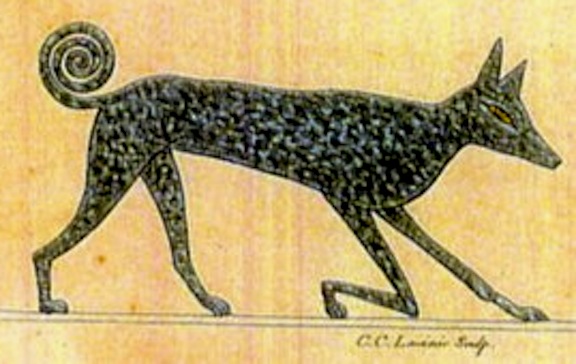
This is a reproduction of a depiction of an unusually colored Tesem dog that was found on some artifacts that date to ancient Egypt. It was reproduced by one of Napoleon’s archaeologists when his imperial ambitions brought him into Egypt. Yes. He wasn’t just into conquering countries. He was a despot of the Enlightenment!
Tesem dogs were of the basenji type, and basenji breed historians often call them basenjis. I would be a little more careful in making such assertions, but it is clear that the basenji from sub-Saharan Africa is quite an ancient lineage of domestic dog. The study that found that modern dogs were mostly derived from Middle Eastern wolves also found that the basenjis are very closely related to Middle Eastern wolves and were likely among the earliest dog lineages to radiate from these wolves.
Because this depiction is a reproduction of a very old image, it is impossible to know what the color was. It could be a heavily ticked dog, which we would roan. Or it could have been one of those weird white markings that sometimes appears on greyhounds from certain lines.
But it’s not a Dalmatian.
***
Now for the real deal.
I cheated.
At around 10:30 EDT on March 31, I posted this piece about coyotes making it to Colombia.
I claimed that this image was of one of two coyotes that were photographed on Colombia’s Pacific Coast within ten miles of the Panamanian border.
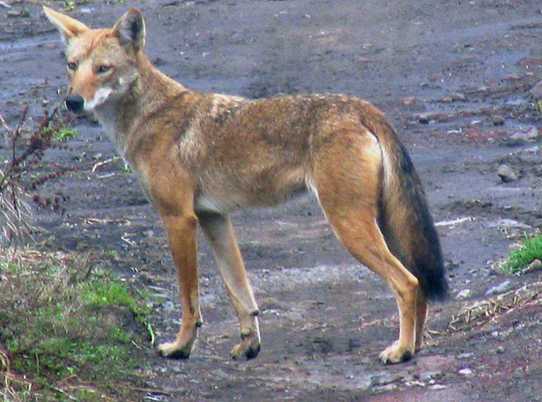
This photo is actually of a Costa Rican coyote.
Coyotes now range over almost all of North America, including Alaska, Newfoundland, and Prince Edward Island. They are absent from the Canadian arctic, but they are now found in every state in the United States but Hawaii. If they were really, really good swimmers, they might make there.
They are also found throughout Mexico. The word coyote is derived from the Nahuatl word “coyotl,” and pre-Columbian Mexican civilizations even kept coyotes in menageries, sometimes crossbreeding them with dogs and Mexican wolves.
And the coyote is also found throughout Central America. They are pretty well-known in Costa Rica, where they have been known to attack adult olive ridley sea turtles that come ashore to lay their eggs in massive waves called arribadas. They also dig up sea turtle nests and hunt the hatchlings when they emerge from the sand.
The coyote is now found as far down into Panama as the Azuero Peninsula. Because of Panama’s unusual geography, they will have to move north and east across the Isthmus of Panama to colonize the rest of the country.
They haven’t made it south of the Panama Canal, but I wouldn’t put it past them. Coyotes have proven more than capable of crossing bridges in densely inhabited areas, and they could make it across the canal.
Once they become established beyond the canal, they could eventually colonize Colombia, and then, they would become the first wild Canis species to colonize South America since the dire wolf.
Of course, if one knows the history of the region very well, Panama was once considered part of South America. Panama was actually a province of Colombia from 1821 until 1903, when the United States forced Colombia to give Panama its independence (and the US got the Canal Zone.)
When Panama was part of Colombia, it was considered part of South America, so by that old definition, coyotes have already colonized South America.
But they haven’t made it to Colombia yet.




CHEATER! CHEATERCHEATERCHEATER!
Didn’t fool me with the basenji- but you sure did with the coyote!!! LOL
If coyotes do make it to South America what impact would they have on maned wolves?
Maned wolves are still a long way from northern Colombia.
They would have more of an impact on other South American Canids, They’d run into Bush dogs in lower Panama. Bush dogs hunt in packs. That would create an interesting dynamic.
Dire wolves came into South America following ancient camelids, the ancestors of the guanacos/llamas, vicunas, and alpacas.
That’s what they lived on South America.
Who came Canis Lupus never made it down there?
They didn’t come into the Americas soon enough. The dire wolf evolved here from Eurasian ancestors that it shared with the modern Canis lupus, and it had time to come south.
Hamilton Smith claims that a CL wolf was killed in Honduras, but officially, they never came down below the Valley of Mexico.
Is it just me or does the Coyote look strikingly like a Ethiopian wolf? Are very red coats like that common in southern sub species of coyote?
The Central American ones often are quite tawny in color.
They are also in the 20 pound range.