Feeds:

Archive for April, 2012

The original function of Neapolitan mastiffs

I have never bought that Neapolitan mastiffs represented a relic population of Roman Molossus dogs. I do agree that mastiff type dogs are pretty old, but making claims about dogs based upon whether they superficially resemble dogs that appear on old artifacts is a very dubious proposition. (My personal favorite claim is that the Ancient Egyptians had dachshunds because one can find short-legged dogs depicted in wall art from that time period.)

So what was a Neapolitan mastiff before it became a fancy show dog?

Well, the old name for this breed in Engliahs was “Italian bulldog,” a name that I initially thought was dubious. These dogs do superficially look like bulldogs, but they are much more like mastiffs than bulldogs.

It turns out that the name “Italian bulldog” wasn’t a dubious proposition. These mastiffs were used as farm dogs- most specifically as livestock guardians that watched over herds of cattle.

My source for this bit of information comes from the 1908 Diplomatic and Consular Reports from the British Foreign Office:

The Neapolitan mastiff is a heavy and useful cattle dog. He has a fine smooth coat and is generally brindled or black. He is kind by nature, but easily made savage if he is tied up or ill-treated. His original use was to go out with the cattle and goats and protect them from the wolves which in olden days were very common all over the district. Then, as now, he guarded the homestead at night (pg. 15).

The dog wasn’t a bulldog in the same way that the English used them, but it isn’t that different from the way the Southern farm bulldogs were used in the United States. Farm bulldogs were  (and still are) used to guard stock and children to protect them from predators of all types.

So the Neapolitan mastiff’s original function wasn’t as a Roman war dog or a fighter in the Colosseum.

It was a type of livestock guardian dog– the indigenous livestock guardian dog of southern Italy.

It’s a lot less romantic original function than the one that connects this dog to the Roman Empire.

But it’s not unexpected.

Italians are not Romans. Italy has had a history since the fall of Rome.

And Italy itself didn’t exist as unified nation until the late nineteenth century.

The southern part of what is now Italy has been under the control of so many different political entities and royal houses that all sorts of different influences have come into the region.

A Neapolitan mastiff never existed as a closed registry breed until after the Second World War. The farm dogs of southern Italy were constantly getting new blood from different regions. There was a selection for strong guardian instincts but also docility toward the family and stock.

This also goes a long way to explaining why many early imports of Neapolitan mastiff to the United States often bonded very strongly to their owners and hated everyone else. This is exactly what one would want in a livestock guardian dog. Although North America livestock guardian dogs have been selected for a more docile temperament, those from the Old World often had tendencies toward hyper bonding toward stock and family and high aggression toward outsiders.

It also suggests that the traditional spiked collar that these dogs wear has more to do with protecting the neck from attacks from wolves than anything else.  The same goes for the cropped ears. Many livestock guardian breeds have cropped ears and wear spiked collars to assist in fending off attacks from wolves. Spiked collars prevent the wolves from biting down on the neck, and the nearly amputated ears don’t provide anything for the wolves to grab.

I’ve not seen anyone recommending Neapolitan mastiffs for this purpose. The fancy show dog is probably not hardy enough to withstand rustic conditions, though the dogs might be useful on a small farm where they can be observed more closely.

***

 In my research on Lord Byron’s Newfoundland, I came across another dog he owned.

In 1819, Byron procured a “bulldog”  from Italy.  This dog was named Moretto.

This particular dog accompanied Bryon on his ill-fated decision to join the Greeks in their war of independence against the Ottomans,

And I don’t know if anyone has considered this possibility, but it may have been that Moretto actually was part of the landrace that gave us the Neapolitan mastiff.

I’ve seen that the Newfoundland people have taken the story of Boatswain and run with it almost as far it could go. Never mind that Boatswain wasn’t  anything like the dogs we call Newfoundlands today.

But if Newfoundland dog people can make hay with Boatswain, I don’t see why the Neapolitan mastiff people aren’t making hay with Moretto.

Moretto was probably very much like the rough Neapolitan mastiffs before they became show dogs. Perhaps, he was much more like them than Boatswain was like today’s shaggy giant Newfoundland.

But people are selective in what romantic stories they want to believe.

The fact that Moretto was always described as a bulldog may have thrown everyone off.

Of course, the Neapolitan mastiff was always called the Italian bulldog in English until very recently.

I can’t imagine there ever being true English bulldog types in Italy until the foundation of the modern dog fancy, so it seems to me much more likely that he was a Neapolitan mastiff.

Read Full Post »

Flying dogs over the Murrumbidgee River (1978)

These are two photos of a golden retriever named Moon that comprise a single piece by the Australian photographer Matt Kelso:

Moon belonged to some friends of the photographer who happened to live near the Murrumbidgee River in New South Wales just outside of Australia’s Capital Territory.

Moon was obviously a very driven retriever. She is trying to catch stones on the dive before they hit the water, which isn’t an easy task for anyone, especially if you don’t have hands!


Read Full Post »

Have you ever wondered what Lord Byron’s dog looked like?

You know, Boatswain, the “Newfoundland” dog that we know Byron so deeply cherished that when he died of rabies, the Romantic poet composed these lines, which are usually referred to as “Epitaph to a Dog” or “Inscription on the Monument to a Newfoundland Dog” :

Near this Spot

are deposited the Remains of one

who possessed Beauty without Vanity,

Strength without Insolence,

Courage without Ferosity,

and all the virtues of Man without his Vices.

This praise, which would be unmeaning Flattery

if inscribed over human Ashes,

is but a just tribute to the Memory of

BOATSWAIN, a DOG,

who was born in Newfoundland May 1803

and died at Newstead Nov. 18, 1808.

When some proud Son of Man returns to Earth,

Unknown by Glory, but upheld by Birth,

The sculptor’s art exhausts the pomp of woe,

And storied urns record who rests below.

When all is done, upon the Tomb is seen,

Not what he was, but what he should have been.

But the poor Dog, in life the firmest friend,

The first to welcome, foremost to defend,

Whose honest heart is still his Master’s own,

Who labours, fights, lives, breathes for him alone,

Unhonoured falls, unnoticed all his worth,

Denied in heaven the Soul he held on earth –

While man, vain insect! hopes to be forgiven,

And claims himself a sole exclusive heaven.

Oh man! thou feeble tenant of an hour,

Debased by slavery, or corrupt by power –

Who knows thee well must quit thee with disgust,

Degraded mass of animated dust!

Thy love is lust, thy friendship all a cheat,

Thy tongue hypocrisy, thy heart deceit!

By nature vile, ennobled but by name,

Each kindred brute might bid thee blush for shame

Ye, who perchance behold this simple urn,

Pass on – it honors none you wish to mourn.

To mark a friend’s remains these stones arise;

I never knew but one – and here he lies.

Now, virtually every Newfoundland dog owner and breed historian knows these lines.

Everyone with a Newfoundland likes to imagine that their giant dogs have some connection to one owned by one of the greatest poets in the history of the English language.

But you know what?

Byron had a painting of Boatswain commission.  I may have to warn certain Newfoundland dog owners, about the only thing he had in common with modern Newfoundland is that he was a well-muscled dog and that  he was black and white like an Irish-marked Landseer. This painting was done by Clifton Thomson in 1808, just months before poor Boatswain contracted rabies and died.

Other than that, he was essentially a St. John’s water dog with prick ears. He could have passed for a very robust border collie.

Prick-ears could be the result of cropping. I honestly cannot tell from the painting whether he was naturally prick-eared or not.  The other ear that is pointed away from the viewer of the painting in such a way that it may have been semi-pricked.

St. John’s water dogs had small ears, and it would not have been unusual for some of them to have had prick or semi-prick ears.

Boatswain was also a smooth-coated dog, which is nothing like a modern Newfoundland dog at all.

It’s very difficult to get an assessment of his size, but my guess is that he wasn’t much larger than a Labrador retriever– just like a St. John’s water dog.

The only hint of his size that I can find is this painting of him, which was obviously hadn’t seen him. In that painting, he’s not a giant dog at all. He is very much like slightly larger black and white golden retriever.

So when you read breed histories and see people trying to adhere their dogs to some historical animal, one should be a bit skeptical.

I’ve noticed that one never can find painting of Boatswain on any sites about Newfoundland dogs. They almost always put paintings of Landseer Newfoundlands that Landseer himself painted.

This painting of Boatswain doesn’t comport with what people think a Newfoundland dog should look like, so it’s ignored.

But they do seem to like that epitaph.

Whether the dog was exactly like theirs is immaterial.

See related post:

Read Full Post »

“Strawberry” leopard discovered at a South African game reserve

This "strawberry" leopard appears to be unable to produce black pigment. Its nose and lips, as well as the skin around its eyes, appear to be reddish brown.

From io9.com:

You’re looking at the only known example of what conservationists are calling a strawberry colored African leopard. The big, pink-hued cat — which makes its home at South Africa’s Madikwe Game Reserve — is affected by erythrism, a poorly understood genetic condition that causes him to either overproduce red pigments or underproduce dark pigments in his coat.

“It’s really rare,” explained Luke Hunter, president of the wild cat-conservation group Panthera, whom Madikwe officials consulted with about the cat’s unusual coloration. “I don’t know of another credible example in leopards.”

According to National Geographic, erythrism is unusual in [wild] carnivores, which makes sense if you think about it — pinkish fur, after all, is probably not the most ideal form of camouflage for animals whose predatory techniques rely on stealth. But this particular leopard appears to be doing fine. “He’s obviously a successful animal,” said Hunter.

This is the first one that has been seen in recent times. However, Messybeast.com, a great resource for information about just about anything relating to unusual animals, has several images of taxidermies of what appear to be red leopards with a similar mutation, though much darker red in color. (There are some really interesting morphs on that page. The “cobweb panther” looks like a melanstic leopard with ich!)

There is some suggestion that these dark red leopards are faded black leopards, which is a possibility.  Spots can still be seen on black leopards, so exact chemical make up of the fur on the spots is different from the fur that comprises the background.

So it is possible that these red leopards are faded black ones. The fading could have happened due to age or the treatments used to preserve the skin.

I am not sure if anyone has examined these mahogany red leopards to see what they exactly are or were.  DNA could be extracted from at least some of these taxidermies. And then we could find out if they were black leopards or not.

This strawberry or red coloration is likely a recessive trait, and this should be of concern to leopard conservationists.

Several years ago, a brown and white giant panda was discovered in the Qinling Mountains.

It is generally pretty uncommon for very rare recessive traits to be expressed in the wild.

It’s just the nature of recessive traits. They can only be expressed when they are homozygous, and in nature, there is usually enough mixing of genes to keep recessives  diluted in a population.

When the brown panda was discovered, there became lots and lots of worries about inbreeding the Qinling Mountain pandads, which are the more stressed and fragmented of the two populations of giant pandas. Habitat fragmentation may mean that these pandas are becoming inbred, and a sign of that inbreeding is the sudden appearance of unusual recessive traits that are normally hidden.

We don’t typically think of common leopards as being endangered at all.

They are currently the most widespread of the big cats, and range from South Africa all the way to the Russian Far East. They are currently extirpated from much of North Africa and the Middle East, and there is an unusual isolated population of leopards on Java, which are somewhat smaller than normal common leopards.

However, genes do not flow across Asia and Africa as they once did.

As I noted earlier, leopards no longer exist in most of the Middle East and North Africa. Only isolated populations still exist.

And even within the core of leopard range in Asia and Sub-Saharan Africa, the habitat is greatly fragmented.

Leopards and lions no longer cast genes across vast areas. Very often, they are left in smaller preserves, where it is very easy for genetic bottlenecks to form. Dominant males, which rule prides in lions and overlapping territories of females in leopards, are not overthrown on a regular basis, making it more and more likely for a male to wind up mating with his daughters. New blood in the form of enterprising young males no longer enters the gene pool.

Madikwe is actually trying to solve some of these problems. There is a current move to create a corridor between it and Pilanesberg National Park.

This corridor would allow more of a gene flow to exist between populations of lions and leopards, and it would be a great asset to genetic sustainability of wildlife in this region.

This is more and more of a problem than one might expect.  Leopards are considered “near threatened” by IUCN, and lions are considered “vulnerable,” a much more serious distinction.  If lions and leopards cannot exchange genes over a larger area, the better for both species. Neither has experienced much inbreeding in their natural history, and thus, they have no had an opportunity to experience much purging or evolve any inbreeding tolerance.

Unusually colored wild animals often attract attention, but they can be indicative of more serious problems.

This cat seems to be doing fine.

Let’s just hope the population in which he lives will continue to thrive.

***

I should note that there are situations in which recessives can exist at much higher levels than one might normally expect.

One of these traits has a certain selective advantage, it will appear much more frequently than normal recessives.

Among these is melanism in leopards.

Melanistic leopards are most common in jungle or rainforest environments — particularly in Southeast Asia– where it may confer an advantage. A black cat can easily hide the shadows of the night, and because leopards are the consummate ambush predators, this might explain why there are so many black leopards– even though this is a recessive trait.

There is some suggestion now in the literature that melanism may also enhance the immune system.

But if recessives do not confer any advantage, they normally aren’t very common at all.

Read Full Post »

Today’s catch

Four bluegills from my grandpa's pond.

I had no luck catching any trout today, so I decided to try the Westfall family farm pond.

My grandpa spent a lot of time and money making this pond work. He stocked it with bluegill and bass, but he also did he all could keep the pond from leaking. He also controlled the vegetation both around and in the pond.

In the last two  years, his health deteriorated greatly. No one in the family paid much attention to it.

When I showed up today, it was lily pad city.

There was just a big hole of open waterin the middle where no lily pads were to be found.

It was like ice fishing, just with much warmer weather.

The old technique for catching a bluegill is to put a mealworm or small earthworm (“fishworm”) on hook. As soon as you feel a nibble, reel in quick. The fish’s reflex is to grab that which has been taken away from it, and when it grabs it, it will be hooked. (I was using number 10 hooks.)

They were really biting this evening. I caught these 4 within 45 minutes. The only time I lost my bait was to the effing lily pads.

I was shocked at how many fish were in this pond. It’s not a very big one and is no deeper than 6 or 7 feet int he middle.

But there were huge bass swimming around and tons of bluegill.

When we were kids, we’d beg our grandpa to take us fishing. He never took us when the sun was shining right on the pond in the evening. It had to be shaded a bit.

We’d beg.

“Not ’til it’s shaded.”

We’d beg again.

“Not ’til it’s shaded.”

And when it was shaded, we’d go out and fish. I caught a few bass and who knows how many bluegill.

There was one huge bass in the pond that we called “the Great Destroyer.”  I hooked him a few times, but I don’t think I ever reeled him in.

Those were good times.

My grandpa passed in August.

Monday would have been his 79th birthday.

As I sat along the side pond this evening, I thought about those times.

I was a pretty lucky kid to have access to such a great pond– and to have grandparents who lived nearby.

Bluegill aren’t trophy fish in the least.

But their pungent stench takes me back.


Read Full Post »

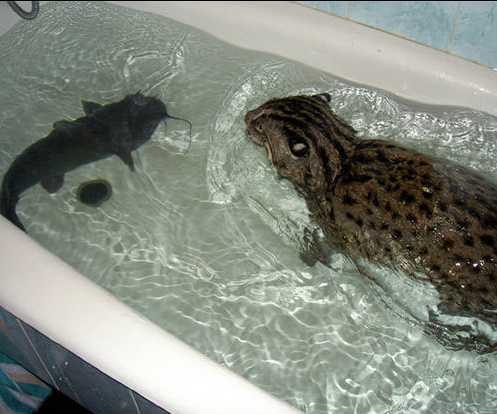
Russian family keeps pet fishing cat

This Russian family has a pet fishing cat. To keep it entertained and obviously well-fed, they allow it to catch catfish in the bathtub and pluck whole chickens in the living room.

Judging from the pics, I don’t think you really want one.

"You taste very good."

Fishing for a catfish in the tub.

Dragging the kill across the floor. Not making any mess at all!

Now for some chicken.

Fishing cats don't eat feathers.

(Source for images)

Fishing cats belong to the leopard cat genus, Prionailurus. Although their size varies greatly,  they are  often significantly larger than leopard cats, and they are much more specialized.

They live almost exclusively on fish, which they catch out of rivers and mangrove swamps.

These cats are distributed in disjointed populations throughout South and Southeast Asia, including Sri Lanka.

The IUCN considers this species endangered.

One would hope that this particular specimen belonged to zoo that was engaged in propagating the species.  Perhaps it does belong to such an institution, but it was hand-reared and is just visiting its raiser’s home again.

But this is Russia, and just about anything can be purchased for the right price.

Very few fishing cats exist in captivity, and in European zoos that are involved in the species survival plan, the entire population of breeding fishing cats derive from twelve unrelated individuals.

These cats are not particularly easy to breed in captivity.   Like clouded leopards, male fishing cats can be quite aggressive towards females when they are first introduced. I remember seeing a show that featured a zoo putting spending weeks and weeks allowing a male and female fishing cat to become acquainted with each other only to have the male kill the female in the end.

If this animal is a pet, I’d be worried about the safety of that domestic cat.

The two species likely can hybridize.  The domestic cat and the leopard cat are commonly crossbred in captivity, and the fishing cat is not that distantly related to the leopard cat.

But the aggression that male fishing cats exhibit and their relative rarity in captivity precludes the possibility of anyone breeding aquatic Bengals.

The truth is that the fishing cat is in trouble in the wild, and the captive population has real issues with genetic diversity.

Every captive individual has valuable genes.

These genes are being squandered when people keep these animals as pets.  This fact becomes particularly more tragic when one realizes that most exotic cats that are kept in homes are neutered in an attempt to reduce spraying. (It usually doesn’t work.)

So although these photos are amazing, one should be concerned about ethics of keeping such a valuable animal as a pet.


Read Full Post »

Nandinia binotata

African palm civets are not civets.

As regular readers of this blog know,  the order Carnivora is split into two suborders.

One of these is more widely covered on this blog for a very simple reason.  The suborder Caniformia gets more attention because that’s where dog and the dog family are located.  This suborder has much wider diversity in terms of ecological niches and varied species. There is a lot of difference between the tiny least weasel that weighs only between 1 and 3 ounces, and the Southern elephant seal, which can weigh 8,800 pounds.  All marine Carnivorans, seals, sea lions, and walruses, are Caniforms, as are all the animals in the weasel family (Mustelidae), which includes otters, badgers, wolverines, martens/fishers, polecats/ferrets, and mink. Skunks were initially thought to be Mustelids, but recent genetic studies have revealed that they belong to their own family called Mephitidae, which they share with two species of “stink badger” that are found in the Philippines and Indonesia.  The raccoon family (Procyonidae) is also Caniform and includes all both species of raccoon, the kinkajou, the olingos, the ring-tail and cacomistle,  and all the coatis. All bears, including the giant panda, are Caniform, and the red panda, once thought to be a bear or a Procyonid, is now classified in its own family called Ailuridae.

Now, classifying Caniformia hasn’t been nearly as difficult as classifying Feliformia.

That’s because the lineages and the physical traits of all of these animals really are quite distinct.

Feliformia has a bit of a problem.

The two best known Feliform families are cats (Felidae) and hyenas (Hyaenidae). It is usually a bit of a surprise for people to learn that hyenas are much more closely related to cats than they are to dogs.    The largest Feliforms are in these two families.

The rest of the suborder are smaller animals,  and what’s worse, many of these animals represent convergences and primitive lineages in such a way that they often resemble each other but aren’t closely related at all.

Mongooses and meerkats (family Herpestidae) are probably the best known of the little Feliforms. These are followed by the civets, genets,  African linsangs, and the binturong (family Viverridae).

And for decades, it was assumed that these all the things called civets or mongooses comprised these two families.

That’s because all these animals look superficially quite similar to each other. In Madagascar, there are animals that could be classified as mongooses or civets, and when classified as either, they were assigned to Viverridae or Herpestidae.

However, when we’ve started looking at the DNA, things have not been as clear cut as we might have assumed. All Malagasy carnivorans are closely related to each other, and they share a common ancestor with Herpestids. They are not closely related to Herpestids to be classified with them, but instead, they have been given their own family called Eupleridae.

But Madagascar is a island with lots of unusual species on it. Surely the mainland species are classified correctly.

Well, genetic studies have revealed that the Asiatic linsangs, the spottted and banded species, aren’t civets at all. They are actually very closely related to cats, and one could almost make the case that they belong in the Felidae family. They are currently classified in their own family called Prionodontidae. The African and Leighton’s linsangs of Africa very closely resemble the two Asiatic species, but they are actually civets. The four species resemble each other as the result of convergent evolution.

And then there is the African or two-spotted palm civet (Nandinia binotata).  Now, it is widely accepted that the modern civets are among the most primitive of all Carnivorans. But it has been suggested through morphological and molecular studies that the African palm civet is an even more primitive species than any of the civett which it superficially resembles.

It has thus been given its own family called Nandiniidae. Reginald Innes Pocock suggested that the African palm civet deserved its own family status in 1929. However, it spent some decades being classified with the Asian palm civet before finally being placed where Pocock believed it belonged.

Viverridae was a catch all family for many years. Anything that looked like a cat with a muzzle was placed there.

But because Feliformia retains many more ancient lineages than does Caniformia, things do get quite confusing.

In Caniformia, most of the smaller species are recently derived. For example, least weasels are derived from larger weasels. Within the genus Mustela, the long-tailed weasel represents the more primitive form. The ermine or stoat is the intermediate form, and the least weasel is the most derived form.

There are even two Caniform carnivorans that have evolved to look something like a civet.

In the Old West, they talked about keeping civet or miner’s cats to keep the mice down.

This so-called American civet is the ring-tail (Bassariscus astutus). It is found throughout the Western United States and in most of Mexico.  In southern Mexico and Central America, one can find the ring-tail’s closest relative, the cacomistle (B. sumichrasti).   These animals are both closely related to the two species of raccoons, but unlike them, this animal has essentially evolved into a civet-like forms.

It’s long been recognized that they are both Procyonids, but of course, the common terms for these animals suggest that they are civets or genets. Or even a type of cat.

One could make the case that the two Asiatic linsangs are actually very primitive cats, but one simply can’t say that a ring-tail or a cacomistle is anything like a cat.

They are raccoons that have become cats.

The only really bizarre taxonomic relationship in large carnivorans is that hyenas are more closely related to cats than they are to dogs.

But in the smaller and more primitive ones,  these relationships are much more bizarre.

And molecular analyses have not been performed on every species, so we may be in for some more surprises.

***

And yes, I know that I’ve piqued your interest about the two Asiatic linsangs.

I’ll post something on them soon.

Read Full Post »

« Newer Posts - Older Posts »

Follow