
This squirrel was discovered at a bird feeder in Scotland.
It was livetrapped, and some hair was taken for DNA analysis.
Its y-chromosome was from an Eastern gray squirrel (Sciurus carolinensis), which is introduced, and the mtDNA was that of a Eurasian red squirrel (Sciurus vulgaris), which is endangered because gray squirrels carry a parapoxvirus that is fatal to red squirrels. Gray squirrels are typically immune to the disease.
The animal has the tufted ears of the red squirrel, and it is very similar in color to many gray squirrels.
The father:

The mother:

This hybrid is likely sterile, but it suggests another threat for Eurasian red squirrels.
If female red squirrels are being bred by male grays, they won’t be producing fertile offspring of their own species.
And every mating between the species is taking away opportunities to produce new red squirrels.
It’s likely that most red squirrel eggs that are fertilized with gray squirrel semen don’t develop, but this one clearly has.
More research is going to have to be done with these squirrels, which have not been considered potential mates because of the wide genetic difference between the two species.
***
At the same feeder, a black squirrel with ear tufts was also photographed:
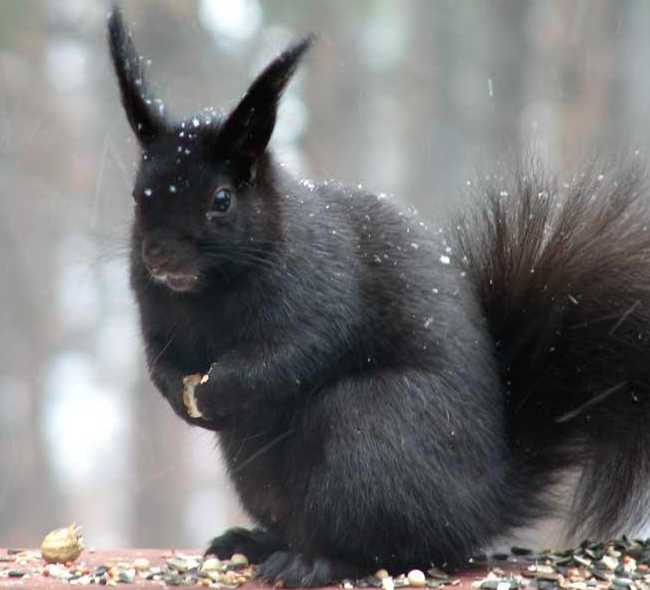
Melanism is very common in Eastern gray squirrels, so maybe this animal is a hybrid, too!




What an interesting post. I have always found the variety of squirrels throughout North America fascinating. It seems each time I travel I see squirrels of a different color: black, white, tan, tan with black underbellies…. How interesting!
That last squirrel is a hybrid: squirrel x demon.
Or it’s something this fellow is putting in the birdseed.
Bad news for the reds!
I see quite a few melanistic grey squirrels here. My woods are deciduous – not the best territory for reds.
Elizabeth
Wow, thank you for posting these wonderful pictures and information. The perceived wisdom was that these two species could not mate let alone produce offspring. It would be interesting to know eventually whether they can produce fertile young, even.
The European canary can produce a small percentage of fertile offspring when mated to the South American hooded siskin and that is how red canaries were produced and full fertility subsequently restored from breeding hybrids back to canaries whilst selecting for retention of red plumage along the way.
Meanwhile, back on topic, there are cases of melanistic red squirrels in parts of Europe which are no way the result of matings across species. It is presumed that these occurred as mutations among red squirrel populations, which have historically sometimes happened when a small group of reds has been forced to inbreed in isolation when cut off in a canyon or up a mountain. These groups have sometimes been given special names, like the so and so mountain squirrel for example.
Just another theory about the hybrid found in Scotland. Greys are still reported as trying to enter Scotland and maybe this mating resulted from a grey finding itself without a mate readily available in an area where the reds are still the common indigenous species and greys are as yet rare.
Yet another rethink and stating the obvious – if that melanistic red pictured was at the same place as the more obvious hybrid then this adds to the supposition that this one too may be a hybrid. This is really fascinating and so you are to be congratulated for making this material available.
Sorry to post yet another thought – but maybe a fertile hybrid between reds and greys could eventually evolve specimens which looked like mostly like reds but have the squirrel pox disease resistance of greys – a sort of Scottish super squirrel, now there’s a thought!
I recall many years ago on a family trip when the children were small, we stopped our VW campervan next to a park in a Bavarian town and were fascinated watching this elderly lady hand feeding red squirrels, some of which were completely black. The picture above reminded me of that occasion so thank you again. It seems to be a fact that melanistic mutants survive in the wild more easily than those of other ‘unnatural’ shades; albino ones especially don’t last long of course. My mind also goes back to watching an old guy handfeeding colourful parrots (I think they were king parrots) at a Queensland camp site where this gentleman was along term resident (lucky him) just a few years ago – again it was a (hired) campervan trip but this time our kids were off with their own offspring – ah well, closer to heaven’s door…
Maybe the hybrids will rescue the red squirrel (Sciurus vulgaris) in the long run?
Let´s assume for arguments sake that the hybrids (or a decent percentage of them) are fertile, you could end up with certain populations of (almost) genetically “pure” red squirrels (Sciurus vulgaris), immune to parapoxvirus.
Just food for thought ! Remember: Nature is not stationary, it´s dynamic.
Nice one Scotty :)