This account of some pet side-striped jackals comes Richard Lydekker’s The Royal Natural History, Volume 1 (1894). I have posted this story before, but it comes from a poor German translation to English. Lydekker was English-born and Cambridge-educated, so there is no language barrier in this account to occlude the meaning.
In inhabited districts on the west coast the side-striped jackal frequently enters the native villages, where it interbreeds with the domestic dogs. Its cry, which may be heard night and morning at all seasons of the year, is fully as longdrawn and appalling as that of the common [golden] jackal. [Eduard] Pechuel-Loesche tells us that these animals can be tamed with facility, and that, when in the Loango district he had several young specimens, one of which attained maturity. They were extremely playful, and would run after and catch almost any animals they saw, including beetles, grasshoppers, birds, and small mammals. They would readily eat almost anything that was offered them, such as bread, beans, rice, fish, flesh, bananas, and oil-palm nuts. Although gentle and friendly as a rule, to some individuals they took a marked dislike, growling and showing their teeth when ever they approached. One of these tame jackals would answer to its name,“Mbulu,” and was remarkable for the cleanliness of its habits, being particularly averse to getting its feet wetted by rain, seeking during showers the shelter of the huts. As a rule, it never sat down on its haunehes after the manner of a dog, but would lie at full length, with its nose resting between its fore-paws, and would generally select a sunny spot, where it lay blinking in the sunlight (pg. 507-508).
Side-striped jackals (Canis adustus) have never made great billing in natural history films.
They are essentially unknown to most people in the West. They don’t tend to hang out in the open, and the core of the natural range tends to be in African countries that have not had as much stability historically. They aren’t as strikingly marked as the closely related black-backed jackal (C. mesomelas).
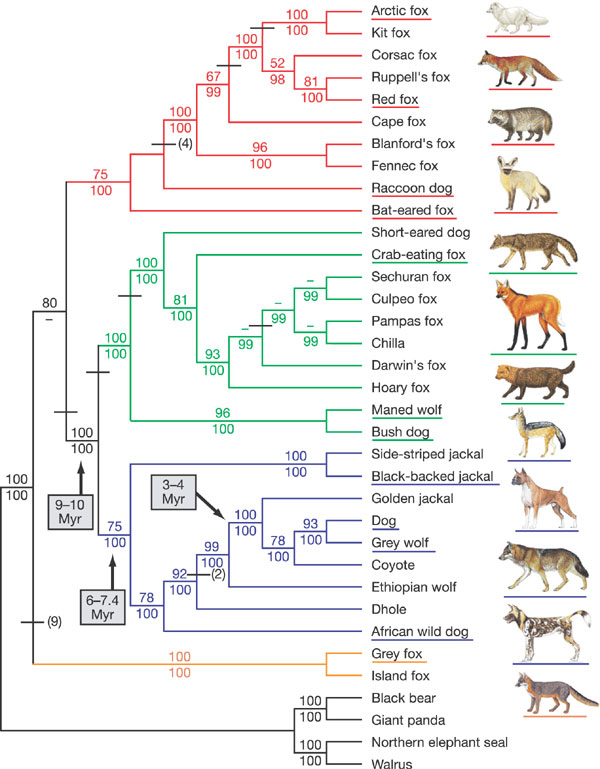
Lydekker made the error of assuming that these animals breed with dogs. The two endemic African jackals cannot interbreed with dogs. They are both as distantly related as a canid can be to domestic dog and still be considered a member of the genus Canis.
However, this account does give us some possible insights into how dogs may have been domesticated.
Eduard Pechuël-Loesche was a German-born adventurer and naturalist, who later earned a Ph.D. at the University of Leipzig. After earning his degree, he made several journeys to what is now the Republic of Congo and the Democratic Republic of Congo.
He encountered these side-striped jackals in what is now the Republic of Congo in the Kingdom of Loango.
Side-striped jackals are the ultimate scavengers.
They have never been seen killing anything bigger than an antelope fawn.
I think they are a good question to the theorists who assume that dog domesticated themselves through scavenging off of humans.
Humans have lived in Africa for far longer than any other place, and in various camps, black-backed and side-striped jackals can often be seen scavenging.
And no one has domesticated them.
If all it takes is these animals losing their fear of people to become better scavengers off of us, wouldn’t it makes sense that these two jackals would have been domesticated instead of the wolf?
From Pechuël-Loesche’s description side-striped jackals wouldn’t have been terribly difficult to domesticate, but no one has.
Only a German explorer with lots of time on his hands even bothered.