
Fennec foxes are not the ancestors of Chihuahuas. If you believe this, you’ll believe anything.
As we’ve looked more closely at dog DNA and compared it to other Canid species, a very consistent fact has been confirmed time and again.
Domestic dogs are very closely related to Eurasian wolves.
Most of the genetic literature on dog origins is hotly contested.
But the ancestral species is not.
Dog DNA is wolf DNA.
It may be that the wolf is the sole ancestor of the domestic dog.
However, there are four species that are chemically interfertile with each other.
The dog and wolf species, Canis lupus, has produced fertile hybrids with Ethiopian wolves (Canis simensis), golden jackals (Canis aureus), and the coyote (Canis latrans). Dingoes and New Guinea singing dogs (which should be called “New Guinea dingoes”) are feral landraces of domestic dogs and belong to the dog and wolf species. We know that all of these animals are chemically interfertile only thorugh circumstantial evidence. Because dogs are derived from wolves and have mated with Ethiopian wolves and produced fertile offspring, we know they all can. Ethiopian wolves are the most distantly related species of the interfertile Canis from the dog and wolf species. If they can interbreed and produce fertile offspring, then they all can.
Thus far, no one has found any genetic markers in domestic dogs from any of these other interfertile species. They might be there. In fact, they likely are.
But any genetic material found from these species is very likely to be trivial.
The only dogs that are known to have the blood of species other than wolves in them are things like the Sulimov dogs, which have golden jackal blood in them, and the intentionally and accidentally bred coydogs.
We might even find genetic material dire wolf or other extinct Canis species in domestic dogs, especially if we’re looking at DNA samples from ancient dogs. (There is some evidence that dire wolves were domesticated by the Clovis people.)
But none of these facts would change what the primary ancestor of the domestic dog is.
Their DNA is overwhelming the same as Eurasian wolves.
Thus, we should think of dogs as being domesticated wolves.
That’s what the evidence shows. One can split hairs and say that dogs have a different ecological niche than wolves and classify them as their own species– which is classically Canis familiaris. But the phylogeny of Canis familiaris stems so closely and so directly from Canis lupus that it makes more sense to call them Canis lupus familiaris.
But for whatever reason, these facts are rejected everywhere.
And not just in fringe publications or on e-mail lists where lots of lunatic “experts” like to hang out.
Perhaps the most recent author of any authority to make claims that domestic dogs are derived from multiple species is Stanley Coren.
In The Intelligence of Dogs, Coren contends that a wide variety of species played a role in developing the domestic dog. He repeats the falsehood that basenjis and Rhodesian ridgebacks are derived from the African wild dog (Lycaon pictus), even though this animal has never interbred with a domestic dog and probably cannot. And even if it could, the offspring would likely be sterile, as we’ve seen when silver phase red foxes have been bred to blue phase arctic foxes.
Coren’s book came out in the mid-90’s, and we’ve since learned many thing about dog origins since then. However, Coren repeated the same claim that basenjis were derived from African wild dog in How to Speak Dog, which came out in 2001.
By that time, I don’t think anyone was seriously considering the African wild dog as a potential ancestor to any domestic dog breed. In fact, by that time, there were moves among conservationists working to save this species to change the common name for this species. Calling them “African wild dogs” was causing lots of confusion. People were considering them feral dogs, and in some areas, they were being killed as an invasive species. The truth is that they are likely a descendant of an early wolf-like Canis relative– Xenocyon lycaonoides– that once roamed over most of Africa and Eurasia. The African wild dog and the dhole maybe the surviving descendants of this early wolf-like species.
Coren also claims that jackals are an ancestor of domestic dogs. But the phylogenetic tree that was drawn from sequencing the dog genome revealed that jackals are not monophyletic. Golden jackals are in a clade with wolves/dogs, coyotes, and Ethiopian wolves. The other two species of jackal– the black-backed jackal (Canis mesomelas) and side-striped jackal (Canis adustus)– are even more distantly related to the clade that includes wolves/dogs, coyotes, and golden jackals than the dhole and African wild dog are.
These two jackals cannot cross with dogs. Lots of people claim they can and will often point to domestic dogs in Africa with jackal-like features. Those dogs are not evidence of cross-breeding. No one has confirmed a black-backed jackal/dog hybrid with any DNA test.
These hybrids exist only in urban legends.
But if these memes won’t die even with experts like Stanley Coren, they have a lot of legs among the laypeople.
If you want to see what I mean, check out the comments on my post about why Chihuahuas can’t be derived from fennec foxes (Vulpes zerda). No, they can’t be– even though they look so much alike!
Here are some gems:

I’d be interested to know what kind of “research” Claire was engaged in. My guess is she was playing with Google, and looking up romantic breed origin myths. That’s not really research.
I answered Claire that Chihuahuas and other small breeds have a gene that makes them small, which is very closely related to a smallness gene that is found in Middle Eastern wolves. One subspecies of Middle Eastern wolf, the Arabian wolf (C. l. arabs) is often quite small, sometimes weighing only 25 pounds.
As I noted earlier in this post, no one has found any genetic markers or genes from other species in domestic dogs, and what’s more, they’d have to come from species with which dogs can interbreed. Dogs cannot interbreed with any kind of fox in the genus Vulpes. If arctic and red foxes produce only sterile offspring when hybridized, the chances of them ever being able to breed with anything as distantly related as a dog have to be a zero percent.
Then comes Phoebe. Phoebe tries to through God at me.

Phoebe appears to be functionally illiterate. The study I quoted came out in 2010, not 1993.
There are no proven facts that Chihuahuas are derived from anything other than wolves. All the evidence shows they are toy dogs, and at least with AKC Chihuahuas, they are primarily derived from European dogs.
The origin and ancestry of Chihuahuas is not a theological question. It is not a matter of belief or opinion. It is a hypothesis that we can test empirically. And when we test these hypotheses, their results are not determined by the belief of the majority.
If the majority of Chihuahua owners think their dogs are derived from fennec foxes, this does not make them correct.
If the evidence shows them to be derived from wolves, then the majority Chihuahua owners are wrong.
And then there is Cindy, who just quotes some website. Everything on the internet is true, right?
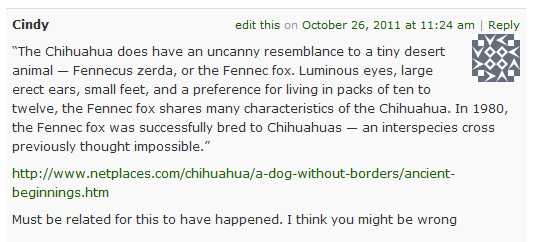
Yeah. That website totally falsifies all the peer-reviewed papers that show that Chihuahuas are derived from wolves!
But the final one is the best one!
Murray Richardson seems to think lots of bizarre things about dog taxonomy!

Almost everything he claims to be fact in that comment is false.
Chihuahuas have unusual teeth because they are brachycephalic. They don’t have rooms in their mouths for all their teeth. They would have normal dog dentition if they had normal mouths. Strike one!
Chihuahuas and all dogs have round pupils, as do wolves. Vulpine foxes, like fennec foxes, have cat-like pupils. Swing and a miss!
No North American wild fox has any dog DNA. That “fact” was entirely rectally derived. Strike three! You’re out!
And Chihuahuas don’t need to drink water? WTF?!
When was the last time anyone crossed a fennec with a maltese? I don’t know, but people do keep fennecs and dogs togehter. Fennecs are a relatively common exotic pet in the United States. I’ve never heard of any crossbreeding or if dogs even respond to a fennec vixen in heat. Domestic dogs don’t respond to red foxes in heat, so why would they respond to the fennec?
I hoped that Murray Richardson was just pulling my leg.
But I was wrong.
Because he came back with this canard.

Facepalm.
Murray seems to believe that all wolves are very large animals, probably because the only ones he’s seen on TV have been of the several subspecies that are native to Canada, Alaska, and parts of the Northern US.
There actually are wolves that are much smaller than these rather famous subspecies. Arabian wolves, which have a similar smallness gene to small domestic dogs, aren’t like these animals at all. A 25-pound wolf can easily become a 3-pound Chihuahua through selective breeding.
After all, we’ve bred tiny horses through selective breeding, along with very small pigs. I don’t know of anyone making claims that these little animals have to have been derived from different ancestors.
Why can’t selective breeding produce super-small dogs?
I wonder what it is about Chihuahuas that makes people believe something so patently absurd.
But I think the unfortunate thing is that so many experts have given license to this nonsense.
Charles Darwin thought that several species begat the dog.
Charles Darwin lived long before we looked at DNA or even knew what it was.
He didn’t know everything.
He was not a religious prophet.
He was a scientist who was constrained to his time and place.
Konrad Lorenz also believed that most dogs were derived from jackals (which he called “aureus dogs”) and that others were derived from wolves (“lupus dogs.”) He later dropped all of this nonsense after listening to the vocalizations of dogs, wolves, and golden jackals.
But by then, he’d already written several books in which he had posited this theory, and it had already been accepted by so many people that one can still run into people who will parrot this lupus and aureus dog dichotomy.
In the end, I think people still have a hard time accepting that dogs are derived from wolves.
Wolves are the only large predator that we have managed to domesticate.
It’s the only domestic animal that is derived from an ancestor that has occasionally considered humans to be prey.
Paradoxically, it’s also the domestic animal with which we have the most intimate relationships. Even cats don’t open themselves up to us in the profound ways dogs do.
How can we have an intimate relationship with an animal whose wild ancestors occasionally hunted humans?
That’s the cognitive block that keeps people from accepting the lupine origins of domestic dogs.
For much of human history, killing off wolves was seen as a great service to civilization.
It’s only been in the last 40 years that we’ve changed our views about wolves.
At the same time, breeding and training dogs that are useful for humanity has also been considered useful for civilization.
Accepting that the useful dog is derived from the much-maligned wolf is really quite difficult.
And that’s a major reason why people have such a hard time accepting that the wolf is ancestor of rhe dog.
The other reason– and the one I think is driving these Chihuahua loons– is that owners of a particular dog breed like to believe that their dogs are super special.
Nothing makes them more super special than to say they derive from an entirely different wild ancestor than other dogs.
It becomes almost a theological discussion when trying to convince them of their error.
These sorts of theories and postulates should be severely ridiculed and debunked when one comes across them.
They are as bad as any kind of creationism, and they prevent any sort of rational discussion about what a dog actually is.
These theories are just mythology.
And there are already too many myths about dogs and what they are floating around.
These particular myths are relatively harmless, but accepting these really poorly thought-out theories means that one might be willing to accept ones that do result in lots of harm to the welfare of the animal.
The notion that Chihuahuas don’t need water because they are derived from fennec foxes really would have a welfare consequence.
I can just see all these Chihuahuas dying of hyperthermia or dehydration because their owners buy into that particular cock-and-bull story.
Facts are stubborn.
And just because you believe a falsehood with a lot of fervor doesn’t mean that it stops being a falsehood.
It just means you like to be wrong with a lot of fervor.
And you look like a fool!




Just to be first to congratulate you on this most excellent piece, retrieverman. I can recall years ago reading articles which stated that dogs were fertile with ALL species of jackal!
I meant one of the first of course..
As the old saw goes “The proof is in the pudding.” One only has to compare the DNA sequences of the wolf, the Chi and the Fennec Fox to each other to confirm or deny relationship (or lack thereof) of any of the three. Since this has already been done, confirming the wolf-Chi link and belying a Fennec-Chi link, any subsequent claims to the latter relationship are pure blarney, regardless of the number of chromosome pairs any of the three species might have.
As for the Fennec and Chi having similar morphology: The Echidna looks like a hedgehog, which in turn looks like a miniature porcupine–yet nobody is foolish enough to posit that any of those three species is descended from any other of them. (Yet the Echidna’s closest living relative, the Platypus, has a markedly different morphology, despite the fact that they are both egg-laying mammals.) The “large luminous eyes” posited as proof of relationship between Fennec & Chi, like the dentition, are almost certainly an artifact of having full-sized organs in a miniaturized head. Since foxes and wolves have similar morphology (due to common distant origins and common evolutionary pressures), miniaturization is expressed in both species in similar ways.
I can’t believe you need to write this article! People who think this have no clue of how dog size works, so, even though I know most readers here, do know, I still want to mention it for the less knowledgeable.
As far as Chihuahua- probably all dog- size goes, the gene that determines size has 6 alleles with 2 messages, 0 and 1. For purposes of this discussion, we can say that 3 are “make me bigger” alleles and 3 are “make me smaller” alleles. They get 3 from each parent and they can be entirely random, from 6 “make me smaller” (mms) alleles, which would produce an extreme runt for the breed, to 3 of each, which would keep the size the same, to 6 make me larger alleles (mmb), which would produce an oversized dog. Both extremes are as rare as 6’s or snakeyes in dice, so most dogs are 11’s so to speak, only slightly larger or smaller than their parents, if not exactly the same size.
Chi breeders love the make me smaller alleles, and disqualify the make me larger ones. And Chi owners often feel cheated if their chi is oversized at adulthood. The acceptable Chi is really a runt with too many MMS alleles and the required size for the standard is a runt who has trouble breeding naturally, at all. 5 pound breeds are too small to reproduce without help, pups can be born with moleras that don’t close, so that becomes a signature of the breed, not a sign that they are a product of a woefully extreme breeding. I don’t know why all dogs who can’t birth on their own aren’t considered as qualzucht dogs and I hope this will come under discussion in the future.
So, a 25 pound wolf would also have the occasional runt with 6 make me smaller alleles. The runt of a 25 pound wolf would probably not be too extreme to breed at adulthood. And so it goes….the 10 pound dog was probably pretty easy to achieve, the 5 pound dog, much harder, and not successfully bred often, until caesarians made it possible. The 5 pound dog is not a breed, it is an extreme variety of a breed, as proven by all the oversized AKC chis.
I got a comment this morning that said that certain dog breeds were derived from Lycaon pictus.
I had to set that record straight.
The Chihuahua stuff is total moonbattery, and it’s all over the internet.
Science literacy, these people do not have!
Indeed! The fennec stuff is a hoot. But most of this chi legend crap is in a weird closed feedback loop that Chi owners spout on their websites and to the parent club, and ultimately, the AKC, where it then becomes, “The Truth” in their “info” pages and thus re-spouted on the breeder’s pages.
It is like saying the techichi was a rodent because the Spanish couldn’t hear the difference in the two words Itzquintle, which means “dog” and tepitzquintle which designate a rodent like a prairie dog.
I recently got told on a chi list, that techichi were rodents. this person was proud because she knew more than other chi people.She bragged she had read everything about Chi history in print.
I didn’t know that pacas were found that far up into Mexico until I read your posts on it.
Well, you can’t fix stupid!
Coren is interesting as a historian (his profession), even if his taxonomy is nuts. His treatment of the RSPCA’s ‘success’ in legislating bans on dog carts and treadmill dogs, it’s impact on dogs in everyday life, and the subsequent replacement of dogs with children in the treadmill business (in Pawprints of History) made a big impression on me.
His history is very good.
But the science methodology can be a bit dodgy.
Why We Love the Dogs We Do is good for history, but somewhat less good when you’re trying to make comparisons about why people choose certain breeds.
For example, Lord Byron Newfoundland dog was likely much more similar to Jimmy Stewart’s golden retriever, yet Coren thought they had the opposite personalities (coolness vs. warmth), so they would want different dogs. Yet any objective reading of the history of the Newfoundland dog, especially like the one Byron owned, would show they behaved more like retrievers than the big Newfoundlands we have today.
“And not just in fringe publications or on e-mail lists where lots of lunatic “experts” like to hang out.”
BWHAHAHAHAHAHA!
I knew you’d like that reference!
hummingbirds have hummingbird moths as their ancestors. Because they look so much alike. And the both can hover. And they both eat nector. YEAH!
A thylacine was just a dingo with a pocket on its belly.
question: is it Canis lupus familiaris or Canis lupus domesticus? I thought the latter name had been used first and therefore would be the applicable “subspecies” name.
Both have been used. Familiaris is the more common.
[…] Many are also quite prone to flights of fancy, as we have seen with the science fiction writers who think that chihuahuas are derived from fennec foxes. […]
[…] Multiple species as the ancestors of the domestic dog: Why this meme won’t die Share this:TwitterFacebookRedditPrintDiggStumbleUponLinkedInEmailLike this:LikeBe the first to like this. […]
[…] Multiple species as the ancestors of the domestic dog: Why this meme won’t die […]
Actually it was the Canadian Government who tested the North American red fox DNA and said that all the Foxes tested had domestic dog DNA… Secondly you are not an expert yourself… So what makes what you say more important that what others believe…? Your also and idiot… Since you think that just because one says that a dogs kidneys are efficient that someone would starve their dog of water… lol Yes I see you have a well rounded intelligence… You also resort to name calling and attitude which shows your not a professional no rather your just some guy who thinks he knows more than others… I never disagreed with you… I just told you what I read… I do not see that you are a genetic expert… and I have in fact read many arguments from experts that do in fact say you are wrong … Like the idea that a different number of chromosomes means you cannot ever have viable offspring… That is just plain false… It is possible… albeit not likely… So before you tell everyone what a hero expert you are… Maybe stop being a hypocrite idiot and have some respect for others… You claim there is a smallness Gene in some european wolf … and by gosh the wolf gets down as small as 25 lbs… Wow thats a far friggin cry from 2-6 lbs of a chihuahua… So how does this explain pray tell the 4lb weight of my chihuahua? Good luck answering that without a bunch of snide cutdowns showing your adolescent ignorance…
You don’t understand selective breeding at all. Dogs have an unusual plasticity to their genome, which allows people to produce many different sizes through selection very rapidly. You also don’t know that pigs and most horses are actually significantly larger than their wild ancestors. Yet you don’t deny that pigs are derived from wild boars or that horses are derived from the now extinct, pony-size wild horse of Eurasia.
This is how size changes in dogs through selective breeding: http://www.npr.org/blogs/13.7/2010/09/30/130237694/the-evolvability-of-dogs
BTW, you are making this study up. There is not a single credible authority who thinks there is.
And there is not a single qualified expert who is publishing today who says I’m wrong.
You need to read more science and less science fiction.
I answered your question a couple of posts above. All dogs can throw larger or smaller offspring depending on which 6 alleles the offspring get – (3 from each parent) ones that make them smaller or ones that make them larger than their parent. Roughly speaking, +++ooo would be average. ++++oo would be larger, etc. and ++oooo makes them smaller. The smallest dogs have +ooooo and oooooo in size alleles, though I think the oooooo version would be a short lived teacup size and occur the least often and the +ooooo though a bit larger, aren’t breedable either.
Originally, the Chihuahua standard was two pounds, but they died and it was impossible to breed them, so the standard crept up to 3 pounds, but it didn’t help the problem, so now it is at 4-5 lbs, but natural birth is still difficult and risky. The size is still too small and is only maintained that way artificially. Breeding dogs 6-8 lbs would not be qualzucht breeding, but the 8-10 pounders are the strongest and healthiest of the smallest dogs.
Here you go Mr. Expert… I really have to wonder if you don’t get that by calling others down you don’t actually influence them to your beliefs… And if you don’t care to influence others… Then why even post anything? Seems to me your more interested in stroking your ego than being right… And you might just be wrong… They have successfully crossed the fennec with a chihuahua…
http://www.chihuahua.classykennels.com/history.html
I haven’t confirmed this nor will I assume its true… I will leave that up to you oh great expert one…
No I am right. You are wrong. You won’t listen because you’re a few pickles short of a jar.
Everything in that piece is Grade A Bullshit.
I have absolutely confirmed that the fennec fox was a an impossible Chihuahua ancestor. There is not a shred of evidence anywhere for that claim. Nor does fennec fox DNA have even one gene in Chihuahua dogs. The DNA testing on Chihuahuas shows they are 100% dog DNA and as far as they can trace it has far more to do with Eurodogs than Amerdogs. It was probably just a story that they used the Arizona dogs in Chi breeding…
Dog origin stories are notoriously full of lies and lack of transparency. Witness the Chinese Crested Story of a Chinese origin. It is still claimed in the history of the breed, and on TV at Westminster every year, even though it was proven by Tosso Lieb of Berne University that the hairless gene was a mutation in Mexico 3k years ago and occurred no where else in the world. All hairless dogs are descended from the original ones in Mexico.