
The Tibetan fox (Vulpes ferrilata) is endemic to the Tibetan Plateau. Its exact position within vulpine phylogeny isn’t clear.
One of the more famous clips from the Planet Earth series is the sequence that shows the unusual-looking Tibetan fox hunting pika.
The fox’s square-muzzled features have intrigued many people, and on the internet, it is often used as a meme to convey messages in much the same way as the corgis and the so-called “LOL cats.” (I don’t find cats particularly funny, but then I’m an extreme ailurophobe.)
This fox is a pika-hunting specialist.
Yes. You heard me correctly. It hunts pikas.
Pikas are not just found in western North America. North America has only two species of these adorable little lagomorphs, but there are many more species in Eurasia.
They are particularly numerous in the Tibetan Plateau, and the Tibetan fox has evolved to be an efficient predator of pikas.
However, the exact function of the fox’s weird looking head isn’t exactly clear. One hypothesis goes that the Tibetan fox evolved its squared off head to make it easier for the fox to jam it into squared off crevices in rocks where a pika might be hiding. Another hypothesis is the fox evolved the head shape as a way of matching the angles of the rock formations in the Tibetan Plateau, which provides the fox greater camouflage when stalking pikas. Still another hypothesis suggests that the head shape is nothing more than an adaptation for retaining heat during the region’s frigid winters. (Arctic foxes, however, don’t have heads that are anything like those of Tibetan foxes, and they live in a much colder climates.)
The truth is none of these hypotheses have been tested.
We just know that the Tibetan fox has a weird head.
And the head shape is not the only mystery behind this fox.
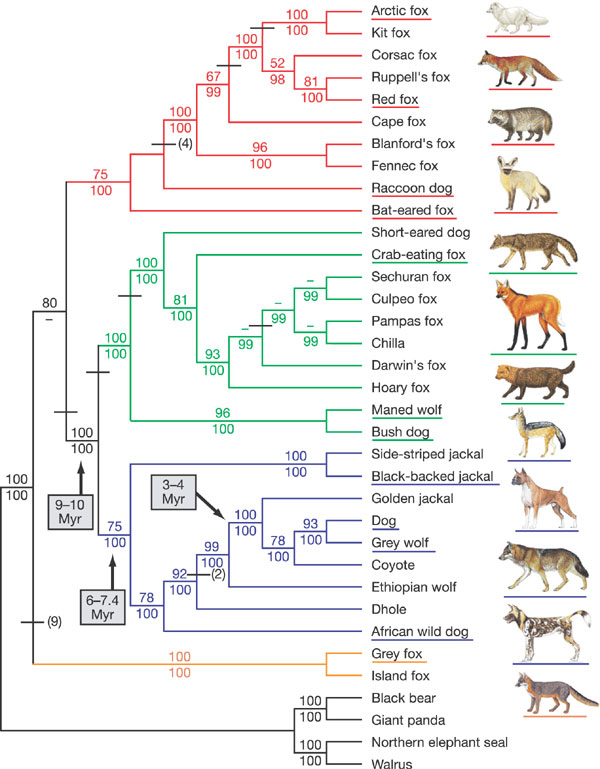
We don’t know where this fox fits in the canid phylogenetic tree.
The only genetic data I’ve been able to find on this species is a study that developed a genetic test for determining whether a fox scat had been left by a red fox or a Tibetan fox, and another study that analyzed the cytochrome-b gene from various carnivoran scats in the region, which found that sequences from Tibetan and Corsac foxes (V. corsac) were virtually indistinguishable. Cytochrome-b gene is found in found in the mitochondria DNA, so what we have is a very narrow mtDNA study that suggests a relationship between the Tibetan fox and the corsac fox.
Corsac foxes are found in the steppe country of Central Asia. They are very much equivalent to our kit and swift foxes.
I don’t know of any other genetic studies on Tibetan foxes and where they might fit in the canid phylogenetic tree.
Tibetan foxes do have some features in common with red foxes.
If you look closely at the photo at the top of this post, you can see that Tibetan foxes have a red base color that is somewhat lighter than the typical red fox. However, in this part of the world, the only two reddish colored foxes are Tibetan and red foxes.
Reds and Tibetans also share a white tail tip, and some red foxes also lack the black legs we typically associate with this species.
This might mean that, despite what the narrow mtDNA studies suggest, the red and Tibetan foxes are close relatives.
In fact, the Tibetan fox might be nothing more than a specialized offshoot of the red fox lineage, in the same way that the arctic fox is a specialized offshoot of the swift fox lineage.
Of course, these two hypotheses are not necessarily mutually exclusive. The corsac fox is actually more closely related to the red fox than to the swift fox that it resembles in both morphology and ecological niche. It may be that the corsac and Tibetan fox may both be offshoots of the red fox lineage, and the corsac lost its red coat as it adapted to living in the steppes.
The truth is we need better genetic studies to see exactly where the Tibetan fox fits.
Its coloration suggests that its a close relative of the red fox, and the cytochrome-b gene analysis says they are related to corsacs.
And as a general rule, one needs to be skeptical of studies that look at mtDNA, especially those that just a narrow sector of that DNA.
At the very least, a microsatellite study is warranted to figure out where this very unusual fox fits.





Has anyone considered the possibility that it serves the same purpose as the surface of an owl’s face, i.e. a sound amplification/directional device?
It’s possible, but pikas don’t hide in the deep leaf litter like mice do.
Why would it need such a good sense of hearing?
Perhaps as a long-distance device to determine whether a given burrow is occupied? Just a thought.
how much do pikas weigh in comparison to mice and other similar rodents that are the usual prey of a fox? It seems to me that the bigger head might be for bigger jaw muscles. Sort of like a jaguar in comparison to a leopard.
Su comportamiento de caza felina es similar a “setter ingles” y a “border collie” pero con un cuello muy potente.
Saludos.
PD. Me encanta la muestra y guía felina al igual que la leona cuando caza…