This is a Labrador retriever from France with what appears to have the somatic black spot mutation that appears in golden and Labrador retrievrs on occasion. It is not inherited, but the cells where the black spots are located do not have the e/e mutation that causes the yellow to red coat. Instead, this somatic muation makes the cells E/e, which gets expressed as black or liver. These dogs are sometimes called mosaics.
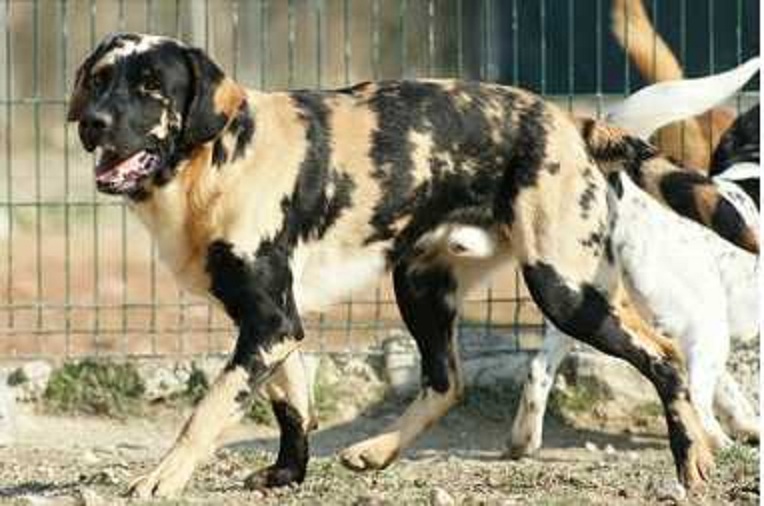
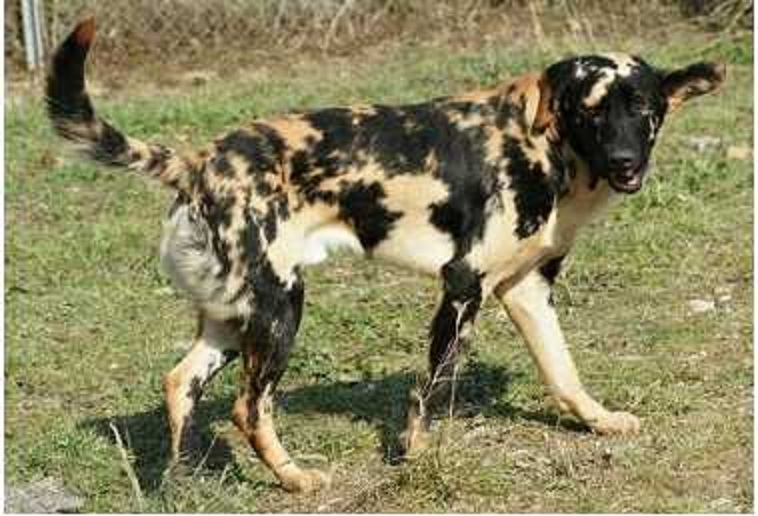
Alternatively, this dog may not be experiencing that somatic mutation. It might actually be a chimera, which happens when two zygotes combine. This dog could be made up of two distinct fertilized eggs– one that would become a black dog and one that would become yellow.
However, it’s much more likely that it is the result of the somatic muations. Chimeras of this type have not been found in domestic dogs.
***
This dog looks very much like an African wild dog, which is called Lycaon pictus (but should be called Canis pictus). The title of this post comes from the African wild dog, for the coloration is so similar that one might be fooled into thinking that this is actually a Labrador retriever/African wild dog cross.
Though the pelage coloration is similar, it is caused by an entirely different genetic basis. African wild dogs inherit their “painted” coloration. If this Labrador were bred to another yellow Labrador, all of his offspring would be likely be yellow. The chances of him producing a puppy that will experience this mutation in the somatic cells are very low, and he would not be responsible for it if one did pop up. Somatic cells are not used in reproduction. Gametes are. This Labrador’s gametes are those of a normal black-skinned yellow Labrador.
See related post:




He is, nonetheless, eyecatching.
The idea of chimerae has always fascinated me. I assume that if he was a chimera that his gametes would be those of one or the other of the twins and not a combination. Or could he have testicles, and thus gametes, from both twins?
it’s my understanding that in dogs, the mosaic is based on a skin level mutation. But one does wonder if some similar genetics are involved in the wild dog — something that regularly causes skin level color mutations? It’s too bad it isn’t a gene that can be inherited. It appears to have no health side effects and could replace Merle.
I was just thinking he looks like a “black merle”. Or a well-marked tortoiseshell cat. Of course, the tortoise/calico coloration in cats different; it’s sex-linked and is heritable. It’s my understanding that some calico cats are chimeras, but most are not.
Male calico (tortoise-and-white) cats are very rare and are usually sterile. I have personally met only five male calico cats over the last 30 years, but I have never seen a male tortoiseshell cat (black & orange mingled markings), either in person or in photos. Calico cats have a white spotting gene & tortoise spots. I wonder if the fact that you do see male calicoes, but do not see male tortoiseshells, has anything to do with the white spotting? I do not know, and I don’t know of any studies that may have been done.
Of the male calico cats I have seen over the years, two were litter brothers, born to a calico mother and unknown father. They were mostly white, with patches of “washed-out” – not dilute (blue/cream), but pale orange & tabby spotting. That’s pretty typical of the male calicoes that do occur; their colors are usually pale compared to female calicoes, and they are usually sterile. These particular two had undescended testicles & when we neutered them we had to do the surgery abdominally. Another male calico was a kitten, also with the pale orange & tabby (rather than solid black) spots. I do not know if it would have had normal male anatomy after puberty; I never saw it after it had its first shots. I have seen two male calicoes (years apart & unrelated cats), that had brilliant orange,black & white coloration & at least one of those cats was not sterile; they were normal toms & one of them had fathered kittens. I think that those two were probably chimeras, although I cannot confirm that.
I don’t like the idea of “test breedings” unless a commitment is made for lifetime care of any resulting puppies, but it would be interesting to know whether this dog could produce offspring (no real reason to assume that he couldn’t), and what they would look like.
What a spectacular-looking dog! I wonder if there are any known health issues associated with this coloration?
Wow! How we react to color to the obscuration of everything else. That dog isn’t a good Labrador. His rear assemblage is weak, his topline isn’t level, his tail is narrow at the base, looks like his front angulation is wrong. Even though I love the look of the ‘hailstone’ markings of some old Labbies, I’m glad the standard calls for solid coloration . . . . not so much to distract the eye from the basic patterns of muscle and bone.
p.s. The color mutation is interesting. Good to see the photos. But color is among the most trivial aspect of dog (and mouse, and horse, and budgie, and human and . . . ) genetics. Also, willing to buy that the dog may be a good dog with a pure pedigree, despite not conforming to the breed standard.
Jen; not to put too fine a point on it here–but most of the followers of this blog are just not all that concerned w/ “breed standards.” What we care about are healthy, happy, long-lived and emotionally well-balanced animals. You’ll note that conformation didn’t make the cut.
Massugu: dogs should have moderate, durable conformation. People who are very into specific breeds and/or into conformation showing tend to get, ah, brainwashed into believing that there is only a very narrow of ‘proper’ conformation for any one job. Conformation people also tend to pay too much attention to bones, especially the ever popular angles, forgetting the soft tissue and the fact that angles are not set in stone (joints move!) and it’s how the dog actually uses it’s body that’s really important.
Looking at purpose bred cross-breeds puts the lie to this. I have seen any number of crosses used for running rabbits or for coursing jacks that a purist could look at and say “not fast enough” or “not agile enough” or “not enough angulation” and they would be dead wrong.
Owning breeds that have a country of origin population, especially with my Salukis and Afghans, has taught me a great deal about how the Western fancy distorts the concept of form following function. The internet is invaluable in this because of the access to photos and video. In other words, just because you don’t like the way it looks, doesn’t mean it’s not functional.
“A good dog with a pure pedigree”? So one depends on the other?
Some of the best dogs I’ve ever had or known were good dogs “despite not conforming to the breed standard”.
Kittenz: My point was that I don’t give a rat’s ass about colour and I’m surprised to see people getting excited about a dog because it has an unusual markings. “Oh, will that breed true? Lets do some backcrossing and establish a new color line of highly inbred dogs.” No thank you.
I don’t dispute that a mutt can be as good a dog as a purebred. Good dogs include purebreds, cross breds, and Heinz 57’s . . . as well as purebreds that don’t conform to breed standard. However, to do its ‘job’ a sight hound should look like a sight hound and a retriever should look like a retriever.
Messagu: I think many followers of this blog care about the functional parts of breed standards.. . . or about the patterns of muscle and bone that make a good working dog of one type or another. This particular dog does not have the conformation I’d look for in a working retriever (particularly angulation).
He’s an interesting example of a color mutation.
“Kittenz: My point was that I don’t give a rat’s ass about colour and I’m surprised to see people getting excited about a dog because it has an unusual markings. “Oh, will that breed true? Lets do some backcrossing and establish a new color line of highly inbred dogs.” No thank you. ”
Gosh, aren’t you just the most noble human being EVAH! CLAPCLAPCLAPCLAP! That what you’re looking for?
What’s wrong with people expressing a little intellectual curiosity? GOD FORBID THAT ANYONE INVOLVED IN DOGS SHOULD BE INTERESTED IN ::GASP:: GENETICS! Oh, noes!
People are interested in color and it’s inheritance because it’s generally fairly straightforward (easy to prove or disprove) and because you can see it. Why do you think there’s about a million different colors and patterns in domestic animals? People are VISUAL CREATURES.
“Messagu: I think many followers of this blog care about the functional parts of breed standards.. . . or about the patterns of muscle and bone that make a good working dog of one type or another. This particular dog does not have the conformation I’d look for in a working retriever (particularly angulation).”
Yeah, because you can tell oh, so very, very much about functionality and durability by looking at TWO pictures of a dog that is quite obviously PLAYING and WIGGLING. You cannot tell anything about the angulation on that dog from those two pictures. I’ve seen a dogs apparent angulation change drastically even in a stack, due to very subtle shifting of stance and center of balance. To judge a dog’s conformation by two photos of the dog playing, FFS, is arrogant and frankly, foolish.
If dogs were breeding us, we’d come in lots of different smells.
lol!
Maybe we already do and we just don’t realize it ;-p
That may be Jen, but unless the thickness of a dog’s tail at the base is connected to a genetic disability, its not important. I’m acquainted w/ excellent hunting Chessies w/ super thick tails and others w/ more or less narrow ones–it never seemed to make any difference to their ability to retrieve waterbirds.
On the other hand, we, being sight/color-oriented anthropoids, notice color first–which is why people have always bred for unique colors and coat patterns. I’m for what works.
This attitude that color is not important, and that expressing a distain for the subject somehow proves that someone cares about what is important in animal breeding is much too prevalent among animal breeders.
There are a handful of genes that are known to play a role in pigmentation (MITF, KIT, MATP, among others), and mutations disrupt that process, which is how things like dilutes or white patterns come about. The problem is that pigmentation is just part of what those genes do, and that same mutation can cause problems, especially when there isn’t a non-mutated gene to take up the slack. This is why merle is a semi-lethal, and why some white patterns have a higher incidence of deafness (and also why some do not). Knowing what causes a color or pattern can tell a lot about the potential problems (if any), and that kind of information is vital to making good breeding decisions.
As a horse color researcher, I cannot tell how often I have heard the claim “we don’t care about color” from dog breeders. I recently went around and around trying to find out a simple answer to the inheritance of blue eyes in Huskies. Did breeders believe they were dominant or recessive? It isn’t hard science. Most people who breed animals have some idea whether a simple trait is dominant or recessive. Do you only get blue eyes from blue eye crosses? Recessive. Get half the litter blue-eyed when one parent is blue-eyed? Dominant. And yet the *only* answer I got was a canned, “in Huskies we don’t consider eye color to be important.” Fine, and good for you. But in your experience, are you getting brown eyes from blue x blue crosses? “We don’t pay attention to that.” I know breeders think this is the ethical approach, but as someone who knows there are often implications to the disruption of pigmentation, the idea that someone isn’t paying attention, even at that most basic level, is a little disturbing.
As for dogs like the one posted, they present a different set of problems. Somatic mutations are often really striking, which in the current environment makes them highly desirable in many domestic animals. It certainly is true in horses, where people have acquired chimeras with the idea that they will corner the market on a new, rare breed of brindle horses. That’s why I tell people that my quick-and-dirty definition of a somatic mutation is “cool-looking horses that don’t have cool-looking parents, and certainly won’t have cool-looking foals.” The better this is understood, the more likely dogs like this one will end up in a home where it is appreciated for itself, and not thrown away after someone breeds it, then inbreeds the offspring, hoping to get rich producing calico Labradors.
And the way to do that is to talk about it, even if it strokes some people’s fur backwards to talk about such “trivial” things.
That is good information and, yes, it should be better (or more systematically) understood by dog owners. As the owner of a pure bred sporting dog, the references to color and temperament I have read seem to largely be anecdotal–which seems incredible, now that I think about it.
Fascinating as far as I know ..not my bred but all Labs are stated to be at/at but the presence of K^B/K^B blocks the expression of tan. Now the so called mosaic (terminology) ? pattern thus far being stated (terminology somatic mutation?) Every breed wants to have descriptive specialty?
Agree Indeed the coat color does not seem greatly important on the surface but one must remember pigmentation takes place on the internal organs as well.
We have all seen enough eye candy in the conformation ring with poor top lines, incorrect tail set and painful to view movement.
The lack of universal terminology as we dog breeders search for answers for me
Mosaicism and Chimerism
http://www.vivo.colostate.edu/hbooks/genetics/medgen/chromo/mosaics.ht... – Similarto Mosaicism and Chimerism
I found this one among studies?
Aug 5, 1998 … Mosaics and chimeras are animals that have more than one … and medical implications, particularly with regard to X-linked genetic diseases
It might be a chimera since the patches are so even, roughly 50/50 to 60/40. If not, that’s the most extensive mosaic I’ve seen thus far! Quite a striking dog. It makes me wonder if the exact rate of these sorts of mutations are known. I’ve heard of mosaics occurring in many animals (dogs, cats, horses, others, and even a lion), but haven’t come across any stats so far. In dogs I’ve seen mostly Lab and golden mosaics, probably due to the breeds being such popular pets.
By the way, if one of his testes was black in whole or in part it’s possible he could father some blacks. It depends on when in development the mutation occurred and whether any tissue that would eventually develop into the sex cells came from the initial point of mutation.
I have wondered the same thing about the prevalence in dogs. In horses we get a lot of KIT gene mutations, which tend to make the animal white or pinto-spotted, but these occur disproportionately in some breeds compared to others. Some of that can be reporting differences. Once a mutation is understood in a breeding community (ie., when your fellow breeders are less likely to assume you crossbred), there is a greater chance mutations will be reported, or at least not hidden or destroyed. But I have wondered if there are other factors involved, too, that make one population more prone to mutations while others are less.
That is a striking-looking dog, very attractive indeed. Reminds me of Dane’s harlequin.
WHO GIVES A CRAP about the thickness of the tail so long as it is attached to a happy healthy, well looked after, loved dog? Who gives a rats hiney about the color of said tail?
When I get home my cross bred ,funny looking drab brown chiweinie, and my old lab X, with her, to small head, and tail like a harbor rope .Their tongues pop out and give kisses, as their tails wave in glee at my return…THAT IS THE PERFECT DOG !