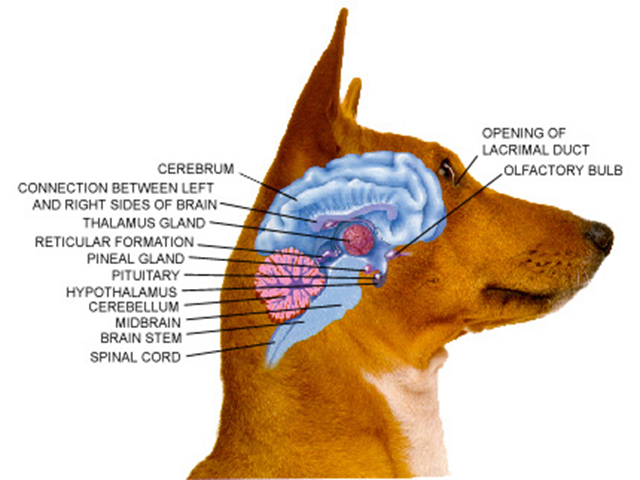
Brain not to scale. Dogs have a lot of big sinuses in the skull where you’d think the brain would be.
It’s a well-known fact that all domestic animals have smaller brains than their wild ancestors.
Some animals have had significant brain size reduction. In every population of domestic and feral pigs, it has been found that in proportion to body size, all domestic and feral pigs have a brain that is 1/3 smaller than that of a Eurasian wild boar. Even fur farmed mink have brains that are 11 to 20 percent smaller than the wild ones.
It generally tends to work this way until one hits comparing dog brain sizes to those of wolves, and there, things become more complicated.
I’ve found very few authors who have examined different wolf subspecies with different breeds of domestic dog. Almost all comparisons with wolf and dog anatomy compare Western breed dogs with captive populations of wolves whose ancestors were either from the northern parts of North America, Europe, or northern Asia.
The problem with using these animals for comparison is that all of these wolves represent what are called “northern wolves.”
Northern wolves are perhaps the most derived of the species. These animals are larger and have very powerful teeth and jaws. They have evolved to hunt larger ungulates in packs, and as wolves go, they are fairly specialized.
The ancestor of all wolves were not animals like these creatures. Mitochondrial DNA lineages in northern wolves go back only 100 to 150,000 years, while southern wolves, particularly those in India, go back 800,000 years. (This study uses mtDNA to suggest that these mtDNA lineages give these animals a unique species status. I’m skeptical. These animals haven’t turned out as unique in the genome-wide studies. It is possible for very old mtDNA sequences to exist in population. In fact, in North America, we have wolves with coyote mtDNA but are almost entirely wolf in their genetic make-up. So be careful of mtDNA studies!)
The ancestral wolf was likely very similar to a coyote or a Middle Eastern/South Asian wolf. The extinction or extirpation of the large dhole or African wild dog-like canid called Xenocyon lycaonoides opened up an ecological niche for these smaller ancestral wolves to become large pack-hunters in their own right, but some wolf subspecies remained smaller and more coyote-like. They didn’t often form packs. Their brains remained proportionally smaller and their jaws were not as powerful.
And it turns out that southern wolves from the Middle East are the primary ancestors of all domestic dogs living today.
I’ve found very little literature that examines the brain sizes of different subspecies of wolf and compares them with domestic dogs.
However, I did find something.
In Helmut Hemmer’s Domestication: The Decline of Environmental Appreciation (1990) , there is a very good discussion of relative brain sizes in different types of wolves and a different types of domestic dog. In relative terms, not all dogs have smaller brains than wolves.
Hemmer points out that the largest brains are in northern Eurasian wolves. Northern North American wolves have slightly smaller brains, but southern wolves have brains that are 5 to 10 percent smaller than the northern wolves.
Dingoes, which are feral dogs, have brains that are 25 percent smaller than northern wolves. Dogs from the tropics and East Asia have brains that are 15 to 2o percent smaller than those of dingoes. Improved Western breeds have brains that vary between those of the dingo and the East Asian and tropical primitive breeds, and some Western breeds, including the greyhounds and “some watchdog breeds” have brains that are proportionally the same size as southern wolves.
Hemmer then goes on to explain that brain size in European dogs was small from the Neolithic to the Middle Ages, and then, as the Middle Ages came about, Europeans began to breed improved dog stocks. Hemmer implies that this is why Western breeds have had an increase in brain size since then.
It is often said that domestication has resulted in smaller brains in domestic dogs. It’s actually much more complex than that.
Raymond Coppinger contends that the smaller brain size of domestic dogs is the result of neoteny.
He claims that dogs have brains that never get as large as that of a four-month-old wolf pup, and he uses this to essentially claim that dogs are perpetually mentally four-month-old wolf pups.
He makes no admission about which wolf subspecies he’s comparing to dogs, but because he’s a North American, he’s likely divining this claim out of comparisons with large-brained northern wolves.
From Hemmer’s work, this appears to be a huge methodological error.
Furthermore, there is a whole body of work that suggests that domestic dogs may have evolved certain cognitive adaptations that don’t exist in wolves.
In computer terms, wolves may have more hardware, but maybe somewhere along the way, a new program was installed that gives them certain advantages in living with and learning from people. You can have all the hardware you want on your computer, but if you don’t have Microsoft Word on your computer, you can’t use it.
Dogs may have that program, even if the brain is smaller in general.
Further, if one reads a little deeper into the Price text I linked to at several places in this post, the entire brain in domestic animals is not reduced absolutely. Some parts are much more reduced. In all species but the mink, the telencephalon (cerebrum) shows the greatest reduction of the size. In mink, both the telencephalon and cerebellum have both been reduced, and Price speculated that because these structures control motor patterns, the reduction in brain size might have something to do with a selection pressure for animals with lower activity levels.
So we need to be careful when someone makes a claim about brain size in dogs and their supposed intellectual inferiority to the wolf.
It’s actually much more complex than that.




smaller size doesn’t prove less intelligence either. Even in the same species. I’ve yet to see any study on what areas the brains are smaller or if it is in its entirety.
From what I’ve read, there is a very weak correlation between brain size and IQ in humans.
I thought it was the size of the neocortex that mattered? But I only used to read about size between species because it was species intelligence that was being studied. How much different could neocortex size be between different humans? Would it be a matter of millimeters? Would even inches matter? Have no clue.
Rman, I was going to write Dr. Wayne about the DNA sourcing for dogs regarding wolf species but just curious where you got your info from, regarding MtDNA of Middle Eastern/South Asian wolves being the real ancestry for dogs, and not Northern wolves ( as in timber wolves and so on).
I have in fact heard this before. I just never bothered to bookmark or pin down sources and have been meaning to. I wanted to go over it to show some other folks.
Thanks. Good blogging!
Ah, and here we go!
http://www.nytimes.com/2010/03/18/science/18dogs.html?pagewanted=all
I thought it was brain mass/body mass (or volume/volume) that was supposed to have some correlation with intelligence. If it’s simply brain mass (or volume) not normalized to body size, then you’d expect Jack Russels to be less intelligent than, say, great Danes. Given that northern wolves are larger than their southern relatives, you’d expect them to have smaller brains.
I’ve read that crows and African grey parrots out-test all canines on animal IQ tests . . . and I would be surprised to see their brain size equaled even that of a your average toy dog.
This is one spot where I’m not sure where the neocortex plays a role; birds. I found this link that suggests info processing in birds depends on different anatomy than mammals; pallium.http://www.pbs.org/wgbh/nova/sciencenow/3214/03-brain.html
I think with mammals specifically it’s the neocortex that holds much of the key. Human neocortexes are massive, and the folds represent that footage folded in tightly to fit in our skulls. Whether neocortex specicially ( not total brain mass), relative to body size, matters, as opposed to total size. I do not know. I don’t know, say, Orca brain anatomy, but I’d venture to say their total brain size is way larger than a person’s. Or is it? And yet while they are very very smart – maybe still smarter than we know – I will guess they are not as smart as humans, at least not in most rational thinking areas. If we learned their language, could we teach them calculus? :)
Ignoring for the nonce the issue of what ‘intelligence’ is (we’ve been there before), my understanding is that the amount of surface area (as represented by the folds) is a better indicator of overall intelligence than is actual brain mass.
In re size, I’ve also read that both archaic H. Sap and Neanderthalensis had larger brains than do modern humans.
I believe that brains can be large in certain areas not necessarily to do with pure intelligence?
Did a little homework. I can’t get to a research library, so I’ll make due with Wikipedia. The Wiki references (which tend to be 1980-1985) say that in mammals, brain size is expected to increase with an exponent of ~0.75 of body weight. So, if a southern wolf weighs 50 pounds and a northern wolf weighs 70 pounds, allometric relationships would predict that the brain of the larger wolf would be 29% larger than that of the smaller wolf. By the same logic, the brain of a 120 lb jumbo size dog should be about 6.45 times larger than that of a 10 lb toy (and a severely obese dog will have a bigger brain than a skinny one). These ideas were heavily criticized in the 1990s, mostly by people saying it’s more complicated.
It would be interesting to see a plot of body vs brain mass for various domestic and wild dog/wolf breeds/varieties. It probably wouldn’t tell us anything about intelligence, but I’ll bet the data would tend to fit on an exponential curve with an exponent between 0.6 and 0.8.
Too, men’s brains are said to generally be larger than women’s. Following the greater size=greater intelligence thesis, can anyone provide empirical evidence that men are generally smarter than women? I don’t think so. (In my personal experience, its been just the opposite.)
Not sure being fatter would matter unless you had a fat head Jen! But cool ref! ;)
BTW Jen, that wasn’t meant as cut. Just a joke!
Scottie, where did the ref come from regarding middle eastern wolves as ancestors?
[…] Some researchers have tried to use brain size as evidence that domestic animals are less intelligent than their wild ancestors. Playing around with brain size in this matter is little more than glorified phrenology, and as I have written about on this blog, the claims about brain size and domestic dogs are actually som… […]
Size doesn’t matter, but how it’s used does. In mammals, the larger the neocortex, the more intelligent. Humans developed foreheads to accommodate our huge neocortex. Similarly, when wolves evolved into dogs, the flat wolf skull developed into a wider skull with a small dome, probably to accommodate the dog’s increased neocortex.
[…] And never mind that many claims about brain size and dog domestication result from improper comparisons between domestic dogs and larger brained northern wolves. When compared with the southern wolves from which dogs most likely derive, many improved Western breeds actually have brains that are the same size as those wolves. […]
SPOILER’S ALERTS:
The mother of all comments coming, not for the faint of heart! (And I apologize beforehand for my English)
_______________________________________________________
One of the basic principles in evolution is that Nature abhors waste. Our brain is exactly powerful enough to cope with the conditions our ancestors had to face as hunter-gatherers, no more, no less. Our talent in other disciplines is but a side-effect, that’s the trained hard-core scientist in me speaking (such cognitive gifts are not always adaptive – think of how our ability to build ever-increasing complex tools in order to ensure our survival, plus the amost unbelievable overlap between all-purpose pattern recognition and advanced maths are the reason why three people none of us trusts have the power to obliterate life on Earth).
Nowadays, taking into account that we’ve established a long-term relationship with canids, and merely by using the first sentence I wrote plus a slight Occam’s Razor shave, the simplest conclusion is obvious: in either commensalistic or symbiotic systems between two animal groups, redundancies are rapidly to be removed – otherwise, the system as a whole is actually using more resources than strictly necessary – a no-go situation in any closed ecosystem (which actually means every single ecosystem in the world).
Therefore, a reliable hypothesis – from someone who admits knowing close to nothing about the subject yet loves puzzles of any nature – would be that suggest that canids MUST find a benefit in their association with us, or we wouldn’t have dogs, and the process leading to their domestication would tend to emphasize their strengths with regards to humans (bonding, acceptance of humans as not only pack member but as alfa individuals, and mostly, the one thing our ancestors didn’t possess: state-of-the-art sensors, cheap cost protection, and a hard-wired interface which easily communicated threats) while switching off by all means necessary our response to them as a possible danger. the aggressive . Definitely a very value/cost quotient. Yet, as always, there is a catch. “There’s no such thing as a free meal”. Alright: so what is the cost for the transition from wolf to dog? The answer is: if your symbiotic companion (humankind) exceeds at a cognitive level, evolution will make you pay the toll and eliminate all waste possible by significantly rewiring – actually, downsizing – your central nervous system so that you rely to think by proxy (meaning humankind). Let your alpha member make the decisions and assist him in the easy implementation of a winning plan, he/she has evolutionarily proven the human race is infinitely superior in both strategic thought, and toolmaking has bypassed any opportunity for other species – predators and prey alike – to keep up with the usual, run-of-the-mill arms race through Darwinian spans of time. So, let’s get a precise (quantitative) figure: lhe average loss of brain vs. weight in dogs amounts to more or less 20-25% when compared with wolves (please take into account that my source is the Internet, with the underlying algorithmic principle Rubbish in / Rubbish out: one can only trust outputs to the extent of input accuracy).
Now, let’s apply the same hypothesis to humankind. Canids from which dogs stem aren’t just fuzzy warm thingies to hug, they are above all, apex predators with an in-built sense of community above individuality. Yet no apex predator can even compare to our species. If you can’t beat them (or avoid them, since tehy are invading your hunting grounds), join them. Human settlings have always produced big amounts of surplus food (our garbage is, and has always been, a treat for any scavenger ). Evolution dictates that, once a niche appears, a struggle will ensue for organisms to fill it. And a wolf’s original behaviour just needed some fine-tuning, since their actions are surprisingly adept for us both to engage in a relationship:
1) Issues that needn’t be changed: a group cooperation protocol similar to ours; a sense of group along with that of the individual; a social scale and, therefore, the need for a clear established hierarchy; basic communication skills.
2) modifications to be addressed: A less threatening look, the need to be alert yet avoid avoidance, the resetting to a constant omega behaviour, and to crystalize a shared set of cues with humankind for rudimentary communication. Evolution kicks in, you got it.
1) + 2) = lots of food waiting for you to claim. So we have a plausible explanation for dogs backed up by data. Now, let’s find a precise, quantitative and more or less precise figure covering all dog species: lhe average loss of brain vs. weight in dogs amounts to more or less 20% when compared with wolves. In which areas is the loss more profound? Why, exactly where we would expect it to be: the neocortex. It is the one area responsible, in mammals for operations such as sensory perception, generation of motor commands, spatial reasoning, general communication (no major variation with wolves to be expected) and, here comes the symbiotic central nervous system undersizing, language and abstract thought.
Now, let’s apply the same line of thought to humans – but since the concepts have already been established, we can jump straight to the conclusions. If a commensalism/symbiosis implies synergy-making and redundancy elimination, the human brain MUST have been affected as well – some of its attributes must have been undertaken by our companion. And, though it is far more difficult to get polished data since there’s no extant feral community of hominids, and must therefore rely on the findings made by the archeologists, we can get an estimate: our brain is 10% smaller now than it was during the pre-domestication era (remains are few and disputed, so I won’t lie, this last piece of reasoning has a lot to do with my experience as a scientist that patterns emerge, plus wishful thinking). Which areas have been left untouched? Guess… the neocortex. And what have we lost? Sensory processing (but sight, we rely on it for precision hand movements). We have accepted dogs as proxys, and go and check every door and window is closed if we hear ours bark when it shouldn’t (a meagre example in a huge list).
So, in this long relationship between humankind and its best friend, who’s has the upper hand? Well, some propose our having dogs was a factor in wiping out the annoying competition of Neanderthals, so that’s 1-0 for us. But they’ve ended up putting us more burden in terms of brainpower than we have 25% vs. 10%. Well, anyway it’s a win-win scenario, so all I can say is: good for them. I still find them fuzzy, warm and loving.
By the way, I’ll never forget a quote my philosophy teacher used to repeat at all times:
“The more I know people the more I love my dog” – Diogenes of Sinope, 412BC – 323BC.
It’s not size alone that determines intelligence–however you want to define “intelligence.” Neanderthals had larger brains than homo sapiens.
What determines intelligence as well as what kind of intelligence an animal has, is its structure, especially the neocortex which is responsible for complexity of social networks, problem solving in new situations, imagination, and the like. When the brains of Homo erectus were in danger of becoming so large that they might interfere with the upright bipedalism of that hominid, the neocortex became higher than the early part of the brain, so that those hominids who developed foreheads to make room for their expanding neocortices got along better than those without raised brows.
Interestingly, the earliest skulls of Canis familiars differed from Canine lupus by having a raised dome on their skulls. In other words, we know the 32,000 year old skull from Altai was a dog’s, not a wolf’s because its skull is not flat. It has a dome to accommodate an expanding neocortex. A dog’s brain is about 45% neocortex. It has double the size of a cat’s brain. When you pat your dog, feel the rise above its muzzle? It’s analogous to the human forehead.
Meanwhile, since dogs have become an integral part of human life, the human brain has shrunk by at least 10%. However, this loss correlates with a reduction in the ability to see and to hear, not in problem solving and invention.
See my blog: http://dogsandwolves-smartoldlady.blogspot.com
In a year or so, my book, Dogs and Wolves, should be published.
Very interesting post, thank you! After writing mine in a rush – I should’ve known better -, I asked the moderator to hold it until I could thoroughly edit it (to check language, facts and internal coherence). However, I’m glad it didn’t happen, since it prompted your reply.
Looking forward to your book,
Jordi Vallès, PhD (in Physics, I’m but a dilettante here…)
The reason why I approved it is because several days went by, and it was such a good comment that I had to approve it!
I’m not complaining (how could I? You managed to get Elaine’s attention!)
:)
Regards from Barcelona
[…] type wolves are wolves smaller brains than the big northern wolves everyone knows so well, and some dog breeds actually have larger brains for their body sizes than these wolves do. I have argued that it might be wrong to say that dogs have had a brain size reduction as a […]
Ya know ? Ive been looking for an article exactly like this. I have been staring at red wolf and Mexican wolf skulls EXELLENT article,thanx.