Many people are aware that cheetahs were used as coursing hounds. One of the last places where coursing cheetahs were used was in British India.
Virtually all hunting cheetahs were captured in the wild as young adults. Cheetahs were fairly easily tamed, and the species does not consider humans to be prey.
Thus, it was actually a good potential domesticate.
Unfortunately, female cheetahs do not ovulate unless their suitors chase them for several miles, and male cheetahs are rather well-known for their poor sperm counts– the result of an extreme genetic bottleneck at the end of the Pleistocene.
Easy as they were to tame, cheetahs were not easy to breed in captivity. It’s only been in recent decades that zoos and captive breeding facilities have figured out how to produce cheetah cubs on a regular basis. Before that, it was just assumed that if hunter needed another coursing cheetah, he would have to capture it.
But Indian nobility weren’t just using cheetahs as hunting animals.
They were also using another species of cat, one that actually does breed fairly well in captivity but is not necessarily easily tamed.
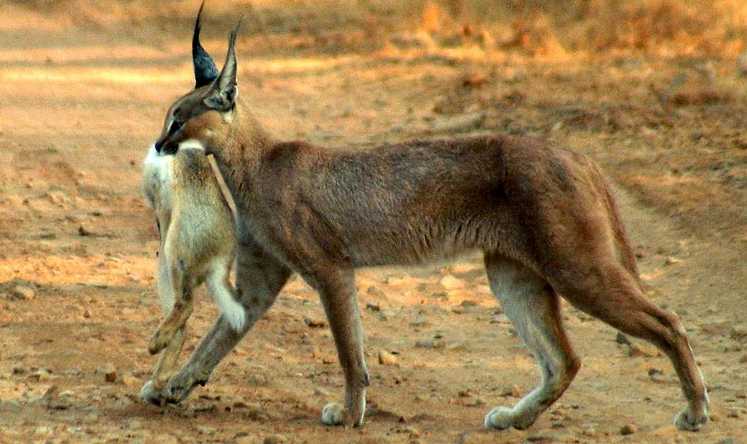
The caracal (Caracal caracal) is a tawny cat with a short tail. It has ornate ear tufts, and it about the size of a bobcat. For a long time, it was thought to be a close relative of the cats in the genus Lynx, which includes the three species of cats that are commonly referred to as lynx and the bobcat.
However, genetic research has revealed that caracal’s closest relatives are the African golden cat (Profelis aurata), which looks like a caracal with out the ear tufts and short tail, and the serval (Leptailurus serval), which looks like a bobcat trying to become a cheetah.
Both the serval and the caracal have been bred extensively in captivity, and the two species have been hybridized. Because of these hybrids, some authorities have classified servals in the caracal genus, calling them Caracal serval. However, if we are to follow the rules of cladistic classification, we cannot put the caracal and serval into the same genus without also including the African golden cat, which is actually the caracal’s closest relative. Leaving it out of the genus would make the genus Caracal parphyletic, and it would not be a clade.
The caracal is found over a broad swathe of Africa and the Middle East. It is also found in much of Pakistan and northwestern India.
In the nineteenth and twentieth centuries Pakistan and India were in the same political entity, usually referred to as British India.
It was during this time that British missionaries, businessmen, and colonial officials noticed that certain nobles were keeping caracals as hunting animals.
The author Divyabhanusinh writes in The End of the Trail: The Cheetah in India (2006) that “the caracal was commonly used in India for sport. The Gaekwad of Baroda maintained a pack of them to hunt peafowl, hare, etc. in the 1860s and the Bheels around Mhow occasionally trained them for hunting'” (pg. 228).

“A Hunting Lynx, 1895.” This was one of the Gaekwad of Baroda’s hunting caracals. Like the cheetahs, it was brought to the hunting field on a bulla cart. (Source for image.)
The hunting caracals were always said to be kept in a pack. The nineteenth century British zoologist Thomas Caverhill Jerdon described these packs of hunting caracals in his Mammals of India (1874), which was published two years after his death:
It appears to be more abundant perhaps in the west of India, in Kandeish, Gujrat, and Cutch; and the Guicowar [the Gaekwad of Baroda] is said to keep a pack of trained lynxes [caracals] with which he hunts peafowl, hares, &c. It appears to be quite unknown in the Himalayas and in Bengal, and the countries to the eastward. The Bheels about Mhow assert that it kills many peafowl, hares, &c., in its wild state, and it is occasionally trained to stalk peafowl, hares, kites, crows, cranes, &c. &c. It is found in Persia and Arabia; in Tibet, where it is sometimes trained, and throughout all Africa (pg. 113).
The only account I can find of the relative utility of the hunting caracals comes from a Col. A.E. Ward. Ward was a British officer and big game hunter, and he describes the caracals as being excellent for use on hares. But only if there were few bushes in the terrain. Ward writes that if there were bushes, “the hares seemed quicker at turning and often got away in spite of the extreme agility of the caracals.” The travel writer G.T. Vigne wrote that “[t]he speed of the caracal, or Indian lynx, is, if possible, quicker in proportion than that of the chita. I saw one slipped at a grey fox [Bengal fox], and he ran into him as a dog would a rat. He often catches crows as they rise from the ground, by springing five or six feet into the air after them.” (Source for both quotes).
For much of the nineteenth century, it was assumed that caracals hunted in packs like dogs. The source was a claim by the Dutch zoologist Coenraad Jacob Temminck. Sir William Jardine attributes this claim to Temminck in his The natural history of the Felinæ ( 1834):
M. Temminck says, that they hunt in packs like the wild dogs, and thus run down their prey. If this is the case, they will most probably use their nose, and will present a very interesting deviation from the typical species (pg. 252).
The Rev. John George Wood also repeated the claim that carcals hunted in packs in his Illustrated Natural History (1865), but Wood also offered some skepticism of the claim:
It is said that the Caracal will sometimes call in the aid of its fellows, and with their assistance will secure even a large animal. Some authors assert that they will unite, like hounds, in the chase of their prey, and will hunt it as regularly as a pack of wolves or wild dogs. But the general opinion seems to be that the Caracal, even when assisted by its companions, gives no open chase, but achieves its end by a few powerful bounds, a stroke with the paw, and a fierce grip with the fangs on the throat of its victim. Some authors assert that the Caracal is often tamed, and rendered useful in hunting; being trained to creep upon its prey and to spring from its place of concealment upon its unsuspecting quarry. When the trained Caracal seizes its prey it crouches to the earth, and lies motionless until its owner comes up and removes the slaughtered victim (pg. 211).
Even if they did hunt in packs, Wood thinks the caracals are more likely ambush hunters, which it actually is, and today, we know they don’t hunt in packs at all. Like virtually all cats, they live solitary lives, coming together only when the female is in estrus.
The attempt to domesticate the caracal was failure. Although you can buy caracals as exotic pets in many parts of the United States, they are not tame animals.
But they do breed fairly easily in captivity.
The question now becomes why the Indian nobles failed to domesticate this species, and the answer can be found in Sir William Jardine’s account of the caracal in The natural history of the Felinæ ( 1834):
Lynxes [caracals] were said to have been kept and trained for hunting, like the hunting-leopard [cheetah], by the sovereigns of the East; but, in modern times, no trace of this property can be found, at least in the present animal; and indeed the character of all is great irritability in confinement, and a mistrust towards their keepers, which is never entirely overcome (pg. 251-252).
Caracals, even when tamed, were just very hard to work with.
Unlike the cheetah, they never became docile enough for people to control them.
Even if they were easily bred in captivity, they just weren’t suitable for domestication.
Now, today, we might be able to produce domestic servals and caracals, but it would take several generations of selective breeding.
And even then, it would still require quite a bit of expertise about exotic cats and their behavior to keep them safely and humanely.
Caracals were one of those domestication attempts that appeared to make sense, but it was simply not successful.
I can’t imagine how they got the birds and hares away from the caracals. My guess is they were very possessive over their kills.
And I certainly would not like to be the hunt assistant whose job was to fight the caracal off the quarry.
They are certainly great predators, but I doubt that they were ever a good choice for cooperative hunting with humans.
It’s just not in their natural history.




Since both species have apparently successfully hybridized w/ the domestic cat (see Savannah and Caracat), I suspect that an intensive breeding program could produce a sufficiently malleable animal to use for these purposes. If such a program was actually undertaken, the results might provide us with a clearer understanding of the process that turned the wolf into the domestic dog. Don’t you think?
No don´t think it would spread any light over wolf domestication.Breeding hybrid cats is no different to breeding any other animals .Pick the best and eat the rest…(sorry have been reading to much about chicken breeding latly)
Besides It is hard to get more than 15% “wild blood” in the males and keep them fertile.
“If such a program was actually undertaken, the results might provide us with a clearer understanding of the process that turned the wolf into the domestic dog. Don’t you think?”
Doing this experiment with cats would probably teach us a lot. They’ve done it with foxes. Has anyone ever actually done it with wolves?
Has anyone done it with wolves?
Yes.
That’s what dogs are.
LOL! I meant has anyone done it as a contolled experiment! :D
The reason why they haven’t done wolves or any animals closely related to dogs is that dog genes are in all of those animals. Maybe not a lot, but they might make enough of a difference to skew the results.
I think they should try black-backed jackals. They are not interfertile with dogs. They aren’t endangered. They are easily habituated to people, but they are quite scrappy with each other– which is probably why no one has tamed them.
I guess the endangered part rules out painted dogs (lycaon pictus) as another possible option, hehe.
Wildcats (African, European, and Asiatic Felis catus ssp.) are notoriously difficult to tame, too, yet we have the domestic cat today, which is descended primarily from the African subspecies. Ancient Egyptians also kept several species of cats & used them in hunting. But an untamed cat is so much more difficult to handle than a canid of similar size; for one thing, they are “armed all round”, very agile & limber, and so fast. They tend to be tame only with their primary keeper, or at the most, with their “immediate family”. I believe that any of the small cats could eventually be domesticated (at least to the degree that our pet cats are domesticated), but it would take very diligent breeding of only those animals most amenable to handling, and many generations. Because people living close to the land have only so much time and resource to devote to unproductive animals, since they had several types of highly productive dogs to use for various kinds of hunting, the keeping of hunting cats would be probably be relegated to a (relatively) rich person’s (such as royalty’s) hobby.
I think that even the big Panthera cats could probably eventually be domesticated if concerted efforts were made; they are intelligent and have to undergo a long period of parental care and instruction, which seems to be one of the things that makes a species amenable to true domestication. But I doubt they could ever be domesticated to the point that they would not pose a danger to people. We’re just too easy for them to hurt, even in play, and the cost of keeping enough breeding animals to attempt domestication would be enormous..
It seems logical that at some stage from interbreeding Scottish and domestic cats some tame kittens would result, but I have never seen any report of this happening. Maybe breeders have given up before that stage was reached discouraged by the extreme fierceness of the crossbred kittens. Also by the time a ‘tame’ generation was produced would it by then even look like a wildcat anymore!
Although I know of no definitive proof, I think that Scottish (and other European and Asian wildcats) have played their part in the development of domestic cats, especially the larger northern types. I also believe that it will someday be shown that the Jungle Cat (Felis chaus) is part of the ancestry of southern Asian domestics like Siamese. Phenotypically there are many similarities between the Jungle Cat and oriental-type domestics, particularly the rather elongated limbs & facial structure. Jungle cats occur in several color morphs, too. The species was among the feline mummies from ancient Egypt, although African wildcat types were far more numerous. They are sometimes kept even today as a pet in their native regions. They become very tame and readily breed with domestics. In fact, there is a hybrid breed under development (the “Chausie”) that is domestic x Jungle Cat.
I believe that the propensity to keep other animals as pets is one of the traits that distinguishes humans. All over the world, in every habitat, native people keep pets, and have probably kept pets for thousands of years, ranging from canids, cats, and other small local carnivores to wallabies and pigs to parrots and other birds. I’ve even read of New Guinean tribes keeping pet cassowaries. We’re historically a nomadic species, and where we go, so go our domesticates, mating with closely related local animals as the opportunities arise. It’s our nature to try to analyze and pigeonhole ideas, but I think that the history and prehistory of the domestication of animals is much less straightforward than we can determine by the means available now.
Amen sister!
If Cheetahs had been easier to breed in captivity, would they be a common domesticated animal today?
Cheetahs would probably never be common in captivity, because they are big, obligate carnivores that need lots of room and are expensive to keep. But they do become very tame, even wild-caught adults, and I think that if they were easy to breed in captivity they would be probably be more popular than, say, tigers in captivity .
Talking about coyotes – they’ve been recently playing golf in Vancouver, Canada
