I’ve never seen a serious discussion about type divergence in the Bouvier des Flandres.
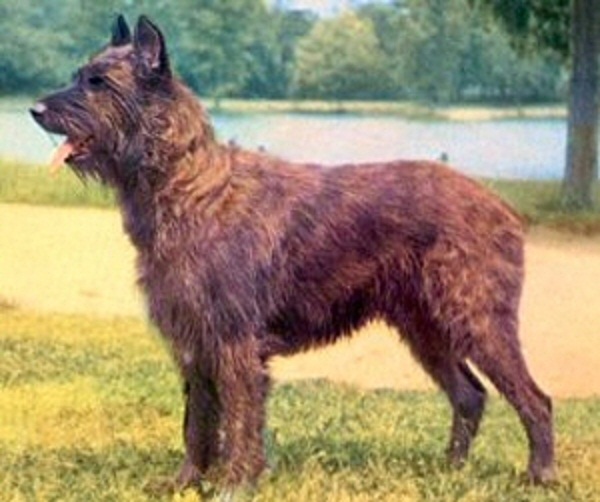
But I’ve never seen one in person that look like this dog:
But most of the ones in North America look like this:

I’ve not seen any discussion about how or if the increase in hair has changed this breed.
Even the ones that are pretty shaggy are still capable of doing the task for which they were originally bred.
But I think that the dog in the top image looks more intimidating.
So if anyone knows more about this breed and how or if there are any type divergences within the breed, please let me know in the comments.





That top pic reminds me of what I see today referred to as the Bouvier des Ardennes, but that’s probably just because the Ardennes are still used more as workers, or at least trialled more as them? The shorter hair is of course, utilitarian and so it would make sense for dogs used more for work.
But that is just a guess. If you kept the hair short like this for the Ardennes AND bouvier I am not sure how similiar they would look. The last time I saw a Bouv with hair kept close, it was in a schnauzer cut including whiskers, natural ears.
Peggy Richter of Kuymal Kennels might have better insight.
The dog in the lower picture appears to have no neck! It looks like no Boov I have ever seen here, where a neck is mandatory. Has it been photoshopped, or is this an example of really bad taxidermy?
Elizabeth
I think you’ve been looking in the wrong places. see the photo gallery here: http://www.nawba.info/photo_album.html — in particular note: Uzzi & Kari; Zander-Dre Casa de Mandingos Owned by Dana Terry; Siggi Owned by David and Nancy Evans; Arion’s Yen T’Go to Fellstar; and Wise Choice Haqikah “Qika” Owner Darlette Ratschan. I’m surprised that this site doesn’t have a photo of Pam Green’s “Bones” as he was the first AHBA herding trial champion and one of the first with an AKC HX. Pam’s site is currently down. Some of the difference you see is grooming (compare to the ungroomed Airedale on this site: http://www.squidoo.com/airedale-terrier-bobby?utm_source=google&utm_medium=imgres&utm_campaign=framebuster
And some is selection in the conformation ring. It used to be that the Bouv was shown groomed like a Giant Schnauzer. I think a “softer and fuller” coat started to be poplular as a means to distinguish and also to be “less intimidating” in the show ring. see also the working dog eu site. Of course there is selection in the conformation ring for what wins — so you do see more and more push for coat (and the wrong type of coat) and more and more of a “cobby” look that if taken to extremes can be very non athletic.
http://www.herlandbouviers.ca/
Agree with you, Peggy but we do see quite a few bouviers with stuffy necks as you imply. Actually the dog in the top picture seems to posses a more functional everyday conformation and arguably better coat – outside the ring, that is, where the best dogs live anyway IMO.
PS: does anyone see a passing resemblance to the wire haired version of the belgian sheepdog?
There aren’t many Bouviers in the area where I live; I could count those that I have been personally acquainted with on two hands with a couple of fingers to spare. But every one of them looks much more like the dog in the second photo, with the short neck. The dog in the second photo here looks like it has been freshly bathed and blow-dried with a brush. Most of those I’ve seen have a heavier, more curly. oily coat. Not curly like a Poodle’s coat, but curlier than this dog’s.
Chervilmeadow, yes, I see a resemblance to the Lakenois, who are less stocky. I thought that as soon as I looked at the photo. It’s the rough coat and head.
the resemblance to Laken isn’t by chance. Some of the Belgian Laken foundation dogs (Vos, for example) are also found in the early Bouvier pedigrees. The Bouv has a longer coat than what is supposed to be found in the Laken, but that’s only one or so genes.
(from Pam Green)
I’ve been in Bouvs for over 30 years, in Bouv Rescue for over 25. There has always been a range of types. The breed history books emphasize two types (with different names at different eras) and a lot of arguement between advocates of each of these. It probably reflects differences in emphasis of use. This was a multi-purpose farm dog, doing everything from hauling carts , turning a churn, herding cattle (or sheep or whatever the farmer had). Used as a customs patrol dog and as a search and rescue dog on battlefields to find survivors. The Belgians invented the police dog at about the same time the Germans were inventing the police dog ; each used the local herding dogs, so the Belgians used the gene pool that eventually gave rise to the Bouvier and the Belgian Shepherd. Originally the terms “bouvier” and “berger” were lower-case and simply job descriptions (cattle herder and shepherd respectivlely). And one dog in his life might play many roles.
Today you can see some taller leggier less heavy boned dogs and these are well adapted for work requiring moderate speed and endurance, such as herding on ranch. You can also see some that are stockier and stouter and , alas, some of them seem to be rather elephantine to my eyes. Whether the dog is kept fit or fat makes a huge difference in movement and stamina, as well as difference in appearance. (Most show dogs are overweight, which is detrimental to health and longevity.) Grooming makes an even more dramatic difference in appearance. Dogs whose coats have been neglected a long time, overgrown and matted, look horrible and it can be difficult to tell which end is which. Got a photo of that on my site. Dogs who have been clipped down , #10 blade all over, look entirely different. The dogs groomed for show by an expert look totally different, and that’s what you mostly see in books. My own dogs are scissored to a shorter length than the show dogs. So are many police Bouvs and handlers tell me that it helps with stamina on a long pursuit — also less burr picking to do when you get home.
Coat texture can vary a lot. Some have a harsher outer coat and some are very soft. The undercoat is supposed to be soft but shouldn’t be as profuse as it is in many today.
What you do with the face hair makes a huge difference in appearance. In US , many people puff the side of face out into what I call “chipmunk cheeks”. In France that is not done, at least according to a judge who was here some years back. A lot of the difference between appearance of Bouv face and that of Giant Schnauzer is difference between puffed out hairy cheeks versus shaven cheeks and face side. It’s greater than difference between Abe Lincoln with beard and Abe without beard.
And of course whether ears are cropped or natural (and lots of variety in the natural ones) and whether tail is docked or natural can make quite a difference. I should do some “photoshop crops” and “photoshop docks” to show this. I like natural tails because they are so very expressive of the dog’s state of mind , which is helpful to most people dealing with the dog. Bouvs are hard to read because of the absence of tail and the covering of lips and eyes with hair. I tell novices to trim off enough hair from face and tail stub to make the “language” more visible. It will grow back later if you want it back.
I do have a lot of photos on my site, which is up sand running at webspace.cal.net/~pamgreen. Photos and art work. Photos of dogs working, including my very wonderful soulmates and working partners Chelsea and Bones. Rescued dog intake photos that will make you glad the internet cannot (yet) convey scents. Articles on working dogs , emphasis on herding and tracking. A bunch of humorous verse , including verse about working trials etc.