
As long-time readers of this blog know, I am a nerd when it comes to the order Carnivora, and today was a very good day for all carnivoran nerds: the discovery of a new species was announced!
It is a procyonid, a member of the “raccoon family.” In English, this is the best way to describe the family. The northern raccoon is the best known species in the family, but the truth is there are many other species. In the US, we actually have three species of procyonid: the aforementioned northern raccoon, the white-nosed coati, and the ringtail.
Into Central and South America, there are more species. In South America, there are three additional species of coati and the crab-eating raccoon, which also ranges up into Panama and Costa Rica. And there is another species of ring-tail called the cacomistle.
Those are just the big ones. The raccoon family also includes some smaller ones that live entirely in trees. You may have never heard of them, and they look so strange that the early naturalists had a hard time describing exactly what they were– and as we’ll see, they still do today.
Probably the best known of these “weird ones” is the kinkajou The only reason you might have heard of the kinkajou is that Paris Hilton had pet one that bit her. It is almost impossible to find a source in the popular press that correctly identifies what a kinkajou is. Almost every source says it’s some kind of monkey.
As carnivorans go, it is a very primate-like one, and this similarity further exacerbated with the kinkajou’s prehensile tail. The only other carnivoran with a prehensile tail is the binturong, a type of civet, which is native to Southeast Asia. Kinkajous live high up in the trees in Central and South American forests and live almost exclusively on fruit, which also makes them seem more like monkeys.
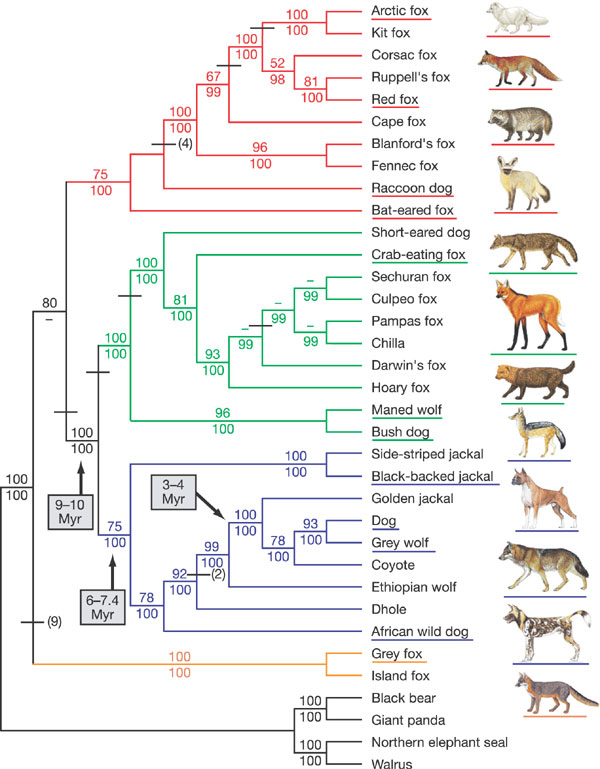
But among the lesser known species of procyonid that look a lot like kinkajous without prehensile tails. These are the olingos, and until today, there were only five species. At one time, it was believe that olingos were just less-derived cousins of the kinkajou, but it turns out that the animals aren’t closely related at all. Though all the olingos and the kinkajou are procyonids, genetic evidence shows kinkajous are a very primitive lineage of the family, and the olingos share a common ancestor with coatis. Olingos likely evolved a similar morphology to kinkajous through what is called parallel evolution is when two species split from a common ancestor but then evolve morphological or behavioral similarities due to being adapted to similar niches. The trenchant heel dentition that bush dogs share with African wild dogs and dholes is a good example of parallel evolution. The physical similarity between thylacines and wolves is convergent evolution, which when two quite unrelated species evolve similarities in morphology and behavior. The kinkajou’s prehensile tail, which shares with several species of New World monkey, is also an example of convergent evolution
Olingos are not well-studied. After all, it’s pretty hard to study animals that live high up in the canopies of trees and only come out at night.
So it was not surprising to me that a new species of olingo was finally documented this week.
This discovery actually didn’t happen in Ecuador or Colombia’s cloud forests, where these unusual olingos are native. Kristofer Helgen, curator of mammals at the Smithsonian Musem of Natural History, happened upon some museum specimens at Chicago’s Field Museum in 2003. Helgen was interested in exploring olingo taxonomy, and he wanted to examine different specimens to get an idea if scientists have missed any morphological distinctiveness in their specimens. Olingo taxonomy is a mess. No one knows how many species there actually are.
It took ten years and the collection of DNA samples from a variety different olingo specimens, but now this new species of olingo has been identified. One of the most interesting parts of the story is that the only olingo sample with GenBank is of a weird individual that was imported to the US through a Colombian dealer. This olingo was smaller and would not mate with any of the other captive olingos with which it was caged, which is probably why its DNA was sent to GenBank. This animal’s name was Ringerl, and she was kept at the National Zoo in Washington, D.C. for a short time (Roland Kays, who was part of this study and is best-known on this blog for being part of the study that debunked the red wolf taxonomic status, tells her story here.)
These animals share only 90 percent of their DNA with other olingos, the species with which it was thought to belong.
This new species is called the olinguito, which has the Spanish diminutive suffix. It’s a somewhat smaller than the other olingos. Indeed, it is now the smallest species of procyonid.
Museum specimens hide a lot of stories.
We just missed a species for a long time. GeneBank and the museums held a mystery that just simply wasn’t known.





And of course, being completely adorable will cause this discovery to sweep the world by storm as opposed to when biologists discover, say, a new species of flatworm. Having said that, I am shamelessly “squeee”ing away over here!
Thanks for the additional information. Just to be shallow, it reminds me of why my wife loves shih tzus!