All over the world, we hear the story of bears. The polar bear may die out due to climate change. The grizzly bear lives only in tiny pockets of its former range in the Lower 48. The spectacled bear is not long for this world, and the giant panda is an avatar of the movement to save endangered species.
American black bears are not among the endangered or threatened, though. They are doing well in such densely populated states as New Jersey.
They are also doing quite well in the wild and wonderful land of West Virginia. When I was a boy, my grandpa loathed bears. If anyone mentioned a bear popping up near his land, he would always go “There isn’t room enough for me and bear in these woods.”
I don’t know where this bear hatred came from, but his ancestors were small farmers who may have lost hogs or sheep to the odd roving bear.
I remember one year that something knocked over his 200-pound deer feeder. It obviously had to have been a black bear. At that time of year, a bear would have been in hyperphagic mode, and the taste of cracked corn in the deer feeder would have been a pleasant repast on a balmy October day.
He never caught the bear in question, but I knew that he really wanted to. He wanted to shoot it for daring to be in this civilized world.
The reason that bear never got killed is because its kind learned long ago to live with us.
And the best way to do that is to avoid our kind at all costs.
By the time I was born, there were only about 500 bears in the state of West Virginia, and now there are about 10,000. Those 10,000 descend from those 500 survivors, who taught their cubs how to thrive in a land where the guns are loaded.
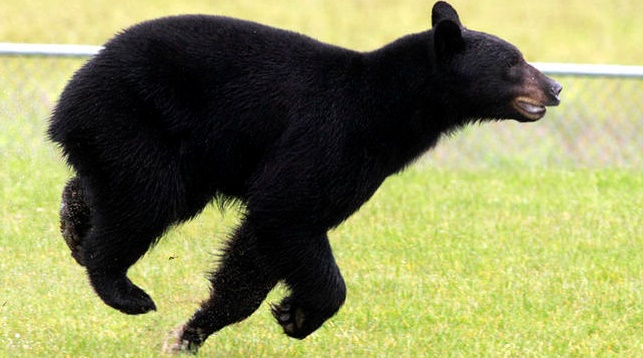
If you see a bear in West Virginia, well over 9 times out 10, all you’ll see is a black form charging into the timber to get as far from you as possible.
The bear that thrives is the bear that knows that the best thing to do when encountering one of us is to run away.
I know that other black bear populations where they sometimes hunt people or, at the very least, tear up garbage.
But not here, they survive only because they are afraid. Fear makes them good neighbors.
And that is the only way a bear can thrive.




Only bear I have ever seen in a lifetime of backpacking in the Appalachians was this summer & he was hoofing it as fast as he could go to get away.
Where they become a problem is in the places where its illegal to hunt them–they lose their fear of humans and their dogs. Hell, even the Whitetails around here just kind of look up for a second and then go back to browsing and we’ve got squirrels that don’t budge even when you walk w/in a couple feet of them.
I lived on Mount Daicy in the then wilderness of Maine in the mid 1950’s. To get toour cabin, we had to canoe down a river a few miles and then hike up the mountain. No signs of humans except for us and our cabin..No electricity, telephone, or other signs of mocern civilization. Bear apparently were numerous, but all I ever saw of them was their back end racing into the dense shrubbery.
I saw a documentary showing how the Inuit hunt polar bears. They set a pack of dogs on the bear. The dogs nip at the bear’s paws from all sides so it can’t run away. Then the humans throw a spear in the bear’s heart. Without dogs, they couldn’t kill the bears.
I think black bears are usually more timid and fearful because of their evolutionary past. Black bears evolved in a environment of mega fauna, dire wolves, saber tooth cats, and American lions, short-face bear, etc These were extremely large and powerful animals.
http://www.bear.org/website/bear-pages/black-bear/bears-a-humans/119-how-dangerous-are-black-bears.html
The modern grey wolf was also around during the era of mega fauna, and I remember reading another article that coyotes then were big as wolves. The black bears that survived are the ones that were fearful and ran away.
Then when humans came and of course any aggressive or bold bear were killed. So most black bears are timid. Any aggressive black bear is probably either mother with cubs, a desperate bear, or genetic throwback.
That doesn’t explain why attacks from black bears aren’t unknown in parts of Canada or Alaska. I’ve had Canadian friends tell me to be fear of them, but their behavior around here suggests they are only slightly more dangerous than a chipmunk.
By contrast, there have been only three fatalities of a black bears in West Virginia== one bear killed three children who were out flower picking. This happened in 1901 in the Allegheny Mountains near the town of Job.
Bears have to learn a lot to survive, and I don’t think everything about their behavior can be chalked up to evolution or genetic determinism.
So it’s an interesting theory, but they know people hunt them here. Even before there was a bear season, there was SSS going on a lot.