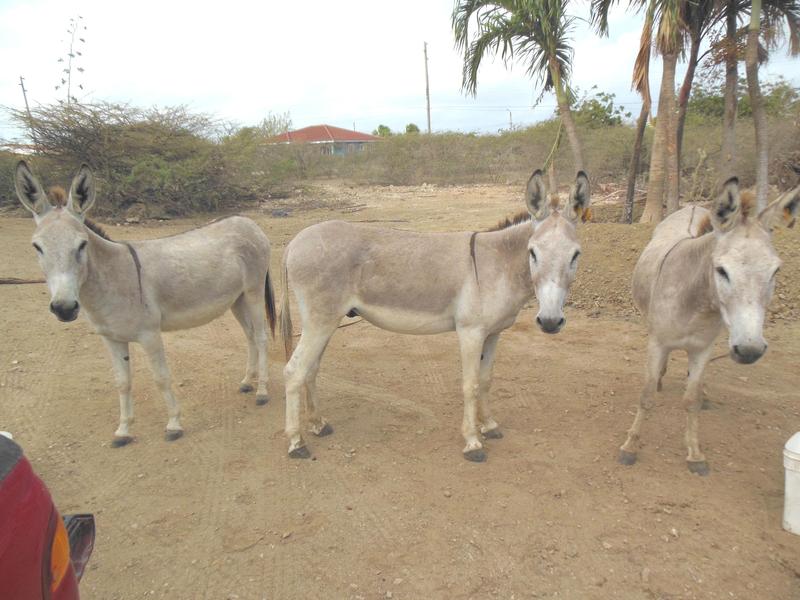
Feral donkeys on Bonaire.
The Nubian wild ass hasn’t been seen in the wild since the 1950s. The subspecies has been presumed to be extinct. It lived in the Red Sea Hills and the Atbara region of Sudan.
Based upon ancient mitochondrial DNA analysis, it was revealed that there were at least two wild populations that are the source for domestic donkeys. The Nubian wild ass was the source one of the clades of donkeys, and the other came froma mystery population. Somali wild asses, the other extant subspecies of African wild ass that actally still can be found in the wild, is not a source for mitochondrial DNA diversity in domestic donkey.
I say all of this right up front, because what I am about to discuss are the limits of using mtDNA analysis to determine the relationship between populations, especially when one is trying to figure out whether feral population has some taxonomic distinctness.
The Dutch Empire still holds steadfastly to some islands in Caribbean. Among these is Bonaire, which is located just north of Venezuela. On that island is a population of feral donkeys, and the current excitement is the possibility that these animals might be pure Nubian wild asses.
If they are, they could be the very last of their subspecies, which is pretty amazing. Keep in mind that there is no real historical context I can think of that connects an island off the coast of Venezuela with Sudan. Now, it’s certainly true that the Dutch colonists were connected to an empire that was all over the Indian Ocean, and the same can be said about the British and Spanish, who also occupied the island at various points in its history.
But even if they were connected across these maritime empires, why would anyone bring wild donkeys to an island and turn them loose?
And that brings us to the evidence for the Bonaire donkeys being Nubian wild asses. This is where mtDNA alone analysis can cause problems.
Researchers at Texas A & M performed an mtDNA analysis with samples from some Bonaire donkeys, samples from Nubian wild asses that were part of museum collections, sequences from four Somali wild asses, and one sequence from a domestic donkey that was available from the National Center for Biotechnology Information.
I looked at the cladogram set up from the mtDNA analysis, and my curiosity was piqued. The domestic donkey’s mtDNA didn’t fit with the Nubians, but we do know that a lot of domestic donkeys actually do descend from Nubian wild asses. Nubian wild asses are a source for their mtDNA diversity, as I mentioned earlier.
But this NCBI sample wasn’t from the Nubian population. Remember that the study I linked to earlier showed that some domestic donkey mtDNA sequences came from an undocumented population that was neither Somali nor Nubian. This particular sample could have come from that mtDNA lineage in domestic donkeys, but if they had included those that had Nubian ancestry, my guess is things would get complicated fairly quickly. The domestic donkey was used as a control, when in reality the best research method would have been to include a lot of samples from domestic donkeys in the study.
For some reason, this just wasn’t done.
Occam’s razor suggests to me that these donkeys aren’t Nubian wild asses after all. If more samples of domestic donkey are included in the analysis, I bet there will be several of them that come up very close to Nubian.
This is why we have to be careful of mtDNA-only studies, and the researchers at Texas A&M may not be aware for the new data on donkey domestication. Some donkeys have Nubian wild ass mtDNA, and others have mtDNA from a mystery wild ass population, which is not of the Somali subspecies.
We need more evidence to see if what the Bonaire donkeys are, but I think it is a very giant leap to call them the last Nubian wild asses.
Of course, what prompted this study is that late last year, the government of Bonaire was going to institute a donkey cull, which, of course, upset animal rights groups. With this analysis by Texas A&M in hand, the government was forced to halt the donkey cull.
However, the evidence that these donkeys are “pure Nubian wild asses” is nowhere near as convincing as it sounds.
I would like them to be. Don’t get me wrong.
But I’m not betting on it.




Of course not, Nubian wild still exists. yet in small numbers but still there.
In the far south eastern corner of Egypt, Elba national park which retains what it could be the last original true wild asses in the world.
an urgent action is needed to save the species from absolute fate of extinction.
here is a link with few photos of true wild asses in their natural habitat
>> I’m the adoptions director at Peaceful Valley Donkey Rescue, the intake ranch and sanctuary in Texas where we maintain a rotating population of 1K North American Feral Donkeys. Y’all are welcome to come out any time and sample the DNA of this herd. Y’all are also welcome to re-sample the 1K Feral Donkeys on Bonaire. I’m bettin there ain’t a dime’s worth of difference in them.