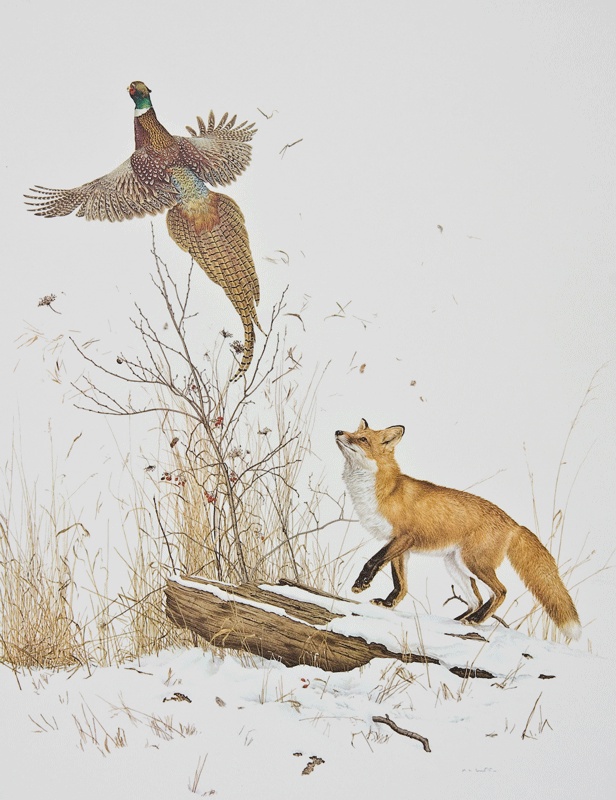
When I was a child, the most common wild dog in West Virginia was the red fox. I remember one night in early summer that my parents and grandparents sat on the back deck and listened to a vixen and dog fox engage in a barking contest with the dogs. The foxes were across the hollow from the house, and the dogs just figured out that there were foxes across the way. My grandpa was certain they had kits there, but they were probably going to move on soon.
But in the years that have passed since then, the foxes have had a lot more to worry about than dogs. All the old pastures have continued to overgrow, eventually returned to the forest from whence they came. What were once disconnected woodlots are now dense woodland, and the dense woodland is the perfect habitat for the gray fox, which is much more territorial than the red. Though usually a bit smaller the red, the gray fox is known for driving off its competitor, making it the only smaller canid that dominates the red fox.
To make matters worse, the woods are also a fine place for coyotes to live. Coyotes generally don’t tolerate red foxes, and unlike gray foxes, reds can’t just shoot up a tree whenever the big dogs are about.
Red foxes have done quite well as a species. Indeed, much of their success on this continent came about as the result of European colonization. The felling of trees at the expense of the gray fox combined with the extirpation of wolves and cougars to create a red fox paradise. At the time of colonization, red foxes were rare south of New York State, but by the end of the nineteenth century, they were common at least to Virginia. Today, they range through the Deep South into Florida. They were were introduced heavily to provide the houndsmen with some good sport.
It was even thought that all red foxes in the East were derived from English imports that were brought over during the colonial period. Now, we know they are actually derived from the Eastern Canadian population. It’s native in the same way the Eastern coyote is, and the same way the raccoon and opossums are as they have spread into Canada.
Much of the nineteenth and early twentieth century here was a dominion bobwhites, cottontails, and red foxes, but when the agrarian economy collapsed following the rapid industrialization that followed the Second World War, the land was abandoned and left to go wild. The land is just better for the gray fox and the coyote now, and though it would be wrong to say that the red fox is rare, it is not the dominant canid on the land now.
They do so much better in areas where agriculture is still going on with some intensity. They are much more common in Eastern Pennsylvania than Western, which is like adjacent West Virginia in that agrarian economy has largely been abandoned. They are also quite numerous in Northern Virginia and Maryland, where you have both urbanization mixed in with massive monocultures of soy and corn.
The little red dog with the black stockings is still an unbelievably successful species. Not only can you find them in the Nile Delta and the Russian Far East, you can also find them in the Australian Outback, where they are working their way through as much native fauna as they can catch. In Britain, their numbers only continue to increase, mainly because they have no natural predators and the British people seem to have an unusual fondness for them (at least to my American eyes!).
But in parts of Eastern North America, they will have to give way to more aggressive dogs that do so much better in a land dominated by forests and thickets.
In this part of the world, they need the largess of agriculture to provide them their comparative advantage over other canids.
Though as wild as any canid so heavily persecuted by man, they really do best in a world dominated by us.
It is the paradox of the red fox. They live in constant fear of our kind, but they could never have become such a dominant species without our attempted conquest of nature.
They must exist both in terror of humanity but also willing to take advantage of whatever opportunities we open up for them.
This is the same paradox by which things like brown rats and raccoons have come to live. The farmer who clears the land of trees and gray foxes to make room for a mousing red is also the one who will shoot the red if he kill his chickens.
However, it is out of this paradox that red foxes thrive, and it is the wild animals that handle the paradox well that wind up thriving in such a human-dominated world.
Life in the shadows of the mercurial naked apes is both advantageous and precarious.
But the red fox is certainly among the masters of that proposition.
The little red dog with black stockings dives behind the overturned garbage can, then slinks over to carry off one of the hipster’s backyard chickens.
Not a bad life.
Provided you don’t get shot.




Totally agree, although these foxes are not only prevalent in the bush but heavily populated in the suburbs. We have a lot of green corridors that take you from the bush to the inner city areas and also into the city itself. I live in the bush now and although there is a family of foxes nearby, i saw far more foxes when I lived closer to the city.