Dog breed origins are often shrouded in a “creation myth.” If you ever read an all-breed dog book, the official breed origins come across as awfully fanciful. Virtually every breed is regarded as ancient or derived from some private stock belonging to some notable: Afghan hounds were the dogs Noah took on the Ark. Beagles appear on the Bayeux Tapestry. Pharaoh hounds were the hunting dogs of the Ancient Egyptian dynasties.
These stories posit the breed as being part of something deep in the past and maintaining the breeds is magnified as a way of paying homage to the past.
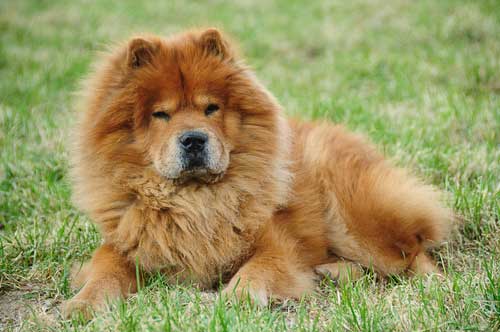
Some breeds are, however, pretty old, or at least genetically distinct from the rest of dogdom to be seen as something unique. Chow chows are a good example. They retain a lot of unique, primitive characters, and as East Asian primitive dogs, they may be among the oldest of strains still in existence.
Konrad Lorenz deeply admired the breed’s wolf-like attributes, believing they represented the best of the so-called “Lupus dogs.” Lorenz believed that most dogs were actually the descendants of golden jackals, and the dogs were friendly to most people and easily broken to fit the will of man. These were the “Aureus dogs.” But the dogs that were more aloof and more independent of the wishes of their masters were seen as the direct descendants of wolves. Lorenz preferred this type of dog, and he kept many chows and chow crosses in crosses as his own personal dogs and “study subjects.”
Lorenz later rejected the dichotomy between the jackal and wolf dogs, but the idea is still worth exploring. What Lorenz actually discovered was a profound division that exists in domestic dogs: the primitive versus the derived.
In terms of evolution, an organism is considered primitive if it retains characters and behavior that are very like the ancestral form. For example, lemurs are considered more primitive than other primates because they have the long muzzles and wet noses of the ancestral primates.
Primitive dogs are those that retain many features in common with the wolf. These features include erect ears, pointed muzzles, howling rather than barking, bitches having only one heat cycle per year, pair-bonding behavior, and general tendency not to be obedient. Many primitive dogs bond with only a single person, and in the most extreme cases, allow only that person to touch them.
Lots of “Nordic” breeds fall into this category, but this list also includes many of the drop-eared sighthounds from Central Asia, the Middle East, North Africa, and the Indian Subcontinent. It also includes many of the village dogs from undeveloped countries, as well as the semi-domesticated pariah dogs and dingoes.
The chow chow sort of fit between both Nordic breed type and the village dog type. It has many of the features of the Nordic breeds– curled tail and prick ears– but it also has had a long history as a village dog in China, where it had periods in which it freely bred.
One would think that chow chow fanciers would be into celebrating their dogs as primitives, like owning something between wild and domestic.
But dog people being dog people are more than willing to add embellishments.
Westerners have done a lot to add to the bear-like features of the chow chow, which Konrad Lorenz actually castigated.
However, dog breeders will often go to great lengths to justify breeding decisions, including putting out absolute science fiction as scientific fact.
A few years ago, I heard an acquaintance mention that a well-educated chow owner she knew firmly believed that chow chow were derived from bears.
I laughed at it. I did not think there was a serious discussion that chow chows were derived from bears.
And then I received notice of this website, which purports to have the full history of the chow chow. The history begins as follows:
It´s assumed that during the Miocene period (between 28 to 12 million years back), the evolution of the Hemicyon, an intermediary between the Cynoelesmus [sic], “father” of all the canine ones, and the Daphoneus [sic] – from which the bears descend as we know them today, – originated the Simocyon, an animal that varied between a fox and a small bear that inhabited in the sub-Arctic regions Siberia and the Northwest of Mongolia and of which it is known had 44 teeth.
I don’t know where this actually comes from, but it is entirely in ignorance of what we now know about the evolution of bears and dogs. Dogs and bears are indeed closely related, but the division between the two is much deeper than the dates proposed here. Their most recent common ancestor was the ancestral stem-caniform miacid, which lived about 40 million years ago. Most of the “ancestors” mention here are actually evolutionary dead ends that have little to do with modern bears or dogs.
First of all Hemicyon was not an intermediary between dogs and bears. The Hemicyon family was actually a branch of the bear lineage. Unlike the true bears, it was digitigrade and was probably a cursorial predator like wolves are today. The Hemicyon family lived between 11 and 17 million years ago, and it has left no living descendants. That is, it is in no way an intermediary form between dogs and bears.
The author mentions “Cynoelesmus,” probably meaning Cynodesmus. My guess is this discrepancy comes from a poor cut-and-paste job, but although Cynodesmus was a primitive dog. It is not the ancestor of all living dogs. The ancestor of all living dogs was Leptocyon. Leptocyon was once considered part of Cynodesmus, but it is no longer.
The other two ancient creatures mentioned in the opening have nothing to do with bears or dogs.
“Daphoneus,” which refers to Daphoenus, a type of Amphicyonid. Amphicyonids were are really spectacular sister family to the canids, which had traits in common with both bears and dogs but really behaved more like big cats. This family has nothing to do with evolution of dogs, except that this is a sister lineage that went extinct.
Simocyon was actually something even a little bit cooler. It was not a dog. It was not a bear. It wasn’t even in the lineage of either family. Instead, it was a genus of leopard-sized animals much more closely related to the red panda. In case you were wondering, red pandas are not closely related to giant pandas. Giant pandas are actually a primitive form of bear. Red pandas are their own thing. Modern red pandas are the only species in their family known as Ailuridae. Millions of years ago, there were several species of red panda, and Simocyon was actually a large predatory red panda. Like the modern red panda, Simocyon had a thumb formed out of its sesamoid bone. Giant pandas have this thumb, and it was thought to connect both modern species of panda. Now, we know that the giant panda, which is a true bear, actually evolved its sesamoid thumb in parallel to the red panda. The red panda lineage evolved this trait so they could more easily climb in trees, while the giant panda evolved it to hold bamboo.
So that entire introduction to chow chow history is simply wrong. It may have been correct carnivoran paleontology at one point, but it also seems that the originators of this theory just went around looking for creatures that sounded like they might be fossil dogs that could be found in Asia. “Cyon” does mean dog, but it doesn’t always refer to dogs in scientific names. Remember that there is a primitive whale the unfortunate name of “Basilosaurus,” which is in no way related to any lizard or dinosaur, and the raccoon family is called “Procyonids,” even though they aren’t that closely related to dogs.
Again, I don’t know why this theory is so popular, except that it can be used as a defense for breeding more and more bear-like features into chow chows than they had when they first came into the West. It’s also a way of making chows so much more super-special than the were before.
But it really makes chow fanciers look silly to anyone who has ever looked closely at carnivoran evolution.
It’s a fun story, but it’s not based in reality.
And when you get the paleontology this wrong, then virtually nothing of value can be trusted until the error is corrected.
Chows are cool as primitive dogs. They don’t need all the malarkey.




Interesting article. I once read a book by Konrad Lorenz that suggested the ‘closest’ domestic cross breed which would resemble a wolf would be a cross between a Chow Chow and a German Shepherd. The Chow would give it the aloofness and independent personality of a wolf and the German Shepherd the ‘look’ and ‘intelligence’ of the wolf.
Most of his dogs were a mixture of chow and GSD.
He also advised the breeders of the strain of dog that led to the Eurasier.
My brother had a fantastic dog who was 50/50 chow/GSD. His appearance was a mixture of traits, but his behavior was more like that of a GSD, except he was a little more laid-back. He was quite dog-aggressive, but only to the point of being top dog on the block; he didn’t try to fight other dogs, but wanted them to kow down to him. He wasn’t human-aggressive but he was very suspicious of men he didn’t know. He warmed up to women more quickly than to men, but never threatened anyone, beyond a deep, fierce challenge bark.
I went to Florida for a weekend visit that turned into a 2-week vacation when my car broke down, and had my very large male GSD with me. We were concerned at first that the two dogs would fight, because Stetson was a big, domineering male, too. But as it turned out, there was no aggression between the two at all. My brother and I stood near one another with the dogs on loose leashes, and watched to see how they’d do.
Both dogs postured a bit – tails up, standing as tall on their toes as they could. Sniff, sniff, sniff, walk around, sniff a bit more. Then Dozer appeared to realize that Stetson was quite a bit the taller of the two, and stood down. Stetson stood down, too, and we had no trouble the whole time I was there.
Dog fanciers are nucking futs.
Excellent job Scottie. And you didn’t even have to go into a lengthy description of the genetic mismatches.
I think that would be boring, but it also shows that most “canine evolution” discussions on breeder websites often involve either out of date paleontology or fossil mining, which is the case here.
As a (former) Chow Chow breeder I always have tried to educate, that a Chow Chow is a dog and that dogs are wolves. This story originates from Lady Dunvar who wrote a book about the Chow Chow in 1914.
Sorry, typo, Lady Dunbar
Such a unique looking dog. My childhood friend had a Chow Chow that looked identical to the one above. His name was killer and that described him perfectly!