
I am not big on popular culture these days. I have not watched one second of Game of Thrones, but I do know that dire wolves have something to do with that series. I am not into that genre of television. Give me an actual documentary about dire wolves, and I’ll be happy.
But I know that dire wolves are thing from that series only because I do sometimes get asked about them. I don’t know how they are portrayed in that series, but most people think of them as just super large gray wolves that went extinct at the end of the Pleistocene.
The funny thing is that there actually was a super large gray wolf that specialized in hunting large game that also went extinct at the end of the Pleistocene. This animal has been called the Beringian wolf, and although no one has dared to give it a subspecies status, it was essentially a form of gray wolf that hunted megafauna in much the same way that the dire wolf did. The two species were contemporaries, but the Beringian gray wolf did not live in the same parts of North America as the dire wolf, which was found through most of the Lower 48 of the United States and ranged down into northern South America. This Beringian wolf apparently ranged from Alaska to Wyoming, while the dire wolf was found in mid-latitude North America and ranged south from there.
No one really pays that much attention the Beringian wolf, but it is very likely that everything we know about modern wolves would have applied to that animal. The only difference would be that this wolf was much more specialized in hunting large prey such as bison than modern big-game hunting wolves are.
The same cannot be said for dire wolves. Dire wolves evolved solely in North America. The general consensus is that it evolved from Armbruster’s wolf, but the exact origin of Armbruster’s wolf is a bit of debate. One well-known hypothesis is that the common ancestor of the modern gray wolf and the Armbruster’s wolf-dire wolf lineage is Canis chihliensis, a Pliocene wolf-like canid. This is the hypothesis suggested by Tedford and Wang, who are leading authorities on North American canid evolution.
However, there is a whole host literature in Eurasian wolves that posits Canis mosbachsensis as the ancestor the modern wolf. This literature, I think, is a bit more robust, for the large numbers of samples of both archaic Canis lupus and Canis mosbachensis show how the wolves of Eurasia went from being small and gracile to larger and more robust over time.
It is possible that this Armbruster’s wolf/dire wolf lineage evolved from an entirely different grouping of the wolf-like canids. It also would place the common ancestor of the dire wolf and modern Canis lupus back millions of years, even to the point where dire wolves were at least as genetically divergent from modern wolves as modern wolves are from African wild dogs.
If that is true, then we cannot make many wild assumptions about dire wolf behavior by comparing them to modern wolves at. We don’t have any preserved dire wolves in permafrost. They never lived where there are currently big stands of permafrost, so we will never have dire wolf pelts.
Attempts have been made to get DNA from the many Rancho La Brea tarpit dire wolf remains, but they have not been successful. It was found that it was just too difficult to separate the bone from the tar.
So we really don’t know exactly how closely related dire wolves are to modern wolves, but I would be surprised if they turned out to be as closely related to modern wolves as modern wolves are to coyotes.
Indeed, the real problem with all of this is much of Canis taxonomy and systematics is not entirely resolved. The real issue I have now is we have good genome comparison literature that shows a much closer relationship between wolves and coyotes than we previously believed. Much of our understanding of Canis evolution is that we have tended to think of a linear evolution from jackal-like forms to wolf-like form, when the truth of the matter is we have had jackal and wolf-like forms evolve independently of each other within different lineages of the wolf-like canids.
So we are taken aback with the findings that the two endemic African jackals, the black-backed and side-striped jackal, are the two most basal and divergent forms of the wolf-like canid clade, and we are even more taken aback that the dhole and African wild dog are not as distinct from the rest of the clade as these two African jackals. This finding has led to the rise of the genus Lupullela for these two jackals.
In addition, the creatures formerly known as African golden jackals were revealed to be much closer to wolves and coyotes than to the Eurasian golden jackal, which has led to a bit of a taxonomy war on what exactly to call these creatures, though the popular press likes to use the term “African golden wolf,” which was the name suggested in one of the papers documenting their discovery.
None of these discoveries would have been indicated through morphological analysis alone. One would think that black-backed jackals and coyotes were particularly close relatives, for they look and behave pretty similarly to each other. At one time, we would have classified both as primitive or basal Canis. Today, I think the best description is that the black-backed jackal is a basal Canis, but that the coyote is actually a very derived but diminutive one.
So we have these problems with extant Canis species, and it is very likely that we’re missing the full picture on how dire wolves relate and compare to modern ones.
One thing that should be noted is that dire wolves had very odd bacula. The baculum is the penis bone that exists in all but a few mammals, and you, if you are a male human being, are among these few mammals without one.
Dire wolves had longer bacula than gray wolves of the same size and they were kinked upward at an odd angle. This bone is probably indicative of a larger penis in a dire wolf than the modern one, and it also might give us some interesting clues about how dire wolves might have behaved.
I have suggested that having this male anatomy might have meant that dire wolves had more competition with sperm penetration than actual male on male conflict during the mating season. We know that within primates, those species that are better endowed tend to be less aggressive with other males of the same species. Those with smaller genitals tend to be more aggressive, and the reason posited for this difference is those with larger genitalia have given up on intermale aggression and the real competition is how far and how much sperm the male can produce.
Maybe something like this was going on with dire wolves. Maybe mating season with dire wolves was just a big ol’ wolf orgy, and the male that could penetrate the female deepest and with the most sperm wound up siring the offspring.
Even calling Canis dirus a “wolf” may not be accurate at all. If it truly is a more distant relative to the gray wolf than we currently assume, then we really need to be careful what we assumptions we are making.
A few years ago, there was a bit of fun speculation on the internet that the dire wolf was actually of South American wild dog clade. A few scholars had toyed with the idea, because there was these two odd species wolfish like canids that were known from the fossil record in South America, called Canis nehringi and Canis gezi. The former was always thought of as being very similar to the dire wolf, and the latter appeared to be somewhat similar to both.
This speculation led to this wonderful image, a depiction of the dire wolf as being an overgrown bush dog. (The one on the right speculates a South American origin, while the one on the left just turns it into a wolf).
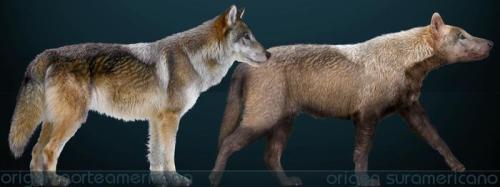
Of course, serious scholarship performed a phylogenetic analysis of these canids and revealed that Canis nehringi was actually a dire wolf offshoot. Canis gezi was found to be a South American clade wild dog.
So yes, this was a fun bit of speculation, but it’s not much more absurd than assuming that the dire wolf was that fundamentally similar to the modern gray wolf.
We just don’t know. I’m sure that we’ll get a good ancient DNA sample from a dire wolf soon, and we’ll be able to answer some of these questions.
But right now, we need to be very careful in assuming that the dire wolf was just an odd Pleistocene gray wolf.
We’re missing a lot of information, and a lot of the research on dire wolves was performed before we had all these “molecular surprises” with extant Canis species.
There is just so much we don’t know, and it might be a good idea to be careful about making assumptions about dire wolves by comparing them to their supposed modern equivalents.
Those equivalents might not be any more equivalent than those equivalents are to modern African wild dogs and dholes. Yes, there are some similarities, but African wild dogs and dholes are very different from wolves in terms of the exact dynamics of their pack behavior and hunting styles.
So we’re assuming a lot now about dire wolves, but it’s best to wait for me evidence before we play around with speculation. Hollywood will never take this cue, but maybe we should hold back a bit.
We just don’t know.



