Fascinating!
I’m going to have to get this book.
Hierarchies in nature aren’t what they appear.
With wolves.
With red deer.
And now honeybees!
Posted in animal behavior, Politics, wildlife, tagged bee, dominance, Honeybee, Honeybee Democracy, Thomas Seeley on January 20, 2011 |
Fascinating!
I’m going to have to get this book.
Hierarchies in nature aren’t what they appear.
With wolves.
With red deer.
And now honeybees!
Posted in animal behavior, animal welfare, dog behavior, dog breeding, dog domestication, wild dogs, wildlife on January 10, 2011 | 3 Comments »
If we see a lot of familiarity in this behavior, it is because we are not that different.
Remember the documentary I posted about hippo hunters on the Niger?
Hunting hippopotamuses in this fashion is every bit as dangerous for humans as it is for leopards to hunt baboons. However, when the human hunters managed to catch a baby hippo, they wound up treating it as if it were a beloved pet dog.
Why is it that a predatory species would try to adopt the offspring of its prey?
Now, humans and leopards do have very different brains. Humans are much more intelligent than leopards are, and we like to think that we are so different that we would not have similar biochemistry.
But the reality is both humans and leopards respond to “cuteness” in similar ways. An animal that gives off the appearance of cuteness causes a release of oxytocin, ” the love hormone.” It is the main hormone behind parental bonding with offspring, and its the main force behind the evolution of cuteness in baby mammals.
It is also what is behind our selection for cuteness in many of our domestic dog breeds– and carttoons. Stephen Jay Gould wrote about how Mickey Mouse “evolved” into a cuter animal over time. The big eyes, short muzzle, and round features make us think he is cute and love him even more.
Animals that possess these features into adulthood are called neotenous. Neoteny was first recognized by Konrad Lorenz, one of the founders of ethology. In his theoretical framework, human babies evolved cuteness as a way of getting parents to care for them. Lorenz was the first to note that our selection for these traits in dogs– shortened muzzles, rounded heads, and big eyes– were a selection for animals that resembled cute baby humans.
Humans are so drawn to cute animals that we have always taken in baby animals. Hunter-gatherers often brought home a wide range of baby animals, which were then cared for as babies. Many of our more successful domestic animal species likely evolved from baby wild animals that were brought home in this fashion. Native Australians, for example, often brought home dingo puppies, which they raised as if they were human infants. The dingoes lived with the camp, accompanying the hunters on their forays and cleaning up refuse.
Of course, cuteness releases oxytocin in a wide range of species, and that is likely what happened with this leopard. When she killed the baboon, she was likely just engaging in normal hunting behavior, but the discovery of the infant caused her to react very differently.
If this leopard had somehow been a social species that was technologically advanced, it might have been able to make a “pet” out of this young baboon.
I should note that cuteness is not universal among all species. In Elizabeth Marshall Thomas’s The Hidden Life of Dogs, her Canadian sled dog exhibits maternal behavior toward a very young opossum joey, which was part of a litter she took in and rehabilitated. The joey is hairless, and its eyes are not open. The animal is quite ugly to the human eye, but even the very predatory husky is somehow moved to maternal behavior toward the opossum. Thomas concludes that the opossum joey is quite similar to a neonatal whelp, and it is this appearance that moves the normally quite predatory dog to want to mother it. This sled dog kills all but one of a lower status packmate’s litter, which makes her behavior toward the opossum even that more remarkable.
Cuteness is one of those forces that can overwhelm us. We all want cute puppies we see in the store or in magazines. Some breeds have entirely moved along the cuteness paradigm. American cocker spaniels are almost entirely built upon producing cute puppies. All of our toy breeds are based upon being very much like babies their entire lives.
And as a strategy, evolving a cute phenotype has been very useful for domestic dogs. Cuteness allows them to live very easy lives and have humans care for their offspring. However, we humans have gone too far in selecting for cuteness. How many breeds have such short muzzles and big heads that they no longer can breed, breathe, cool themselves, or whelp naturally?
What we don’t understand is that we are affected by something deeply primal in our evolutionary history– so deep within us that even animals like leopards are affected by it.
Understanding how cuteness drives our selection pressures and our breed choices is a very important step to solving some problems inherent in domestic dogs.
That is the important lesson that we should learn from this leopard.
Posted in animal behavior, carnivores, tagged skunks, spotted skunk, striped skunk on September 29, 2009 | 2 Comments »
For those of you who don’t live in North America, here’s a very good video on skunks. This show was on PBS not long ago, and the striped skunks were awesome.
I can’t describe what skunk musk smells like. I really can’t.
It’s really not the smell that is bad.
It’s how it irritates your eyes and mucous membranes.
I say this as someone who has been skunked.
I had a dog that reveled in killing skunks, and she attacked one that was maybe 10 feet away from me one evening. As she shook it, the skunk wound up spraying me as “collateral damage.”
In some states, people can keep these animals as pets, but most states ban it because skunks have their own strain of rabies.
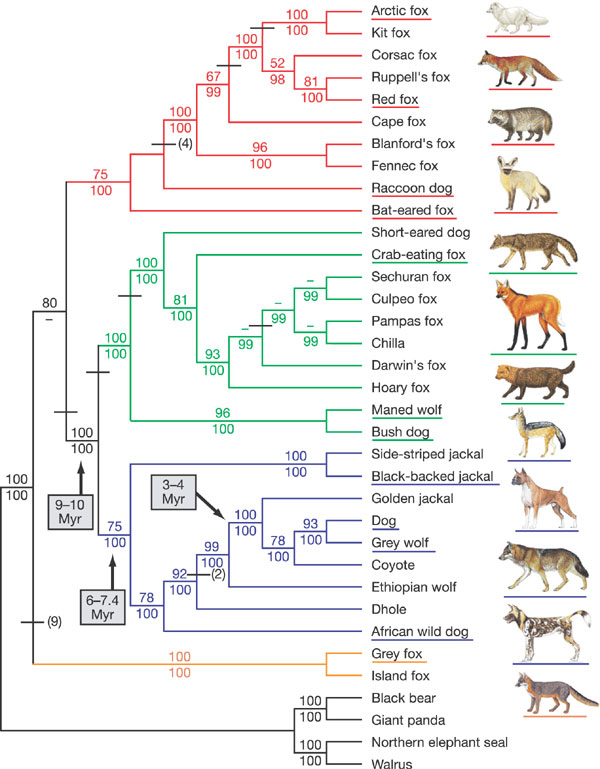
Incidentally, skunks are not weasels (Mustelids). They used to be classified with the weasels, ferrets, mink, otters, badgers, martens, and wolverines (gluttons). But now skunks and stink badegrs are in their own family called Mephitidae. Both skunks and Mustelids are members of the superfamiy Musteloidea, which includes the raccoon family (Procyonidae) and the red panda (Ailuridae). This suborder Caniformia within the order Carnivora. This suborder also includes dogs, bears, seals, sea lions and fur seals, and the walrus.
Finally, we supposedly have Eastern spotted skunks in West Virginia, but I have never seen one here. Those are the skunks that do handstands.


 | retrieverman on Rottweilers are not bulld… |
 | Earth Whisperer Cons… on World’s most notorious I… |
 | Jen Robinson on Rottweilers are not bulld… |
| Nuthatch working at… on Bird buffet | |
| retrieverman on Rottweilers are not bulld… |